NUR 3225 Exam 1 Review
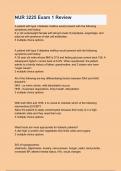
A patient with type I diabetes mellitus would present with the following
symptoms and history:
6 yr old underweight female with abrupt onset of polydipsia, polyphagia, and
polyuria with presence of islet cell antibodies.
3 multiple choice options
A patient with type II diabetes mellitus would present with the following
symptoms and history:
A 35 year old male whose BMI is 37.8 and fasting glucose comes back 156. A
subsequent hgba1c comes back at 6.9%. When questioned, the patient
admits to a family history of father, grandmother, and 2 sisters who have
"sugar issues".
3 multiple choice options
All of the following are key differentiating factors between DKA and HHS
EXCEPT::
DKA - sx mimic stroke, mild dehydration occurs
HHS - Kussmaul respirations, fruity breath, dehydration
3 multiple choice options
With both DKA and HHS, it is crucial to maintain which of the following
interventions EXCEPT:
Allow the patient to sleep uninterrupted because their body is in a high
metabolic state and they need their rest.
3 multiple choice options
What foods are most appropriate for diabetic patients?
A diet high in protein and vegetables that limits carbs and sugars.
3 multiple choice options
S/S of hypoglycemia:
shakiness, diaphoresis, anxiety, nervousness, hunger, pallor, tachycardia,
increased BP, altered mental status, H/A, visual changes
, 1 multiple choice option
S/S of hyperglycemia
polyuria, polydipsia, polyphagia, dry skin, paresthesia, delayed wound healing
1 multiple choice option
Which blood sugar variation is the most dangerous and must be considered
priority?
Hypoglycemia
1 multiple choice option
A patient is found unconscious with a fingerstick blood glucose of 19. What is
the quickest and safest way to raise their blood sugar?
Administer 1 amp of D50 IVP
3 multiple choice options
Metformin, a 1st line oral diabetic medication, is contraindicated in all of the
following situations EXCEPT:
Patients whose BMI is above normal.
3 multiple choice options
Insulin can be given in the following routes:
IV or SC
3 multiple choice options
Somogyi Effect is caused by high doses of insulin that causes hypoglycemia
during the night between the hours of 2 - 4 am that occurs secondary to a
stress response from the release of epi & NE. How should this drop in BG be
managed?
Give a bedtime snack & reduce the dose of insulin.
A patient with type I diabetes mellitus would present with the following
symptoms and history:
6 yr old underweight female with abrupt onset of polydipsia, polyphagia, and
polyuria with presence of islet cell antibodies.
3 multiple choice options
A patient with type II diabetes mellitus would present with the following
symptoms and history:
A 35 year old male whose BMI is 37.8 and fasting glucose comes back 156. A
subsequent hgba1c comes back at 6.9%. When questioned, the patient
admits to a family history of father, grandmother, and 2 sisters who have
"sugar issues".
3 multiple choice options
All of the following are key differentiating factors between DKA and HHS
EXCEPT::
DKA - sx mimic stroke, mild dehydration occurs
HHS - Kussmaul respirations, fruity breath, dehydration
3 multiple choice options
With both DKA and HHS, it is crucial to maintain which of the following
interventions EXCEPT:
Allow the patient to sleep uninterrupted because their body is in a high
metabolic state and they need their rest.
3 multiple choice options
What foods are most appropriate for diabetic patients?
A diet high in protein and vegetables that limits carbs and sugars.
3 multiple choice options
S/S of hypoglycemia:
shakiness, diaphoresis, anxiety, nervousness, hunger, pallor, tachycardia,
increased BP, altered mental status, H/A, visual changes
, 1 multiple choice option
S/S of hyperglycemia
polyuria, polydipsia, polyphagia, dry skin, paresthesia, delayed wound healing
1 multiple choice option
Which blood sugar variation is the most dangerous and must be considered
priority?
Hypoglycemia
1 multiple choice option
A patient is found unconscious with a fingerstick blood glucose of 19. What is
the quickest and safest way to raise their blood sugar?
Administer 1 amp of D50 IVP
3 multiple choice options
Metformin, a 1st line oral diabetic medication, is contraindicated in all of the
following situations EXCEPT:
Patients whose BMI is above normal.
3 multiple choice options
Insulin can be given in the following routes:
IV or SC
3 multiple choice options
Somogyi Effect is caused by high doses of insulin that causes hypoglycemia
during the night between the hours of 2 - 4 am that occurs secondary to a
stress response from the release of epi & NE. How should this drop in BG be
managed?
Give a bedtime snack & reduce the dose of insulin.