Neurological Conditions Overview
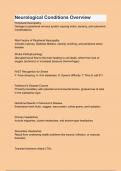
Peripheral Neuropathy
Damage to peripheral nervous system causing motor, sensory, and autonomic
manifestations
Risk Factors of Peripheral Neuropathy
Includes Leprosy, Diabetes Mellitus, obesity, smoking, and peripheral artery
disease
Stroke Pathophysiology
Disrupted blood flow to the brain leading to cell death, either from lack of
oxygen (ischemic) or increased pressure (hemorrhagic)
FAST Recognition for Stroke
F: Face drooping, A: Arm weakness, S: Speech difficulty, T: Time to call 911
Parkinson's Disease Causes
Primarily hereditary with potential environmental factors, gradual loss of cells
in the substantia nigra
Nutritional Needs in Parkinson's Disease
Emphasize fresh fruits, veggies, lean protein, whole grains, and hydration
Primary Headaches
Include migraines, cluster headaches, and tension-type headaches
Secondary Headaches
Result from underlying health problems like trauma, infection, or vascular
disorders
Transient Ischemic Attack (TIA)
, Temporary blockage of blood flow to the brain, resolves without residual
neurological manifestations
Mean Arterial Pressure (MAP)
Average arterial pressure throughout one cardiac cycle, systole and diastole
MAP
Mean Arterial Pressure formula: DP + 1/3(SP - DP)
Intracranial Pressure
Pressure increase in the cranium from lesions, tumors, or fluid accumulation
Brain Tumor
Abnormal growth in the brain, classified by cell or tissue origin
Secondary Brain Tumor
Occurs above the tentorium cerebelli (supratentorial) or below (infratentorial)
ICP Assessment Signs/Symptoms
Includes dysarthria, visual changes, memory loss, and vomiting
Brain Tumor Diagnosis
Involves CT scan, MRI, PET, and angiography
ICP Monitoring
Includes ventriculostomy and cerebral oxygenation monitor
Cushing's Triad
Signs of increased ICP: high systolic BP, widened pulse pressure, decreased
pulse
Peripheral Neuropathy
Damage to peripheral nervous system causing motor, sensory, and autonomic
manifestations
Risk Factors of Peripheral Neuropathy
Includes Leprosy, Diabetes Mellitus, obesity, smoking, and peripheral artery
disease
Stroke Pathophysiology
Disrupted blood flow to the brain leading to cell death, either from lack of
oxygen (ischemic) or increased pressure (hemorrhagic)
FAST Recognition for Stroke
F: Face drooping, A: Arm weakness, S: Speech difficulty, T: Time to call 911
Parkinson's Disease Causes
Primarily hereditary with potential environmental factors, gradual loss of cells
in the substantia nigra
Nutritional Needs in Parkinson's Disease
Emphasize fresh fruits, veggies, lean protein, whole grains, and hydration
Primary Headaches
Include migraines, cluster headaches, and tension-type headaches
Secondary Headaches
Result from underlying health problems like trauma, infection, or vascular
disorders
Transient Ischemic Attack (TIA)
, Temporary blockage of blood flow to the brain, resolves without residual
neurological manifestations
Mean Arterial Pressure (MAP)
Average arterial pressure throughout one cardiac cycle, systole and diastole
MAP
Mean Arterial Pressure formula: DP + 1/3(SP - DP)
Intracranial Pressure
Pressure increase in the cranium from lesions, tumors, or fluid accumulation
Brain Tumor
Abnormal growth in the brain, classified by cell or tissue origin
Secondary Brain Tumor
Occurs above the tentorium cerebelli (supratentorial) or below (infratentorial)
ICP Assessment Signs/Symptoms
Includes dysarthria, visual changes, memory loss, and vomiting
Brain Tumor Diagnosis
Involves CT scan, MRI, PET, and angiography
ICP Monitoring
Includes ventriculostomy and cerebral oxygenation monitor
Cushing's Triad
Signs of increased ICP: high systolic BP, widened pulse pressure, decreased
pulse