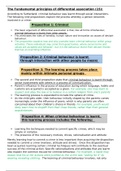
The Fundamental principles of differential association (15):
According to Sutherland, criminal behaviour was learnt through social interactions.
The following nine propositions explain the process whereby a person becomes
involved in a crime:
Proposition 1: Criminal
behaviour is learnt
The basic argument of differential association is that, like all forms of behaviour,
criminal behaviour is learnt from other people.
This eliminates the roles of heredity, human nature and innovation as causes of deviant
behaviour.
This proposition explains how and why juveniles learn criminal behaviour within group
activities. These individuals may come from good homes, where social norms and
values are accepted and followed – but it is the behaviour learnt from deviant friends
that has an overriding influence.
Proposition 2: Criminal behaviour is learnt
through interaction with other people by means
of a process of communication
Proposition 3: The learning process takes place
mainly within intimate personal groups
The second and third proposition state that criminal behaviour is learnt through
active involvement with others in a process of communication.
Parent’s influence in the process of education during which language, habits and
customs are acquired is accepted as a given. For example, one may learn to
respect and obey the law or to believe in a certain religion from one’s parents
The learning process is expanded to include the sphere of crime.
As the child gets older, their behaviour initially shaped by the parents comes
increasingly under the influence of peers, which is why parents are often
concerned about their children’s choice in friends. For example, youth would
likely learn how to shoplift from their close friends, rather than from general
acquaintances.
Proposition 4: When criminal behaviour is learnt,
this learning process includes the following:
Learning the techniques needed to commit specific crimes, which may be
simple or complex.
The presence of the necessary motives, drives, rationalisation and attitude
Merely learning how to commit a crime is less important than acquiring the disposition
needed to commit a crime (motives, attitude and drives). Once this disposition has
been acquired, learning certain criminal techniques will contribute to the eventual
success of the criminal action. Specific rationalisations and attitudes that are learnt
also explain the common excuse for criminal behaviour. For example, a rapist may
reason that his or her actions were justified as the victim was “asking for it” by
wearing revealing clothing. The learning of criminal behaviour involves, not only
According to Sutherland, criminal behaviour was learnt through social interactions.
The following nine propositions explain the process whereby a person becomes
involved in a crime:
Proposition 1: Criminal
behaviour is learnt
The basic argument of differential association is that, like all forms of behaviour,
criminal behaviour is learnt from other people.
This eliminates the roles of heredity, human nature and innovation as causes of deviant
behaviour.
This proposition explains how and why juveniles learn criminal behaviour within group
activities. These individuals may come from good homes, where social norms and
values are accepted and followed – but it is the behaviour learnt from deviant friends
that has an overriding influence.
Proposition 2: Criminal behaviour is learnt
through interaction with other people by means
of a process of communication
Proposition 3: The learning process takes place
mainly within intimate personal groups
The second and third proposition state that criminal behaviour is learnt through
active involvement with others in a process of communication.
Parent’s influence in the process of education during which language, habits and
customs are acquired is accepted as a given. For example, one may learn to
respect and obey the law or to believe in a certain religion from one’s parents
The learning process is expanded to include the sphere of crime.
As the child gets older, their behaviour initially shaped by the parents comes
increasingly under the influence of peers, which is why parents are often
concerned about their children’s choice in friends. For example, youth would
likely learn how to shoplift from their close friends, rather than from general
acquaintances.
Proposition 4: When criminal behaviour is learnt,
this learning process includes the following:
Learning the techniques needed to commit specific crimes, which may be
simple or complex.
The presence of the necessary motives, drives, rationalisation and attitude
Merely learning how to commit a crime is less important than acquiring the disposition
needed to commit a crime (motives, attitude and drives). Once this disposition has
been acquired, learning certain criminal techniques will contribute to the eventual
success of the criminal action. Specific rationalisations and attitudes that are learnt
also explain the common excuse for criminal behaviour. For example, a rapist may
reason that his or her actions were justified as the victim was “asking for it” by
wearing revealing clothing. The learning of criminal behaviour involves, not only