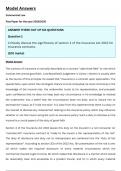
Model Answers
Commercial Law
Past Paper for the year 2019/2020
ANSWER THREE OUT OF SIX QUESTIONS
Question 1
Critically discuss the significance of section 3 of the Insurance Act 2015 for
insurance contracts.
(100 marks)
Model Answer
The contract of insurance is normally described as a contract “uberrimae fidei” or one which
involves the utmost good faith. Lord Mansfield’s judgement in Carter v Boehm is usually seen
as the source of this principle. He stated that “insurance is a contract upon speculation. The
special facts, upon which the contingent chance is to be computed, lie most commonly in the
knowledge of the insured only: the underwriter trusts to his representation, and proceeds
upon confidence that he does not keep back any circumstance in his knowledge to mislead
the underwriter into a belief that the circumstance does not exist, and to induce him to
estimate the risque, as if it did not exist”. It is clear from this statement that there is a duty on
the insured to disclose any material fact relating to the insurance policy which may influence
whether or not the insurer will grant such an insurance policy. Such a duty to disclose on the
insured is a crucial aspect of the duty of good faith.
Section 3 of the Insurance Act 2015 places this duty on the insured in a non-consumer (or
“commercial”) insurance contract to “make to the insurer a fair representation of the risk”.
The duty of disclosure and duty not to misrepresent are combined into the “duty of fair
representation”. According to section 3(3) of the 2015 Act, fair presentation of the risk is one:
(a) which makes the required disclosure of every material circumstance which the
commercial insured ought to know, (b) which makes that disclosure in a manner which would
be reasonably clear and accessible to a prudent insurer, and (c) in which every material
, representation as to a matter of fact is substantially correct, and every material
representation as to a matter of expectation or belief is made in good faith. It is clear that the
Act is protecting the interests of the insurer so that they may make the best-informed choice
before deciding whether or not to grant an insurance policy to an individual.
In terms of section 3(4), the type of disclosure required by the insured can be seen to be
quite extensive. There must be “disclosure of every material circumstance that the insured
knows or ought to have known” or, failing that, “disclosure which gives the insurer sufficient
information to put a prudent insurer on notice that it needs to make further enquiries for the
purpose of revealing those material circumstances”. Liability is heavily placed on the insured
in order to make every material circumstance which they know or ought to have known. It
provides a form of security for the insurer in order to assist their decision whether or not to
grant an insurance policy. It can be argued that this section is created to put the insurer’s
mind at ease that if the insured has complied with this section, any fault or misrepresentation
of the disclosed facts will place immediate liability on the insured.
Section 3(5) provides a criterion of what is not required to be disclosed by an insured. The
insurer is, firstly, not required to disclose anything that “diminishes the risk”. The insured only
needs to disclose information which will increase the risk. This was explored in the Dora case,
which although is old law and was related to the terms of the Marine Insurance Act 1906, it is
still relevant in the discussion of diminishing the risk. In that case, the insured was not
required to disclose the fact that a yacht would spend a large proportion of its time in the
builders yard, because it was at less risk than it was at sea. Arguably, there is an element of
common sense in the fact that anything that will reduce the risk, is useless to disclose as
evidenced in the Dora case.
Secondly, the insurer need not disclose any circumstance known, presumed to be known, or
the insurer ought to have known. Another old case before the 2015 Act helps to illustrate this
exclusion. In the case of George Cohen, Sons & Co v Standard Marine Insurance Co Ltd, the
insurers were held unable to avoid a policy on the grounds that the insured had failed to
disclose that an obsolete battleship under tow had no steam power to assist steering. This
was because it was well known that such a vessel often went out to sea in that condition.
Commercial Law
Past Paper for the year 2019/2020
ANSWER THREE OUT OF SIX QUESTIONS
Question 1
Critically discuss the significance of section 3 of the Insurance Act 2015 for
insurance contracts.
(100 marks)
Model Answer
The contract of insurance is normally described as a contract “uberrimae fidei” or one which
involves the utmost good faith. Lord Mansfield’s judgement in Carter v Boehm is usually seen
as the source of this principle. He stated that “insurance is a contract upon speculation. The
special facts, upon which the contingent chance is to be computed, lie most commonly in the
knowledge of the insured only: the underwriter trusts to his representation, and proceeds
upon confidence that he does not keep back any circumstance in his knowledge to mislead
the underwriter into a belief that the circumstance does not exist, and to induce him to
estimate the risque, as if it did not exist”. It is clear from this statement that there is a duty on
the insured to disclose any material fact relating to the insurance policy which may influence
whether or not the insurer will grant such an insurance policy. Such a duty to disclose on the
insured is a crucial aspect of the duty of good faith.
Section 3 of the Insurance Act 2015 places this duty on the insured in a non-consumer (or
“commercial”) insurance contract to “make to the insurer a fair representation of the risk”.
The duty of disclosure and duty not to misrepresent are combined into the “duty of fair
representation”. According to section 3(3) of the 2015 Act, fair presentation of the risk is one:
(a) which makes the required disclosure of every material circumstance which the
commercial insured ought to know, (b) which makes that disclosure in a manner which would
be reasonably clear and accessible to a prudent insurer, and (c) in which every material
, representation as to a matter of fact is substantially correct, and every material
representation as to a matter of expectation or belief is made in good faith. It is clear that the
Act is protecting the interests of the insurer so that they may make the best-informed choice
before deciding whether or not to grant an insurance policy to an individual.
In terms of section 3(4), the type of disclosure required by the insured can be seen to be
quite extensive. There must be “disclosure of every material circumstance that the insured
knows or ought to have known” or, failing that, “disclosure which gives the insurer sufficient
information to put a prudent insurer on notice that it needs to make further enquiries for the
purpose of revealing those material circumstances”. Liability is heavily placed on the insured
in order to make every material circumstance which they know or ought to have known. It
provides a form of security for the insurer in order to assist their decision whether or not to
grant an insurance policy. It can be argued that this section is created to put the insurer’s
mind at ease that if the insured has complied with this section, any fault or misrepresentation
of the disclosed facts will place immediate liability on the insured.
Section 3(5) provides a criterion of what is not required to be disclosed by an insured. The
insurer is, firstly, not required to disclose anything that “diminishes the risk”. The insured only
needs to disclose information which will increase the risk. This was explored in the Dora case,
which although is old law and was related to the terms of the Marine Insurance Act 1906, it is
still relevant in the discussion of diminishing the risk. In that case, the insured was not
required to disclose the fact that a yacht would spend a large proportion of its time in the
builders yard, because it was at less risk than it was at sea. Arguably, there is an element of
common sense in the fact that anything that will reduce the risk, is useless to disclose as
evidenced in the Dora case.
Secondly, the insurer need not disclose any circumstance known, presumed to be known, or
the insurer ought to have known. Another old case before the 2015 Act helps to illustrate this
exclusion. In the case of George Cohen, Sons & Co v Standard Marine Insurance Co Ltd, the
insurers were held unable to avoid a policy on the grounds that the insured had failed to
disclose that an obsolete battleship under tow had no steam power to assist steering. This
was because it was well known that such a vessel often went out to sea in that condition.