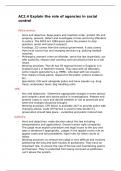
AC2.4 Explain the role of agencies in social
control
Police service:
- Aims and objective: Keep peace and maintain order, protect life and
property, prevent, detect and investigate crimes and bring offenders
to justice. The PACE Act 1984 gives police the powers to stop
question, arrest and search suspects
- Fundings: 2/3 comes from the central government. It also comes
from local council tax and charging services e.g. policing football
matches.
- Philosophy: prevent crime an disorder, serve the law impartially, act
with authority, respect and courtesy and use physical fore as a last
resort.
- Working practises: The UK has 39 regional forces in England, 4 in
Scotland and 1 in Northern Ireland. They deal with all offenders,
some require specialisms e.g. HMRC, who deal with tax evasion.
- Ther duties include patrol, respond to the public, protect evidence
etc.
- Specialists: CID work alongside police and have squads e.g. drug
fraud, underwater team, dog handling units.
CPS:
- Aim and objectives: Determine appropriate charges in more serious
and complex cases and advise police in investigations. Prepare and
present cases in court and decide whether or not to prosecute and
when the charges should be brought.
- Working practises: CPS Direct is available 24/7 to provide police with
charging advise. Code Of Practice is used to help decide if a
prosecution should take place – evidential and public interest test.
Judiciary:
- Aims and objectives: make decision about the law including
interpretations and applications. Ensure human right complaints.
The judge must explain procedure and legal issues to the jury and
pass a sentence if appropriate. Judges in the appeal courts rule on
appeal cases and set precedents, legal rules for other courts to
follow.
- Working practices: to remove the judge is very difficult and involves
petitioning the king and both houses of parliament. They have an
important role, to ensure the rule of the law and maintaining justice
and fairness. They’re protected from being removed so politicians
can’t abuse the system.
control
Police service:
- Aims and objective: Keep peace and maintain order, protect life and
property, prevent, detect and investigate crimes and bring offenders
to justice. The PACE Act 1984 gives police the powers to stop
question, arrest and search suspects
- Fundings: 2/3 comes from the central government. It also comes
from local council tax and charging services e.g. policing football
matches.
- Philosophy: prevent crime an disorder, serve the law impartially, act
with authority, respect and courtesy and use physical fore as a last
resort.
- Working practises: The UK has 39 regional forces in England, 4 in
Scotland and 1 in Northern Ireland. They deal with all offenders,
some require specialisms e.g. HMRC, who deal with tax evasion.
- Ther duties include patrol, respond to the public, protect evidence
etc.
- Specialists: CID work alongside police and have squads e.g. drug
fraud, underwater team, dog handling units.
CPS:
- Aim and objectives: Determine appropriate charges in more serious
and complex cases and advise police in investigations. Prepare and
present cases in court and decide whether or not to prosecute and
when the charges should be brought.
- Working practises: CPS Direct is available 24/7 to provide police with
charging advise. Code Of Practice is used to help decide if a
prosecution should take place – evidential and public interest test.
Judiciary:
- Aims and objectives: make decision about the law including
interpretations and applications. Ensure human right complaints.
The judge must explain procedure and legal issues to the jury and
pass a sentence if appropriate. Judges in the appeal courts rule on
appeal cases and set precedents, legal rules for other courts to
follow.
- Working practices: to remove the judge is very difficult and involves
petitioning the king and both houses of parliament. They have an
important role, to ensure the rule of the law and maintaining justice
and fairness. They’re protected from being removed so politicians
can’t abuse the system.