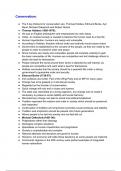
Conservatism:
● The 5 key thinkers for conservatism are, Thomas Hobbes, Edmund Burke, Ayn
Rand, Michael Oakeshott and Robert Nozick
● Thomas Hobbes (1588-1679):
● He was an English philosopher and emphasised two main ideas
● Order- an ordered society is needed to balance the human need to a free life
● Human Imperfection- humans are needy and vulnerable
● According to Hobbes, freedom without order and authority would cause chaos
● Government is established by the consent of the people, as they are voted by the
people in order to preserve order and peace
● Since humans are needy and vulnerable, people will compete violently to gain
the basic necessities of life. Humans are competitive and will challenge others to
obtain the best for themselves
● People interpret the world around them which is distorted by self interest, as
people are competitive and want what is best for themselves
● Hobbes concludes that the society should be a peaceful life under a strong
government to guarantee order and security
● Edmund Burke (1729-97):
● Irish politician and writer. Part of the Whig Party and an MP for many years
● Change has to be gradual or it will disrupt society
● Regarded as the founder of conservatism
● Quick change will only end in chaos and tyranny
● The state was resembled as a living organism, any change can be made if
necessary to preserve social stability and social harmony
● Revolutionary change can lead to social and political breakdown
● Tradition represent the wisdom and order in society which should be preserved
and respected
● Continuation of tradition and empiricism promotes social continuity and stability
● Tradition and empiricism should be passed onto future generations
● Allows people to be tied into society and not feel left out
● Michael Oakeshott (1901-90):
● Pragmatism rather than ideology
● Ideologies complex situations
● Specialises on human imperfection and pragmatism
● Society is unpredictable and complex
● Rational attempts and decisions are good for society
● However, not everyone will make these decisions as some people are irrational
● Communist regimes in the 20th century were perfect examples of misguided
human rationalism
, ● A pragmatic approach delivers the interests of the people
● It also maintains a social stability
● Flexible and decisions could be made easily, unlike an ideological approach
● Ayn Rand(1905-82):
● Russian born american philosopher
● People should pursue their happiness and their dreams
● Hard work to achieve a life of purpose and productiveness
● Rational self interest and a laissez-faire economy
● Rejects government welfare and wealth redistribution programmes
● Disapproves personal altruism, because people do not make rational self
interested decisions
● Laissez-faire economy allows an individual to be self interested and making
rational decisions
● Robert Nozick(1938-2002):
● US philosopher and right wing libertarian
● Intellectual figure in the creation of the New Right( neoconservatism and
neoliberalism)
● Individuals own their bodies, talents, abilities and labour
● Argued that since humans are rational, it gives them rights to their lives, liberty
and results from their labour
● Individuals cannot be forced to work for another person’s purposes no matter if
its good or bad
● Taxes to fund welfare programmes are immoral
● They amount to a type of forced labour that is imposed by the state
● For example, you are working for free for some of your wage as it will be taxed
● Treat individuals as a means of a resource to further goals of equality which
violates the idea of self interest
● Night watchman state: role of the state must be restricted in order to preserve
individual freedom
● Promotes self ownership
● Self ownership opposes taxation in order to fund welfare states
● Taxation is a form of slavery-working for free as part of your wage
● Welfare programmes can create a dependency culture, where people have no
incentives to work
● 6 core idea and principles of conservatism, Pragmatism, Tradition, Human
Imperfection, organic society, paternalism, libertarianism
● Pragmatism: Doing what is best for the people, doing what is best in the
moment
● Making rational decisions
● Humans lack the intellectual ability to comprehend the realities of the world
● The 5 key thinkers for conservatism are, Thomas Hobbes, Edmund Burke, Ayn
Rand, Michael Oakeshott and Robert Nozick
● Thomas Hobbes (1588-1679):
● He was an English philosopher and emphasised two main ideas
● Order- an ordered society is needed to balance the human need to a free life
● Human Imperfection- humans are needy and vulnerable
● According to Hobbes, freedom without order and authority would cause chaos
● Government is established by the consent of the people, as they are voted by the
people in order to preserve order and peace
● Since humans are needy and vulnerable, people will compete violently to gain
the basic necessities of life. Humans are competitive and will challenge others to
obtain the best for themselves
● People interpret the world around them which is distorted by self interest, as
people are competitive and want what is best for themselves
● Hobbes concludes that the society should be a peaceful life under a strong
government to guarantee order and security
● Edmund Burke (1729-97):
● Irish politician and writer. Part of the Whig Party and an MP for many years
● Change has to be gradual or it will disrupt society
● Regarded as the founder of conservatism
● Quick change will only end in chaos and tyranny
● The state was resembled as a living organism, any change can be made if
necessary to preserve social stability and social harmony
● Revolutionary change can lead to social and political breakdown
● Tradition represent the wisdom and order in society which should be preserved
and respected
● Continuation of tradition and empiricism promotes social continuity and stability
● Tradition and empiricism should be passed onto future generations
● Allows people to be tied into society and not feel left out
● Michael Oakeshott (1901-90):
● Pragmatism rather than ideology
● Ideologies complex situations
● Specialises on human imperfection and pragmatism
● Society is unpredictable and complex
● Rational attempts and decisions are good for society
● However, not everyone will make these decisions as some people are irrational
● Communist regimes in the 20th century were perfect examples of misguided
human rationalism
, ● A pragmatic approach delivers the interests of the people
● It also maintains a social stability
● Flexible and decisions could be made easily, unlike an ideological approach
● Ayn Rand(1905-82):
● Russian born american philosopher
● People should pursue their happiness and their dreams
● Hard work to achieve a life of purpose and productiveness
● Rational self interest and a laissez-faire economy
● Rejects government welfare and wealth redistribution programmes
● Disapproves personal altruism, because people do not make rational self
interested decisions
● Laissez-faire economy allows an individual to be self interested and making
rational decisions
● Robert Nozick(1938-2002):
● US philosopher and right wing libertarian
● Intellectual figure in the creation of the New Right( neoconservatism and
neoliberalism)
● Individuals own their bodies, talents, abilities and labour
● Argued that since humans are rational, it gives them rights to their lives, liberty
and results from their labour
● Individuals cannot be forced to work for another person’s purposes no matter if
its good or bad
● Taxes to fund welfare programmes are immoral
● They amount to a type of forced labour that is imposed by the state
● For example, you are working for free for some of your wage as it will be taxed
● Treat individuals as a means of a resource to further goals of equality which
violates the idea of self interest
● Night watchman state: role of the state must be restricted in order to preserve
individual freedom
● Promotes self ownership
● Self ownership opposes taxation in order to fund welfare states
● Taxation is a form of slavery-working for free as part of your wage
● Welfare programmes can create a dependency culture, where people have no
incentives to work
● 6 core idea and principles of conservatism, Pragmatism, Tradition, Human
Imperfection, organic society, paternalism, libertarianism
● Pragmatism: Doing what is best for the people, doing what is best in the
moment
● Making rational decisions
● Humans lack the intellectual ability to comprehend the realities of the world