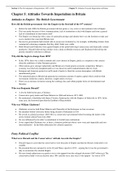
Section 1: The Development of Imperialism c1857-c1890 Chapter 5: Attitudes Towards Imperialism in Britain
Chapter 5: Attitudes Towards Imperialism in Britain
Attitudes to Empire: The British Government
How did the British government view the Empire in the first half of the 19th century?
• Before the mid-1800s the British government did not peruse a very active or interventionist role in Empire
• This was partly because of slow communications, lack of institutions to deal with Empire and from a general
lack of commitment to intervention itself
• The Empire was bound up with a sense of nationalist prestige and identity but it was the freedom to trade and
access markets that concerned Britain most
• Successive governments had resisted calls to secure new territories by, for example, withholding charters from
commercial colonising companies that they didn’t think were viable
• Both Disraeli and Gladstone were against Empire at this point believing it unnecessary and financially counter-
productive. Disraeli believed that colonies were a drain on British resources and Gladstone believed that the
priority should be with those in Britain
Why did this begin to change from 1870?
• In the 1870s, there was a shift in attitude and a new interest in Empire, partly as a response to the concern
about the ambitions of other European powers
• Other nations grew stronger industrially and Britain now found greater economic competition. Britain’s
economy was relatively unsophisticated as it was based on earlier industrialisation than its rivals
• European and American protective tariffs made it harder to flood the western hemisphere with British
manufactured goods
• The industrialisation in Britain had generated an enormous amount of surplus capital which could not find
investments within the country, therefore, sought outlets overseas
• There was an increase in interest among the working-class and within popular forms of entertainment and
literature
Who was Benjamin Disraeli?
• A Jew by birth but became a Christian
• Conservative party leader and Prime Minister in 1868 and between 1874-1880
• He maintained a friendship with Queen Victoria, flattering her with the Empress of India title in 1876. In the
same year, she bestowed upon him the Earldom of Beaconsfield
Who was William Gladstone?
• Gladstone served as both Prime Minister and Chancellor of the Exchequer on four occasions
• He attended Oxford University before being elected to Parliament in 1831
• He served as colonial secretary (1845-46) in a conservative government before becoming the leader of the
newly formed Liberal Party from 1868
• He was influenced by his other’s commitment to Scottish non-conformism
• It was argued that Gladstone was, at heart, a domestic politician whose views were anti-imperialist and non-
interventionalist – he had little enthusiasm for colonial expansion
Party Political Conflict
What were Disraeli and the Conservatives’ attitude towards the Empire?
• Disraeli began to assert that the conservatives were the party of Empire and that the liberals would allow it to
crumble
• He presented this new perspective in his Crystal Palace speech in 1872 – arguing that it was the government's
duty to reconstruct the colonial Empire
• His new-found enthusiasm was partly to try to win support from the enlarged electorate (1867 reform act) The
conservatives hadn’t won an election since 1841 and this was a sure way to win support – he won in 1874
Chapter 5: Attitudes Towards Imperialism in Britain
Attitudes to Empire: The British Government
How did the British government view the Empire in the first half of the 19th century?
• Before the mid-1800s the British government did not peruse a very active or interventionist role in Empire
• This was partly because of slow communications, lack of institutions to deal with Empire and from a general
lack of commitment to intervention itself
• The Empire was bound up with a sense of nationalist prestige and identity but it was the freedom to trade and
access markets that concerned Britain most
• Successive governments had resisted calls to secure new territories by, for example, withholding charters from
commercial colonising companies that they didn’t think were viable
• Both Disraeli and Gladstone were against Empire at this point believing it unnecessary and financially counter-
productive. Disraeli believed that colonies were a drain on British resources and Gladstone believed that the
priority should be with those in Britain
Why did this begin to change from 1870?
• In the 1870s, there was a shift in attitude and a new interest in Empire, partly as a response to the concern
about the ambitions of other European powers
• Other nations grew stronger industrially and Britain now found greater economic competition. Britain’s
economy was relatively unsophisticated as it was based on earlier industrialisation than its rivals
• European and American protective tariffs made it harder to flood the western hemisphere with British
manufactured goods
• The industrialisation in Britain had generated an enormous amount of surplus capital which could not find
investments within the country, therefore, sought outlets overseas
• There was an increase in interest among the working-class and within popular forms of entertainment and
literature
Who was Benjamin Disraeli?
• A Jew by birth but became a Christian
• Conservative party leader and Prime Minister in 1868 and between 1874-1880
• He maintained a friendship with Queen Victoria, flattering her with the Empress of India title in 1876. In the
same year, she bestowed upon him the Earldom of Beaconsfield
Who was William Gladstone?
• Gladstone served as both Prime Minister and Chancellor of the Exchequer on four occasions
• He attended Oxford University before being elected to Parliament in 1831
• He served as colonial secretary (1845-46) in a conservative government before becoming the leader of the
newly formed Liberal Party from 1868
• He was influenced by his other’s commitment to Scottish non-conformism
• It was argued that Gladstone was, at heart, a domestic politician whose views were anti-imperialist and non-
interventionalist – he had little enthusiasm for colonial expansion
Party Political Conflict
What were Disraeli and the Conservatives’ attitude towards the Empire?
• Disraeli began to assert that the conservatives were the party of Empire and that the liberals would allow it to
crumble
• He presented this new perspective in his Crystal Palace speech in 1872 – arguing that it was the government's
duty to reconstruct the colonial Empire
• His new-found enthusiasm was partly to try to win support from the enlarged electorate (1867 reform act) The
conservatives hadn’t won an election since 1841 and this was a sure way to win support – he won in 1874