Biology 120: Exam 2 Questions & Answers Already Passed!!
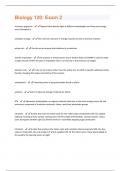
accessory pigments - Pigment that absorbs light at different wavelengths and then pass energy onto chlorophyll a activation energy - the minimum amount of energy required to start a chemical reaction active site - the site on an enzyme that attaches to a substrate aerobic respiration - the process in which pyruvic acid is broken down and NADH is used to make a large amount of ATP; the part of respiration that is carried out in the presence of oxygen allosteric site - A site on an enzyme other than the active site, to which a specific substance binds, thereby changing the shape and activity of the enzyme. amylopectin - branching chain of polysaccharides found in plants amylose - starch or glucose storage molecule for plants ATP - adenosine triphosphate, an organic molecule that acts as the main energy source for cell processes; composed of a adenine molecule, ribose, and three phosphate groups C3 plants - A plant that uses the Calvin cycle for the initial steps incorporates CO2 into organic material, forming a three-carbon compound as the first stable intermediate, common plants- stoma close during dry weather- get CO2 directly from air- essentially stopping sugar production C4 plants - A plant that prefaces the Calvin cycle with reactions that incorporate CO2 into fourcarbon compounds, the end product of which supplies CO2 for the Calvin cycle., these plants adapt to dry weather by opening stoma at nightCalvin cycle - The second of two major stages in photosynthesis (following the light reactions), involving atmospheric CO2 fixation and reduction of the fixed carbon into carbohydrate., a biochemical pathway of photosynthesis in which carbon dioxide is converted into glucose using ATP CAM plants - Store the organic acids made at night in vacuoles and use them for photosynthesis during the day when stomata are closed carotenoids - An accessory pigment, either yellow or orange, in the chloroplasts of plants. By absorbing wavelengths of light that chlorophyll cannot, these can broaden the spectrum of colors that can drive photosynthesis. cellulose - a polysaccharide that is the chief constituent of all plant tissues and fibers, chemical compound made out of sugar; forms tangled fibers in the cell walls of many plants and provides structure and support chitin - structural polysaccharide found in fungi and arthopods chlorophyll a - main photosynthetic pigment in plants, absorbs violet-blue and red chlorophyll b - An accessory photosynthetic pigment that transfers energy to chlorophyll a, absorbs blue and orange-red cyclic phosphorylation - replenishes ATP levels only-no NADPH is formed; occurs when the Calvin cycle (which requires enormus energy) uses up available ATP; electrons travel from PSII to PSI and back to PSII again electron transport chain - a series of molecules, found in the inner membranes of mitochondria and chloroplasts, through which electrons pass in a process that causes protons to build up on one side of the membrane, a series of proteins in which the high-energy electrons from the Krebs cycle are used to convert ADP into ATP. enzyme complexes - the temporary intermediate compound formed when the substrates make contact with the active site on the surface of the enzymeenzyme pathway - a series of enzymes that work in sequence to convert a substrate molecule into specific end products. Enzymes - proteins that act as biological catalysts speeding up reactions FADH2 - electron carrier produced during the Krebs cycle; another main electron carrier in cellular respiration. feedback inhibition - A method of metabolic control in which the end product of a metabolic pathway acts as an inhibitor of an enzyme within that pathway. fermentation - process by which cells release energy in the absence of oxygen, anaerobic process by which ATP is produced by glycolysis glycogen - polysaccharide that stores glucose in animals glycolysis - first step in releasing the energy of glucose, in which a molecule of glucose is broken into two molecules of pyruvic acid krebs cycle - stage of cellular respiration that finishes the breakdown of pyruvic acid molecules to carbon dioxide, releasing energy, A chemical cycle involving eight steps that completes the metabolic breakdown of glucose molecules to carbon dioxide; occurs within the mitochondrion mitochondria - Powerhouse of the cell, organelle that is the site of ATP (energy) production monosaccharide - a simple sugar that is the basic subunit of a carbohydrate NADH - electron carrier that stores energy used to make ATP; most common electron carrier in cellular respirationnon-cyclic phosphorylation - or electron transport; both ATP and NADPH formed; electron energized by absorption of light and pass through electron transport chain to NADP+, When electrons from Photosystem II go through ETC and are added to NADP⁺ to make NADPH when light is limited. oxidative phosphorylation - A process occurring in the mitochondria that results in the formation of ATP from the flow of electrons across the inner membrane to bind with oxygen; part of the electron transport chain photoelectric effect - effect that photons can dislodge electrons; taking what was light energy and converting it to electrical energy (or chemical energy) photorespiration - a metabolic pathway that consumes oxygen, releases carbon dioxide, generates no ATP, and decreases photosynthetic output; generally occurs on hot, dry, bright days, when stomata close and the oxygen concentration in the leaf exceeds that of carbon dioxide
Written for
- Institution
- Biology 120
- Course
- Biology 120
Document information
- Uploaded on
- June 17, 2024
- Number of pages
- 5
- Written in
- 2023/2024
- Type
- Exam (elaborations)
- Contains
- Questions & answers
Subjects

Also available in package deal