NAVLE Prep Questions And Answers With Verified Solutions
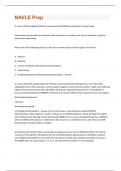
A 1 year-old Thoroughbred stallion is presented with difficulty walking for the past week. Examination reveals ataxia in the pelvic limbs and there is a tendency for him to overreach in all four limbs when ambulating. Which one of the following choices is the most common cause of these signs in the horse? A - Tetanus B - Botulism C - Cervical vertebral malformation/malarticulation D - Lead toxicity E - Occipitoatlantoaxial malformation/malarticulation - Answer-... A 1-year old female spayed Doberman Pinscher has presented after being hit by a car. Initial chest radiographs show mild contusions, and the patient appears to be otherwise stable. A right mid-shaft long oblique femoral fracture has been identified. Routine pre-operative blood work is unremarkable. A buccal mucosal bleeding test (BMBT) is elevated at 6 minutes. What will you administer prior to surgery? Whole blood transfusion Vitamin K Desmopressin acetate 1,25 dihydrocholecalciferol - Answer-The correct answer is desmopressin acetate (DDAVP). Administration of desmopressin results in release of von Willebrand factor, which will help this patient with clotting. Given this dog's breed and elevated BMBT there is a very strong likelihood she is afflicted with von Willebrand's disease. In Dobermans this results in an inability to form a clot. This can be life threatening if the dog is taken to surgery. A whole blood transfusion does not provide an adequate source of von Willebrand factor but may be necessary if the patient's bleeding cannot be controlled despite appropriate pre-operative measures. 1,25 dihydrocholecalciferol is the active form of vitamin D which aids intestinal resorption of calcium. The BMBT does not assess factors 2, 7, 9, or 10 and therefore vitamin K is not indicated.A 10-year old Golden Retriever has presented for a progressive onset of exercise intolerance and voice change. On physical exam the patient is noted to have a 7/9 body condition score. Mucous membranes are pink. Capillary refill time is less than 2 seconds. Lung sounds are clear bilaterally. Stridorous breathing is noted on inspiration. Laryngeal paralysis is suspected and a sedated laryngeal exam has been recommended. The owner agrees to routine blood work, chest radiographs, and a laryngeal examination. Which of the following medications will help assist in evaluation of laryngeal function? Propofol Dopamine Ketamine Doxapram Diphenhydramine - Answer-Doxapram is a central nervous stimulant that has effects on respiratory centers. It is thought that it may work by stimulating the reflex activation of carotid and aortic chemoreceptors. At one point, it was used in critical care patients during resuscitation efforts; however, this has fallen out of favor since doxapram results in increased work associated with respiration without an increased amount of arterial oxygenation. When performing a laryngeal exam, the goal is to have the patient just deep enough so you can perform a laryngeal exam. Injectable anesthetics such as thiopental or propofol are used. Overzealous administration of these can result in a false diagnosis of laryngeal paralysis and it is therefore recommended to administer Doxapram to help stimulate respiration and definitively confirm your diagnosis
Geschreven voor
- Instelling
- NAVLE
- Vak
- NAVLE
Documentinformatie
- Geüpload op
- 15 juni 2024
- Aantal pagina's
- 39
- Geschreven in
- 2023/2024
- Type
- Tentamen (uitwerkingen)
- Bevat
- Vragen en antwoorden
Onderwerpen

Ook beschikbaar in voordeelbundel