

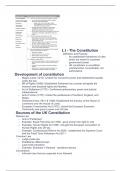
1.1 - The Constitution
Definition and Purpose
o An established framework of rules
which are meant to constrain
government power
o UK constitution is uncodified,
unentrenched, not judicable, not
authoritative.
Development of constitution
o Magna Carta (1215): Limited the monarch's power and established equality
under the law.
o Bill of Rights (1689): Established Parliament as a power alongside the
monarch and declared rights and liberties.
o Act of Settlement (1701): Confirmed parliamentary power and judicial
independence.
o Acts of Union (1707): United the parliaments of Scotland, England, and
Wales.
o Parliament Acts (1911 & 1949): Established the primacy of the House of
Commons over the House of Lords.
o European Communities Act (1972): Joined the European Economic
Community and gave it power over UK law.
Sources of the UK Constitution
Statute Law
o Acts of Parliament
o Example: Equal Franchise Act 1928 - gave women the right to vote
o Example: Human Rights Act 1998 - brought the European Convention of
Human Rights into UK law
o Example: Constitutional Reform Act 2005 - established the Supreme Court
and the Fixed Term Parliament Act 2011
Common Law
o Judge-made law
o Establishes different laws
o Laws hold precedent
o Example: Somerset V Steward - abolished slavery
Conventions
o Informal rules that are expected to be followed
, o Not laws
o Example: Salisbury Convention 1945 - House of Lords should not block
legislation in the Governing Party's manifesto
o Example: Royal Assent - convention that the monarch grants assent to
legislation
Authoritative Works
o Books and works that set out how Parliament should run and how ministers
should act
o Example: Walter Bagehot's 'The English Constitution' 1867 - sets out the role
of the Prime Minister
o Example: Erskine May's 'Treatise on the Law, Privileges, Proceedings and
Usage of Parliament' 1844 - sets out parliamentary procedure
o Example: A.V. Dicey's 'Introduction to the Study of the Law of the Constitution'
1885 - includes the 3 strands of the rule of law
EU Law
o UK joined the EU in 1973
o European Communities Act guaranteed the supremacy of EU law over UK law
o Example: R (Factortame Ltd) v Secretary of State for Transport - EU law
takes precedence
o UK left the EU after triggering Article 50
Customs and Traditions
o Not hugely important to the constitution
o Allow for the smooth running of the constitution
o Example: Monarch announcing the legislative programme for the coming year
Principles of the Constitution
Twin pillars (parliamentary sovereignty and rule of law)
Parliamentary Sovereignty
o Parliament can make, repeal, or amend any law
o Example: European Communities Act 1972 repealed to enable Brexit
Case Study: Covid Threat
o Former president of the UK Supreme Court criticized emergency laws
restricting freedoms during the Covid-19 crisis
o Coronavirus Act 2020 gave sweeping powers to the government
o Dominic Cummings' decision to travel during lockdown breached the law and
government guidance
Rule of Law
o Everyone is equal to the law
o Everyone is subject to the law
o Example: Johnson prorogued Parliament in 2019 and the Supreme Court
found it to be unlawful
Unitary State
o Governed as a single entity
o UK has become a more quasi-federal state due to devolution
o Scotland in particular feels very separate
Parliamentary Government under a Constitutional Monarch
o Government is drawn from Parliament
o Government relies on Parliament for support
o Monarch is head of state, but powers are exercised by the government
o Example: Monarch hasn't refused royal assent for 300 years
,1.2 Constitutional Reform
Evaluate the extent to which constitutional reforms introduced since 1997 have been
successful in achieving their objectives.
• The aims-
• Decentralisation- power should be devolved back to the people, Scotland and wale
offered there own elected Govs, and the opportunity of city and town mayors.
• Democratisation- public should be given given influence over decision making
through greater use of referendums on important constitutional issues. To
encourage democracy house of lords would be reformed
• Transparency- to encourage greater trust in government, the role of senior judiciary
would be reformed. Freedom of information act would open up government making
it more accountable.
• Rights protection- British human rights were not protected by codified constitution,
gov committed to incorpricated the European convention on Human Rights into
British law. This would provide the judiciary with an important new statue,
protecting and advancing civil liberties.
• Modernisation - outdated and inefficient
Tony Blair and his Government
Who was Tony Blair and when was he in government?
o Tony Blair was the Labour Prime Minister from 1997-2007
o He was a modernizing and progressive leader who won a large majority 179
Why did he want to reform the constitution?
o The constitution hadn't been reformed in over a century
o Power was too centralized and the rights of citizens were insufficiently
protected
o He wanted to address these issues and engage the public in politics
Constitutional Reform under the Blair Government
Devolution/Local Government
o Devolution provided greater powers to govern themselves
o 1997 Referendums were held in Scotland, Wales, and Northern Ireland 1998
o Towns and cities were given the opportunity to elect their own mayors in 1998
o The aim was to provide the constituent parts of the UK with greater self-
determination. The 3 devolved powers would ensure policies would be more
suited to the Uk needs as a whole.
o It was successful in some aspects, but there were also failures and
controversies such as in 2004, north east rejected proposals for regional
assembly. And Scotland continued to want independence (SNP – asked for
another referendum)
House of Lords Reform
o Legislation was introduced in 1999 to reform the upper house
o Hereditary peers were removed but 92 and life peers became the majority
o The aim was to make the house a more professional body and increase
legitimacy
o It was partly successful, but controversial no further reforms occurred.
Electoral Reform
, o Tony Blair aimed to change the first-past-the-post system
o He introduced new electoral systems for devolved assemblies
o He was unsuccessful in introducing proportional representation
Human Rights Act 1998
o It incorporated the European Convention on Human Rights into British law
o It led to better protection of civil liberties.
o 2001 after 9/11, gov started imprisoning people they suspected – were not
given trial before being held. This supreme court said it was unlawful. But gov
passed prevention of terrorist act suspending the act – Belmarsh case.
o There are limitations to the act as it does not represent higher constitutional
law, and it is not entrenched.
Supreme Court/Constitutional Reform
o The Supreme Court was established in 2005
o It ended the House of Lords' judicial function, appointment of judges more
transparent.
o The aim was to achieve a guaranteed separation of powers
o It was successful in separating the government branches and making the
judiciary more independent
Freedom of Information Act 2000
o The act made the government more transparent
o It allowed access to information such as expenses and court case
Constitutional Reform 2010-15 – coalition
Fixed Term Parliament Act 2011- was revoked.
o The act meant that another election would occur exactly 5 years after the last
general election.
o The act made it harder for the PM to call a snap general election at their time
of choosing.
o The act allows a general election if the government loses a vote of confidence
or if 2/3 of the House of Commons agrees.
o This has been successful in limiting the PM's power and making the duration
of the elected party's stay in power more predictable.
Electoral Reform
o The agreement stated that the government would call a referendum offering
the public the opportunity to replace the FPTP with the AV.
o In the 2011 referendum, opponents of change successfully portrayed the AV
as complicated and lacking transparency.
o The public was in favor of FPTP.
Parliamentary Reform 2009
o It gave backbench MPs more influence and addressed the government's
dominance of the House of Commons.
o Most recommendations of the Wright committee were enacted, giving
backbenchers more control over what's debated in parliament.
o The membership of selected committees was no longer determined by the
whips, but instead elected by the MPs in a secret ballot.
o This was successful in increasing the legitimacy of selected committees and
making them more confident in scrutinizing the government.
Further Devolution
Definition and Purpose
o An established framework of rules
which are meant to constrain
government power
o UK constitution is uncodified,
unentrenched, not judicable, not
authoritative.
Development of constitution
o Magna Carta (1215): Limited the monarch's power and established equality
under the law.
o Bill of Rights (1689): Established Parliament as a power alongside the
monarch and declared rights and liberties.
o Act of Settlement (1701): Confirmed parliamentary power and judicial
independence.
o Acts of Union (1707): United the parliaments of Scotland, England, and
Wales.
o Parliament Acts (1911 & 1949): Established the primacy of the House of
Commons over the House of Lords.
o European Communities Act (1972): Joined the European Economic
Community and gave it power over UK law.
Sources of the UK Constitution
Statute Law
o Acts of Parliament
o Example: Equal Franchise Act 1928 - gave women the right to vote
o Example: Human Rights Act 1998 - brought the European Convention of
Human Rights into UK law
o Example: Constitutional Reform Act 2005 - established the Supreme Court
and the Fixed Term Parliament Act 2011
Common Law
o Judge-made law
o Establishes different laws
o Laws hold precedent
o Example: Somerset V Steward - abolished slavery
Conventions
o Informal rules that are expected to be followed
, o Not laws
o Example: Salisbury Convention 1945 - House of Lords should not block
legislation in the Governing Party's manifesto
o Example: Royal Assent - convention that the monarch grants assent to
legislation
Authoritative Works
o Books and works that set out how Parliament should run and how ministers
should act
o Example: Walter Bagehot's 'The English Constitution' 1867 - sets out the role
of the Prime Minister
o Example: Erskine May's 'Treatise on the Law, Privileges, Proceedings and
Usage of Parliament' 1844 - sets out parliamentary procedure
o Example: A.V. Dicey's 'Introduction to the Study of the Law of the Constitution'
1885 - includes the 3 strands of the rule of law
EU Law
o UK joined the EU in 1973
o European Communities Act guaranteed the supremacy of EU law over UK law
o Example: R (Factortame Ltd) v Secretary of State for Transport - EU law
takes precedence
o UK left the EU after triggering Article 50
Customs and Traditions
o Not hugely important to the constitution
o Allow for the smooth running of the constitution
o Example: Monarch announcing the legislative programme for the coming year
Principles of the Constitution
Twin pillars (parliamentary sovereignty and rule of law)
Parliamentary Sovereignty
o Parliament can make, repeal, or amend any law
o Example: European Communities Act 1972 repealed to enable Brexit
Case Study: Covid Threat
o Former president of the UK Supreme Court criticized emergency laws
restricting freedoms during the Covid-19 crisis
o Coronavirus Act 2020 gave sweeping powers to the government
o Dominic Cummings' decision to travel during lockdown breached the law and
government guidance
Rule of Law
o Everyone is equal to the law
o Everyone is subject to the law
o Example: Johnson prorogued Parliament in 2019 and the Supreme Court
found it to be unlawful
Unitary State
o Governed as a single entity
o UK has become a more quasi-federal state due to devolution
o Scotland in particular feels very separate
Parliamentary Government under a Constitutional Monarch
o Government is drawn from Parliament
o Government relies on Parliament for support
o Monarch is head of state, but powers are exercised by the government
o Example: Monarch hasn't refused royal assent for 300 years
,1.2 Constitutional Reform
Evaluate the extent to which constitutional reforms introduced since 1997 have been
successful in achieving their objectives.
• The aims-
• Decentralisation- power should be devolved back to the people, Scotland and wale
offered there own elected Govs, and the opportunity of city and town mayors.
• Democratisation- public should be given given influence over decision making
through greater use of referendums on important constitutional issues. To
encourage democracy house of lords would be reformed
• Transparency- to encourage greater trust in government, the role of senior judiciary
would be reformed. Freedom of information act would open up government making
it more accountable.
• Rights protection- British human rights were not protected by codified constitution,
gov committed to incorpricated the European convention on Human Rights into
British law. This would provide the judiciary with an important new statue,
protecting and advancing civil liberties.
• Modernisation - outdated and inefficient
Tony Blair and his Government
Who was Tony Blair and when was he in government?
o Tony Blair was the Labour Prime Minister from 1997-2007
o He was a modernizing and progressive leader who won a large majority 179
Why did he want to reform the constitution?
o The constitution hadn't been reformed in over a century
o Power was too centralized and the rights of citizens were insufficiently
protected
o He wanted to address these issues and engage the public in politics
Constitutional Reform under the Blair Government
Devolution/Local Government
o Devolution provided greater powers to govern themselves
o 1997 Referendums were held in Scotland, Wales, and Northern Ireland 1998
o Towns and cities were given the opportunity to elect their own mayors in 1998
o The aim was to provide the constituent parts of the UK with greater self-
determination. The 3 devolved powers would ensure policies would be more
suited to the Uk needs as a whole.
o It was successful in some aspects, but there were also failures and
controversies such as in 2004, north east rejected proposals for regional
assembly. And Scotland continued to want independence (SNP – asked for
another referendum)
House of Lords Reform
o Legislation was introduced in 1999 to reform the upper house
o Hereditary peers were removed but 92 and life peers became the majority
o The aim was to make the house a more professional body and increase
legitimacy
o It was partly successful, but controversial no further reforms occurred.
Electoral Reform
, o Tony Blair aimed to change the first-past-the-post system
o He introduced new electoral systems for devolved assemblies
o He was unsuccessful in introducing proportional representation
Human Rights Act 1998
o It incorporated the European Convention on Human Rights into British law
o It led to better protection of civil liberties.
o 2001 after 9/11, gov started imprisoning people they suspected – were not
given trial before being held. This supreme court said it was unlawful. But gov
passed prevention of terrorist act suspending the act – Belmarsh case.
o There are limitations to the act as it does not represent higher constitutional
law, and it is not entrenched.
Supreme Court/Constitutional Reform
o The Supreme Court was established in 2005
o It ended the House of Lords' judicial function, appointment of judges more
transparent.
o The aim was to achieve a guaranteed separation of powers
o It was successful in separating the government branches and making the
judiciary more independent
Freedom of Information Act 2000
o The act made the government more transparent
o It allowed access to information such as expenses and court case
Constitutional Reform 2010-15 – coalition
Fixed Term Parliament Act 2011- was revoked.
o The act meant that another election would occur exactly 5 years after the last
general election.
o The act made it harder for the PM to call a snap general election at their time
of choosing.
o The act allows a general election if the government loses a vote of confidence
or if 2/3 of the House of Commons agrees.
o This has been successful in limiting the PM's power and making the duration
of the elected party's stay in power more predictable.
Electoral Reform
o The agreement stated that the government would call a referendum offering
the public the opportunity to replace the FPTP with the AV.
o In the 2011 referendum, opponents of change successfully portrayed the AV
as complicated and lacking transparency.
o The public was in favor of FPTP.
Parliamentary Reform 2009
o It gave backbench MPs more influence and addressed the government's
dominance of the House of Commons.
o Most recommendations of the Wright committee were enacted, giving
backbenchers more control over what's debated in parliament.
o The membership of selected committees was no longer determined by the
whips, but instead elected by the MPs in a secret ballot.
o This was successful in increasing the legitimacy of selected committees and
making them more confident in scrutinizing the government.
Further Devolution


