

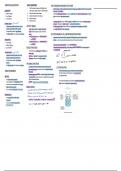
OXIDATION & REDUCTION HALF EQUATIONS THE STANDARD HYDROGEN ELECTRODE
1. Write the unbalanced equation and identify the atoms • is a half-cell used as a reference electrode and consists of: hydrogen gas in equilibrium with H+ ions of concentration
OXIDATION which change in oxidation number in a REDOX equation 1.00 mol dm^-3 (at 100pKa)
• addition of oxygen 2. Deduce the oxidation number changes • when the standard hydrogen electrode is connected to another half -cell, the standard electrode potential of that half-
• loss of hydrogen 3. Abalcnce the oxidation number changes cell can be read from a high resistance voltmeter
• loss of electrons 4. Balance the charges
5. Balance the atoms • the hydrogen electrode is always on the left, the polarity of the half cell measured is always with respect to hydrogen
Feat Fest
OXIDISING AGENT ,
• half reaction will always be a reduction reaction —> standard reduction potentials
• a substance that oxidises another atoms or ion by ACTIVITY SERIES • the more negative the value; the better the half cell is at pushing electrons so the equilibrium lies to the left
causing it to gain electrons, electron acceptor • metals higher in reactivity can displaces less reactive • more negative the half cell = better reducing agent
• the agent itself gets reduced - gains electrons metals from their compound or solution or from their
• the oxidation number of the oxidising agent decreases oxides ELECTROCHEMICAL CELLS SPONTANEOUS REACTIONS
• the LESS reactive metal act as a REDUCING AGENT • a spontaneous reaction occurs when the combination of half cells produces a positive voltage through the
REDUCTION —-> are OXIDISED voltmeter, i.e., the more negative electrode pushes electrons onto the more positive electrode
• the LESS reactive metal, act as a OXIDISING AGENT
• loss of oxygen
—> are REDUCED • if delta electrode potential is POSITIVE = reaction is SPONTANEOUS
• addition of hydrogen
• gain of electrons REDOX TITRATIONS • if delta electrode potential is NEGATIVE = forward reaction is NON-SPONTANEOUS, the reverse reaction will
be SPONTANEOUS constant
• in redox titrations, an oxidising agent is titrated against a faraday
REDUCING AGENT H202 H20 ~
reducing agent ⑦
• a substance that reduces another atom or ion by • electrons are transferred from one species to the other AGP = -
n
.
number
~
F E
.
of - transfered
causing it to lose electrons, electron donor • indicators are sometimes used to show the endpoint
• the agent itself gets oxidised - loses/doantes
A6" O & : 0 if at equilibrium
electrons
= >
-
THE WINKLER METHOD
=
• the oxidation number of the reducing agent increases
• a technique used to measure dissolved oxygen in freshwater systems
ELECTROPLATING
• higher dissolved oxygen concentrations correlate with high productivity and
OXIDATION NUMBER little pollution
• involves the electrolytic coating of an object with a very thin metallic layer
• this is for the purposes of the decoration or for corrosion prevention
• biological oxygen demand (BOD) is the amount of oxygen used to decompose
• ex, gold plated jewellery
METALS: the organic matter in a sample of water over a specified time period, usually 5
• have positive values in compounds days, at a specified temperature
• for successful electroplating, the metal needs to be deposited slowly and evenly
• value is usually that of the Group Number Al is +3 • high BOD = organic waste = lower level of dissolved oxygen
• anode is made of the same metal to replenish metal loss
• where there are several possibilities the values go no
higher than the Group number CHEMICAL ANALYSIS
• An can be +2 or +4, Mn can be +2, +4,+6,+7 ① 2 Mn
*
(ag) + 40H (g) + 02(q) / 2 MnOc(s) + 2H20(1)
Mn2 (aq) (ag) (1)
+
(ag) (aq) 2H20
+
& MnOz (s) + 2 1 + 4H - + 1z +
NON METALS:
& 23203" (ag) 12 (ag) Sy0g" (ag) 21 (ag)
-
+ < +
• mostly negative based on their usual ion 2-
• Cl usually -1 • 1 mole of O2 —> 2 moles of MnO2 —> 2 moles of I2 —> 4 moles of S2O3
• can have values up to their group number
units of oxygen content : mg/dm3 or ppm
• Cl +1,+3,+5 or +7
1. Write the unbalanced equation and identify the atoms • is a half-cell used as a reference electrode and consists of: hydrogen gas in equilibrium with H+ ions of concentration
OXIDATION which change in oxidation number in a REDOX equation 1.00 mol dm^-3 (at 100pKa)
• addition of oxygen 2. Deduce the oxidation number changes • when the standard hydrogen electrode is connected to another half -cell, the standard electrode potential of that half-
• loss of hydrogen 3. Abalcnce the oxidation number changes cell can be read from a high resistance voltmeter
• loss of electrons 4. Balance the charges
5. Balance the atoms • the hydrogen electrode is always on the left, the polarity of the half cell measured is always with respect to hydrogen
Feat Fest
OXIDISING AGENT ,
• half reaction will always be a reduction reaction —> standard reduction potentials
• a substance that oxidises another atoms or ion by ACTIVITY SERIES • the more negative the value; the better the half cell is at pushing electrons so the equilibrium lies to the left
causing it to gain electrons, electron acceptor • metals higher in reactivity can displaces less reactive • more negative the half cell = better reducing agent
• the agent itself gets reduced - gains electrons metals from their compound or solution or from their
• the oxidation number of the oxidising agent decreases oxides ELECTROCHEMICAL CELLS SPONTANEOUS REACTIONS
• the LESS reactive metal act as a REDUCING AGENT • a spontaneous reaction occurs when the combination of half cells produces a positive voltage through the
REDUCTION —-> are OXIDISED voltmeter, i.e., the more negative electrode pushes electrons onto the more positive electrode
• the LESS reactive metal, act as a OXIDISING AGENT
• loss of oxygen
—> are REDUCED • if delta electrode potential is POSITIVE = reaction is SPONTANEOUS
• addition of hydrogen
• gain of electrons REDOX TITRATIONS • if delta electrode potential is NEGATIVE = forward reaction is NON-SPONTANEOUS, the reverse reaction will
be SPONTANEOUS constant
• in redox titrations, an oxidising agent is titrated against a faraday
REDUCING AGENT H202 H20 ~
reducing agent ⑦
• a substance that reduces another atom or ion by • electrons are transferred from one species to the other AGP = -
n
.
number
~
F E
.
of - transfered
causing it to lose electrons, electron donor • indicators are sometimes used to show the endpoint
• the agent itself gets oxidised - loses/doantes
A6" O & : 0 if at equilibrium
electrons
= >
-
THE WINKLER METHOD
=
• the oxidation number of the reducing agent increases
• a technique used to measure dissolved oxygen in freshwater systems
ELECTROPLATING
• higher dissolved oxygen concentrations correlate with high productivity and
OXIDATION NUMBER little pollution
• involves the electrolytic coating of an object with a very thin metallic layer
• this is for the purposes of the decoration or for corrosion prevention
• biological oxygen demand (BOD) is the amount of oxygen used to decompose
• ex, gold plated jewellery
METALS: the organic matter in a sample of water over a specified time period, usually 5
• have positive values in compounds days, at a specified temperature
• for successful electroplating, the metal needs to be deposited slowly and evenly
• value is usually that of the Group Number Al is +3 • high BOD = organic waste = lower level of dissolved oxygen
• anode is made of the same metal to replenish metal loss
• where there are several possibilities the values go no
higher than the Group number CHEMICAL ANALYSIS
• An can be +2 or +4, Mn can be +2, +4,+6,+7 ① 2 Mn
*
(ag) + 40H (g) + 02(q) / 2 MnOc(s) + 2H20(1)
Mn2 (aq) (ag) (1)
+
(ag) (aq) 2H20
+
& MnOz (s) + 2 1 + 4H - + 1z +
NON METALS:
& 23203" (ag) 12 (ag) Sy0g" (ag) 21 (ag)
-
+ < +
• mostly negative based on their usual ion 2-
• Cl usually -1 • 1 mole of O2 —> 2 moles of MnO2 —> 2 moles of I2 —> 4 moles of S2O3
• can have values up to their group number
units of oxygen content : mg/dm3 or ppm
• Cl +1,+3,+5 or +7


