Formals charge
Orbitals
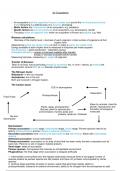
• FC = valence electrons - 1/2 (number of bonding electrons) - (number of non bonding electrons)
• s= s orbital is closer to nucleus =
·
greater bond compared to p orbital • —> FC = V - 1/2 x B = N
• p= & • most preferred structure when formal charge is 0
• d=
• f =& Hybridization H
Cl Hy I
It - -s
294 sp3
↑ P
st
• 4 single bonds = sp^3 c = H C
J
H
C
• each atom that combine has an atomic orbital
-
p
- -
i
• 3 single bonds = sp^2
↓I I -
S
-
↳
-
P
> Oxygen has 2 lone pairs of
containing a single unpaired electron
• 2 single bonds = sp CI
C d Hip H3
electrons. This is also counted.
• when a covalent bond is formed, form a combined
CI Sp
orbital containing 2 electrons
• Consider double single bonds with hybridisation cause it is about s and p orbitals
• the greater the atomic over lap, the stronger the bonds
Shapes of Molecules 4
-bond Resonance structures Trigonal bipyramid
jop
.. 180
- CI
120
• bonding pairs = 5
• are formed from head to head (end to end) overlap to atomic orbitals F di
• lone pairs = 0
-
II
• a single covalent bond formed when 2 non-metals combine Species Resonance structure Hybrid
D&
• molecular geo = Trigonal bipyramid
&
-
• the electron density is concentrated between 2 nuclei Carbonate ions gi·
:
[o]"
Sp
Die
• s + s orbital & s + p-orbitals = sigma ortbial
di-
E > C
&
S
-
I+ &D
4) H CO is - - · • bonding pairs = 4 Fe
...... 2179
O
a-
.. :
-
S
-
Sp
• lone pairs = 1
&
-
• the electron density in a sigma bond is symmetrical about a line Benzene
•
joining in the nuclei of the atoms forming the bond
The electrostatic attraction between the electrons and nuclei bond
& • molecular geo = See saw
F
• bonding pairs = 3
the atom to each other Ozone
r I
...
↑
7
& F
• lone pairs = 2
-
D3 "
0..
.
F
-
• molecular geo = T- shape
Carbonylate ion
T -bonds
E m-
:
[
-
(RCOO )
&
c • bonding pairs = 2
R- -
m
• are formed from the sideways overlaps of adjacent orbitals -
r
o
• lone pairs = 3
r -
-
• the 2 lobes that make up the pi-bond lie above and below the plane
• molecular geo = linear
-
of a sigma bond
• this maximise overlap of p-orbitals
Octahedral
• a single pi-bond is drawn as 2 electron clouds, one arising from F
• bonding pairs = 6
F F
each lobe of p-orbitals
...........
S
·
• lone pairs = 0 #
#F
&
• p-orbital + p-orbital = pi bond if ‘lateral overlap’, from double bonds F
• molecular geo = Octahedral
O - ..... i ..... F
Ef • bonding pairs = 5
F
- c c
- plane
-
>
-
T
& • lone pairs = 1
I F>F S
S
-
-
e-cloud
• molecular geo = Square based planar
180
F
• bonding pairs = 4 ...-
F
Xe---
XX
• lone pairs = 2 F
/ 1 XX
-
• molecular geo = Square planar
Orbitals
• FC = valence electrons - 1/2 (number of bonding electrons) - (number of non bonding electrons)
• s= s orbital is closer to nucleus =
·
greater bond compared to p orbital • —> FC = V - 1/2 x B = N
• p= & • most preferred structure when formal charge is 0
• d=
• f =& Hybridization H
Cl Hy I
It - -s
294 sp3
↑ P
st
• 4 single bonds = sp^3 c = H C
J
H
C
• each atom that combine has an atomic orbital
-
p
- -
i
• 3 single bonds = sp^2
↓I I -
S
-
↳
-
P
> Oxygen has 2 lone pairs of
containing a single unpaired electron
• 2 single bonds = sp CI
C d Hip H3
electrons. This is also counted.
• when a covalent bond is formed, form a combined
CI Sp
orbital containing 2 electrons
• Consider double single bonds with hybridisation cause it is about s and p orbitals
• the greater the atomic over lap, the stronger the bonds
Shapes of Molecules 4
-bond Resonance structures Trigonal bipyramid
jop
.. 180
- CI
120
• bonding pairs = 5
• are formed from head to head (end to end) overlap to atomic orbitals F di
• lone pairs = 0
-
II
• a single covalent bond formed when 2 non-metals combine Species Resonance structure Hybrid
D&
• molecular geo = Trigonal bipyramid
&
-
• the electron density is concentrated between 2 nuclei Carbonate ions gi·
:
[o]"
Sp
Die
• s + s orbital & s + p-orbitals = sigma ortbial
di-
E > C
&
S
-
I+ &D
4) H CO is - - · • bonding pairs = 4 Fe
...... 2179
O
a-
.. :
-
S
-
Sp
• lone pairs = 1
&
-
• the electron density in a sigma bond is symmetrical about a line Benzene
•
joining in the nuclei of the atoms forming the bond
The electrostatic attraction between the electrons and nuclei bond
& • molecular geo = See saw
F
• bonding pairs = 3
the atom to each other Ozone
r I
...
↑
7
& F
• lone pairs = 2
-
D3 "
0..
.
F
-
• molecular geo = T- shape
Carbonylate ion
T -bonds
E m-
:
[
-
(RCOO )
&
c • bonding pairs = 2
R- -
m
• are formed from the sideways overlaps of adjacent orbitals -
r
o
• lone pairs = 3
r -
-
• the 2 lobes that make up the pi-bond lie above and below the plane
• molecular geo = linear
-
of a sigma bond
• this maximise overlap of p-orbitals
Octahedral
• a single pi-bond is drawn as 2 electron clouds, one arising from F
• bonding pairs = 6
F F
each lobe of p-orbitals
...........
S
·
• lone pairs = 0 #
#F
&
• p-orbital + p-orbital = pi bond if ‘lateral overlap’, from double bonds F
• molecular geo = Octahedral
O - ..... i ..... F
Ef • bonding pairs = 5
F
- c c
- plane
-
>
-
T
& • lone pairs = 1
I F>F S
S
-
-
e-cloud
• molecular geo = Square based planar
180
F
• bonding pairs = 4 ...-
F
Xe---
XX
• lone pairs = 2 F
/ 1 XX
-
• molecular geo = Square planar