

PATHO exam 1
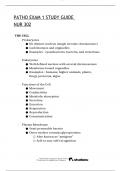
PATHO EXAM 1 STUDY GUIDE NUR 302 THE CELL - Prokaryotes ● No distinct nucleus (single circular chromosome) ● Lack histones and organelles ● Examples : cyanobacteria, bacteria, and rickettsiae - Eukaryotes ● Well defined nucleus with several chromosomes ● Membrane bound organelles ● Examples : humans, higher animals, plants, fungi, protozoa, algae - Functions of the Cell ● Movement ● Conductivity ● Metabolic absorption ● Secretion ● Excretion ● Respiration ● Reproduction ● Communication - Plasma Membrane ● Semi-permeable barrier ● Outer surface contains glycoproteins ○ Also known as “antigens” ○ Self vs non-self recognition ○ Plays a role in allergies, autoimmune diseases, transplant rejection, and blood transfusion reactions - Sodium- Potassium Pump ● ATP is required (Active transport process) ● Establishes resting membrane potential ● Maintains fluid volume ● Drugs can alter pump activity - Mitochondria ● Cell energy producer ● Converts nutrients into ATP ● Contains its own DNA ○ Derived maternally ● Mitochondrial DNA damage may play a role in diabetes, cancer, and heart disease ○ Free radicals may damage mitochondrial DNA ● Energy producing sites : “power plants” of the cell ● Regenerate if extra energy is needed ● Synthesizes ATP ● Cell has high energy requirement = many mitochondria - Aerobic Metabolism ● Glucose to pyruvate, which enters Krebs cycle ● Occurs in the mitochondria ● Used by mitochondria to form ATP ● Requires simple forms of carbs, proteins, and fats ● Releases water and carbon dioxide ● Net yield = 34 ATP - Anaerobic Metabolism ● Oxygen not available (hypoxia) ● Glucose to pyruvate to lactic acid (can alter pH) ● Provides less than 5% of the ATP requirements of the cell ● Occurs in the cytoplasm, not in the mitochondria ● Occurs in times of intense molecular exertion when O2 demand exceeds supply ● How cells that do not have mitochondria get energy ● Accumulation of lactic acid causes pain ● Deep breathing provides more O2 to restore balance of ATP ● Net yield = 2 ATP - Lysosomes ● Digestive system of the cell ● Lyse = break apart, lyso = dissolution, some = body ● Lysosomal enzyme = digestive enzyme ● Lysosomes digest debris as cells are damaged or have completed their life cycle - Endoplasmic Reticulum ● Network of tubules which act as a transport system ● Smooth ER = lipids ● Rough ER = proteins ● ER stress may play a role in cancer, obesity, and diabetes - Ribosomes ● “Protein factories” ● Hypoxia causes decreased protein synthesis - Golgi Apparatus ● Processes, packages, and secretes proteins ● Example ○ ACTH synthesized as a preprohormone ○ Insulin is another hormone that uses similar signaling - Nucleus ● Control center of the cell ● Surrounded by cytoplasm ● Contains DNA and proteins ● Surrounded by a double membrane ○ Lipid bilayer ■ Permeable to some molecules, but not to others ● Main job of Nucleus ○ Cell division and control of genetic information ○ Regulates cell growth, metabolism, and reproduction - Cellular Communication ● Autocrine Signaling ○ When a cell releases a chemical into the extracellular fluid that affects its own activity ● Paracrine Signaling ○ Enzymes rapidly metabolize the chemical mediators, and therefore they act mainly on nearby cells ● Endocrine Signaling ○ Relies on hormones carried into the bloodstream to cells throughout the body ● Synaptic Signaling ○ Occurs in the nervous system, where neurotransmitters act only on adjacent nerve cells through special contact areas called synapses CELL INJURY - Cell Adaptation ● Normally, a cell is able to change its size or form without compromising its normal function ● Once stimulus is removed, the cell presumes its previous characteristics ○ Example = a woman’s uterus after birth of a child ● Normal or abnormal adaptation? ○ Depends on whether the stimulus was appropriate and if the cell went back to previous state after stimulus was removed ● It is only when stress is overwhelming or adaptation is ineffective, that cell injury and death occur ● Cells adapt to changes in the internal environment. Cells may adapt by undergoing changes in size, number, and type. These changes may lead to : atrophy, hypertrophy, hyperplasia, metaplasia, and dysplasia - Atrophy ● Decrease in cell size ● When sufficient number of cells are involved, tissue atrophy occurs ● Occurs when decrease in work demand, most cells are able to revert to a smaller size and a lower and more efficient level of functioning ● General causes of atrophy : ○ Disuse - arm in a cast ○ Denervation - parallelization ○ Loss of endocrine stimulation - women in menopause resulting in atrophy in reproductive organs ○ Inadequate nutrition ○ Ischemia - Hypertrophy ● Increase in cell size ○ Subsequent increase in size of the affected organ without increase in the number of cells ● Usually represents response of a specific organ to an increased demand for work ● Increase in intracellular organelles (especially mitochondria) ● Same number of cells, but they are just bigger in size ● Represents the response of an organ to an increased demand for work ● Skeletal muscle enlargement with weight lifting = good ● Cardiomegaly leads to cardiomyopathy and heart failure = bad - Hyperplasia ● Increase in cell number, resulting in increased tissue mass ● Examples = menstruation, liver regeneration, wound healing, warts ● Often occurs together with hypertrophy due to the same triggers - Metaplasia ● Reversible change ○ Does not necessarily lead to cancerous changes; however, if the stimulus is not removed, cancerous changes will likely occur ● One type of adult cell is replaced by another type ● Usually in response to chronic irritation and inflammation ○ Example = GERD - Dysplasia ● Deranged cellular growth ● Often a result of chronic inflammation or a precancerous condition ● Cells vary in size, shape, and organization compared to normal ● Example = cervical dysplasia detected by a Pap Test ● Abnormal changes ● Common sites - reproductive and respiratory sites ○ Strong associated with malignancy - Neoplasia ● New growth ● Disorganized, uncoordinated, uncontrolled cell growt
Document information
- Uploaded on
- June 13, 2024
- Number of pages
- 23
- Written in
- 2023/2024
- Type
- Exam (elaborations)
- Contains
- Questions & answers


