

Hannah Ongenae
Lesson 8: Political Participation and social movements in the contemporary world
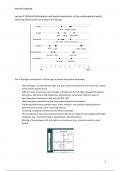
Classifying political parties according to the ideology
This is left/right classification is not enough to analyze the political landscape:
- New cleavages: not only left and right, but also cultural values (Kriesi et al.) and in EU, stance
toward the European Union.
- Different ways of naming a new cleavage, orthogonal to the left-right cleavage: GAL (green,
alternative, libertarian)-TAN (traditional, authoritarian, nationalist). Different ways of
describing these separations! Not only the GAL-TAN
- Libertarian/post-materialist parties favor expanded personal freedoms
- Traditional/authoritarian parties favour order, tradition, and stability, believing that the
government should be a firm moral authority on
- Increasing complexity and diversity of political ideologies.
- The emergence of new issues and movements that do not neatly fit into traditional left-right
categories (e.g., environmentalism, globalization, identity politics).
- Blurring of lines between left and right on certain issues (e.g., economic policies, social
issues).
1
, Hannah Ongenae
Task: analyze two political parties based on the indicators that you choose (justify (!) why you chose
them), needs to be a presentation and not a document.
The origin of public opinion. A slow path toward sophistication, yet media revolutions.
PO= public opinion
The origin of public opinion
Television is the main source of information in almost all countries… Yet, something is changing
(social media is rising)
Overall trend: people are more informed than in the past; with higher cognitive sophistication, higher
knowledge and higher demands. We used to think that people with high education and
income have more trust in institutions (they have more influence on politics for a variety of reasons).
No more automatic, however.
Mobilization and political organizations:
Antonio Gramsci: “Every political mobilisation
without political organisation is subject to fail”
There is always a specific political goal behind
political mobilization.
Why people participate in politics? A brief recap of the theories
If I told you that participating or voting (like any political action) "costs," what comes to mind for
you?
2
Lesson 8: Political Participation and social movements in the contemporary world
Classifying political parties according to the ideology
This is left/right classification is not enough to analyze the political landscape:
- New cleavages: not only left and right, but also cultural values (Kriesi et al.) and in EU, stance
toward the European Union.
- Different ways of naming a new cleavage, orthogonal to the left-right cleavage: GAL (green,
alternative, libertarian)-TAN (traditional, authoritarian, nationalist). Different ways of
describing these separations! Not only the GAL-TAN
- Libertarian/post-materialist parties favor expanded personal freedoms
- Traditional/authoritarian parties favour order, tradition, and stability, believing that the
government should be a firm moral authority on
- Increasing complexity and diversity of political ideologies.
- The emergence of new issues and movements that do not neatly fit into traditional left-right
categories (e.g., environmentalism, globalization, identity politics).
- Blurring of lines between left and right on certain issues (e.g., economic policies, social
issues).
1
, Hannah Ongenae
Task: analyze two political parties based on the indicators that you choose (justify (!) why you chose
them), needs to be a presentation and not a document.
The origin of public opinion. A slow path toward sophistication, yet media revolutions.
PO= public opinion
The origin of public opinion
Television is the main source of information in almost all countries… Yet, something is changing
(social media is rising)
Overall trend: people are more informed than in the past; with higher cognitive sophistication, higher
knowledge and higher demands. We used to think that people with high education and
income have more trust in institutions (they have more influence on politics for a variety of reasons).
No more automatic, however.
Mobilization and political organizations:
Antonio Gramsci: “Every political mobilisation
without political organisation is subject to fail”
There is always a specific political goal behind
political mobilization.
Why people participate in politics? A brief recap of the theories
If I told you that participating or voting (like any political action) "costs," what comes to mind for
you?
2


