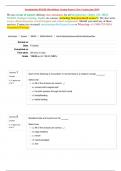
Straighterline BIO250 Microbiology Graded Exam 3 (New Version June 2024)
Question 1 Correct 4.17 points out of 4.17 Each of the following is inoculation of normal biota to a newborn except . Select one: a. All of the choices are correct. b. contact with hospital staff c. the birth process through the birth canal d. breastfeeding e. bottle feeding Question 2 Correct 4.17 points out of 4.17 Resident biota are found in/on the . Select one: a. All of the choices are correct. b. large intestine c. mouth d. nasal passages e. skin Straighterline BIO250 Microbiology Graded Exam 3 (New Version June 2024) We are a team of experts offering class attendance for all Straighterline, Online ATI, HESI, NCLEX, Portage Learning, Sophia etc courses (including final proctored exams!!). We also write essays, discussion posts, research papers and school assignments. Should you need any of these services, Contact us via email: or : +1 (540) 753-5914. Guaranteed Passing! Live Courses | Sciences | BIO250 | BIO250_MH_V6 | Unit 18: Infectious Diseases Affecting the Skin and Eyes Started on State Finished Completed on Time taken 28 mins 21 secs Grade 125.00 out of 125.00 (100%)Question 4 Correct 4.17 points out of 4.17 What is one goal of the Human Microbiome Project? Select one: a. To sequence the DNA of all microorganisms b. To provide comprehensive characterization of microbiota relating to human health and disease c. To study the prevalence of disease d. To elucidate genetically linked diseases e. To study microorganisms in an artificial habitat Question 5 Correct 4.17 points out of 4.17 The membrane attack stage of the complement cascade involves . Select one: a. the production of inflammatory cytokines b. initiation of the cascade c. the cleaving of C3 to yield C3a and C3b d. C1q binding to surface receptors on a membrane e. a ring-shaped protein digesting holes in bacterial cell membranes and virus envelopes Question 3 Correct 4.17 points out of 4.17 Some diseases can cause long-term or permanent damage in the patient termed . Select one: a. edema b. sequelae c. abscesses d. granulomas e. swollen lymph nodesQuestion 7 Correct 4.17 points out of 4.17 The four classic signs and symptoms of inflammation include all of the following except . Select one: a. swelling b. redness c. pain d. chills e. warmth Question 8 Correct 4.17 points out of 4.17 Plasma cells . Select one: a. are derived from T lymphocytes b. function in cell-mediated immunity c. produce and secrete antibodies d. function in blood clotting Question 6 Correct 4.17 points out of 4.17 A person will typically experience the sensation of when fever is starting to occur in the body. Select one: a. pain b. chills c. heat d. sweatingQuestion 10 Correct 4.17 points out of 4.17 During which response to the antigen do we display a latent period of no secretory antibody synthesis? Select one: a. Secondary b. Tertiary c. Primary d. Quaternary Question 11 Correct 4.17 points out of 4.17 Epinephrine . Select one: a. reverses constriction of airways b. causes desensitization c. inhibits the activity of lymphocytes d. is an antihistamine Question 9 Correct 4.17 points out of 4.17 The most abundant class of antibodies in serum is . Select one: a. IgG b. IgD c. IgM d. IgE e. IgAQuestion 13 Correct 4.17 points out of 4.17 High levels of tryptase in the blood is indicative of . Select one: a. high levels of degranulating mast cells suggesting an allergic reaction b. overuse of dietary supplements c. a viral and/or fungal infection d. a bacterial infection Question 14 Correct 4.17 points out of 4.17 Which event occurs with the sensitizing dose of allergen? Select one: a. Prostaglandins causing vasodilation and increased vascular permeability b. Binding of allergen to adjacent IgE binding sites on mast cells and basophils c. Histamine acting on smooth muscle d. Degranulation e. Binding of IgE by the Fc region to mast cells and basophils Question 12 Correct 4.17 points out of 4.17 John, a Peace Corps worker in the country of Mali in Africa, was in a car accident while traveling through a rural area. He was treated at a tiny rural hospital, and due to his loss of blood, he required a transfusion. John has B- blood type and has never received a transfusion before. Which statement is correct regarding this scenario? Select one: a. He can safely receive O- blood even though he makes anti-A antibodies. b. The preferred blood type to give John, in addition to his own B type blood, would be AB. Both types of blood have the B antigen on the cells, so they would correspond to his own antigens. As for Rh, he can receive only Rh- blood since he would have a reaction against Rh+. c. He can be given types O or B, no matter whether Rh- or Rh+. At this point in time, he does not have anti-Rh antibody. O has no antigens on the blood cells, so he is also safe to receive that type in addition to his own B type. d. He can be given A+ blood type in addition to B+. Rh- means that he makes no antibody to Rh.Question 16 Correct 4.17 points out of 4.17 An example of a secondary acquired immunodeficiency is . Select one: a. SCID b. DiGeorge syndrome c. agammaglobulinemia d. AIDS e. adenosine deaminase (ADA) deficiency Question 17 Correct 4.17 points out of 4.17 Human blood types involve all of the following except . Select one: a. inheritance of two of three possible alleles b. genetically determined glycoprotein markers c. genes that code for an enzyme that adds a terminal carbohydrate to RBC receptors d. MHC genes e. ABO antigen markers Question 15 Correct 4.17 points out of 4.17 The potential for hemolytic disease of the newborn occurs when . Select one: a. maternal Rh - cells enter an Rh + fetus b. fetal Rh - cells enter an Rh + mother c. fetal Rh + cells enter an Rh - mother d. maternal Rh + cells enter an Rh - fetus e. fetal Rh + cells enter an Rh + motherQuestion 19 Correct 4.17 points out of 4.17 When minute samples of DNA need to be genetically analyzed for identification purposes, which test can be effectively used? Select one: a. Western Blot b. Weil-Felix reaction c. PCR d. Widal e. Direct fluorescence antibody Question 20 Correct 4.17 points out of 4.17 Urine and fecal specimens require . Select one: a. incubation in selective media b. Both incubation in differential media and incubation in selective media are correct. c. incubation in differential media d. sterile collection conditions e. Both sterile collection conditions and incubation in differential media are correct. Question 18 Correct 4.17 points out of 4.17 An effective test to determine whether an individual is allergic to a specific substance is to . Select one: a. test for levels of IgE specific for the allergen b. inject high levels of the allergen so see if the patient goes into anaphylactic shock c. test for the allergen in the blood d. test for high levels of IgG in the serumQuestion 22 Correct 4.17 points out of 4.17 The ELISA test has been used as the most common, rapid screening test for HIV infection. Its sensitivity is very high but its specificity is rather low (for an important identification test). Which statement describes this accurately? Select one: a. The test can identify the patient's antibody to HIV only when it is large quantities. b. Only certain kinds of instruments can be used to pick up the small amounts of fluorescence given off in the ELISA. c. A false positive test result may develop due to the test antigens capturing normal antibodies. d. The patient's specimen has to be handled in a certain way to maintain the integrity of the viral DNA. Question 23 Correct 4.17 points out of 4.17 Dr. John Doe, a research microbiologist for a university medical center, has been accused of sending Bacillus anthracis, the causative agent of anthrax, through the mail to the President. You, as a public health official with the CDC, have to determine if it is the same strain as the two strains of B. anthracis found cultured in his lab. Which method of identification would you use to compare these three bacterial samples? Select one: a. Gram staining b. Serological testing using agglutination c. Biochemical test identification d. Pulse-field gel electrophoresis Question 21 Correct 4.17 points out of 4.17 Specimen collection . Select one: a. does not require special handling b. is always done by a medical professional c. must be done under sterile conditions d. must utilize aseptic techniquesQuestion 25 Correct 4.17 points out of 4.17 The integument includes all of the following except . Select one: a. sweat glands b. surface capillaries c. hair d. skin e. nails Question 26 Correct 4.17 points out of 4.17 Which of the following is not true of bacterial conjunctivitis? Select one: a. Infection produces a clear discharge from the eye. b. Treatment is with a broad-spectrum topical antibiotic. c. It can be caused by S. pyogenes or S. pneumoniae. d. It can be transmitted through both direct and indirect contact. Question 24 Correct 4.17 points out of 4.17 The environment of human skin requires an adaptation for microbes that can tolerate moderately conditions. Select one: a. alkaline b. thermophilic c. halophilic d. psychrophilic e. anaerobicQuestion 28 Correct 4.17 points out of 4.17 The smallpox vaccine uses the virus. Select one: a. smallpox b. variola c. human herpesvirus 6 d. herpessimplex e. vaccinia Question 29 Correct 4.17 points out of 4.17 Impetigo can be caused by either Staphylococcus aureus or Streptococcus pyogenes. Culture-based identification of the causative organism can be complicated by . Select one: a. their common optimal growth temperature, 37°C b. the ability of S. aureus to kill S. pyogenes c. the fastidious nature of both organisms d. the common surface antigens of these two organisms Question 27 Correct 4.17 points out of 4.17 Eyes are relatively vulnerable to infection because . Select one: a. there is a restricted response by B and T cells b. All of these choices are correct. c. they are not covered by keratinized epithelium d. immune privilege restricts access to the cells conferring innate immunityQuiz navigation Show one page at a time Finish review 1 2 3 4 5 6 7 8 9 10 26 27 28 29 30 © 2023 StraighterLine. All rights reserved Question 30 Correct 4.17 points out of 4.17 Which of the following statements regarding viremia is incorrect? Select one: a. Droplet transmission of viruses like the measles virus results in viremia. b. Shingles is a manifestation of persistent viremia after a course of chicken pox. c. The variola virus multiplies in white blood cells, andcell lysis results in viremia. d. HHV-3is disseminated to the skin by viremia.
Written for
- Institution
-
Straighterline.Com
- Course
-
BIO250
Document information
- Uploaded on
- June 12, 2024
- Number of pages
- 11
- Written in
- 2023/2024
- Type
- Exam (elaborations)
- Contains
- Questions & answers
Subjects
-
straighterline bio250 microbiology graded exam 3

Also available in package deal