Summary #4 the sun is tired
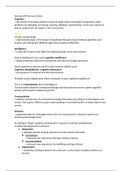
Cognition
= the activity of knowing and the process through which knowledge is acquired to solve
problems by attending, perceiving, learning, thinking, remembering. In this way a person is
able to understand and adapt to the environment.
PIAGET
Genetic epistemology
= experimental study of the origin of knowledge through clinical methods (question and
answer) and seeing how different ages solve problems differently
Intelligence
= a basic life function that helps the individual adapt to the environment
Goal of intelligence is to reach cognitive equilibrium
= balance/harmony between environment and internal thought processes.
Novel experiences that do not fit in with common beliefs cause:
Cognitive disequilibrium /cognitive dissonance
= incongruence in external and internal processes
Prompts mental adjustments which eventually restore cognitive equilibrium.
This is an interactionist idea of intelligence:
The interaction between existing knowledge and external environment sparks cognitive
activity which sparks intellectual growth.
Constructivists
= children actively have to construct knowledge themselves by acting on novel objects and
events. This causes children to gain understanding of essential features of these objects and
events.
Schemes
= organized patterns of thought/action that are constructed to interpret experiences
(enduring knowledge base)
According to Piaget cognitive development is equal to schematic development.
Creation/development of schemes:
o Adaptation
= adapting already existing schemes to environmental demands
Assimilation
= interpret new experience through existing schemes
Accommodation
= interpret new experience by modifying existing schemes
o Organization
= combining existing schemes into a new one, so that more complex schemes are
formed
, Stages of cognitive development
o Invariant developmental sequence
= all children progress through the stages in the same order and cannot be skipped
o Sequence of the stages is fixed
o Stages are universal: characterize children all over the world
The sensorimotor stage (birth-2 years)
Major transition:
Reflexive creatures with limited knowledge reflective &planful problem solvers
Infants coordinate their sensory imput and motor capabilities behavioral schemes (act
on/explore environment)
Such drastic cognitive growth that substage were required
1. Reflex activity (0-1)
= not high intellect, use of reflexes as primitive adaptation, no object permanence
2. Primary circular reactions (1-4)
= discovery of ability to control own bodily movements, repeating satisfying actions
(centered on own body), look at the spot at which an object has disappeared.
3. Secondary circular reactions (4-8)
= repeating satisfying actions focused on external objects, encounter hese interesting
acts by chance (= not fully intentional), partially concealed = object permanence
4. Coordination of secondary circular reactions (8-12)
= first goal orientated/planful behaviors, combination of multiple
responses/schemes, start imprecise imitation that requires much repetition, some
searching for concealed objects (incomplete object permanence); A not B error
(search for an object where it was found not where it was hidden), idea that object
location depends on child’s behavior.
Tertiary circular reactions (12-18)
= exploratory schemes, trial and error/experimenting, curiosity, motivation to learn,
deferred imitation (after model leaves; requires mental representation), understands
visible displacements in object permanence, systematic imitation.
5. Symbolic problem solving (18-24)
= mental experimentation/symbolic thought/problem-solving, internalize behavioral
schemes, complete object concept (also Invisible displacement), imitation of complex
behavioral sequences.
Criticism sensorimotor stage
x Underestimates children’s cognitive development
x Opposing theories
Neo-nativism
Infants are born with innate knowledge (e.g.; object permanence/understanding of
arithmetic/violate cognitive laws surprise in babies) due to genetic heritage
Theory-theories
Cognition
= the activity of knowing and the process through which knowledge is acquired to solve
problems by attending, perceiving, learning, thinking, remembering. In this way a person is
able to understand and adapt to the environment.
PIAGET
Genetic epistemology
= experimental study of the origin of knowledge through clinical methods (question and
answer) and seeing how different ages solve problems differently
Intelligence
= a basic life function that helps the individual adapt to the environment
Goal of intelligence is to reach cognitive equilibrium
= balance/harmony between environment and internal thought processes.
Novel experiences that do not fit in with common beliefs cause:
Cognitive disequilibrium /cognitive dissonance
= incongruence in external and internal processes
Prompts mental adjustments which eventually restore cognitive equilibrium.
This is an interactionist idea of intelligence:
The interaction between existing knowledge and external environment sparks cognitive
activity which sparks intellectual growth.
Constructivists
= children actively have to construct knowledge themselves by acting on novel objects and
events. This causes children to gain understanding of essential features of these objects and
events.
Schemes
= organized patterns of thought/action that are constructed to interpret experiences
(enduring knowledge base)
According to Piaget cognitive development is equal to schematic development.
Creation/development of schemes:
o Adaptation
= adapting already existing schemes to environmental demands
Assimilation
= interpret new experience through existing schemes
Accommodation
= interpret new experience by modifying existing schemes
o Organization
= combining existing schemes into a new one, so that more complex schemes are
formed
, Stages of cognitive development
o Invariant developmental sequence
= all children progress through the stages in the same order and cannot be skipped
o Sequence of the stages is fixed
o Stages are universal: characterize children all over the world
The sensorimotor stage (birth-2 years)
Major transition:
Reflexive creatures with limited knowledge reflective &planful problem solvers
Infants coordinate their sensory imput and motor capabilities behavioral schemes (act
on/explore environment)
Such drastic cognitive growth that substage were required
1. Reflex activity (0-1)
= not high intellect, use of reflexes as primitive adaptation, no object permanence
2. Primary circular reactions (1-4)
= discovery of ability to control own bodily movements, repeating satisfying actions
(centered on own body), look at the spot at which an object has disappeared.
3. Secondary circular reactions (4-8)
= repeating satisfying actions focused on external objects, encounter hese interesting
acts by chance (= not fully intentional), partially concealed = object permanence
4. Coordination of secondary circular reactions (8-12)
= first goal orientated/planful behaviors, combination of multiple
responses/schemes, start imprecise imitation that requires much repetition, some
searching for concealed objects (incomplete object permanence); A not B error
(search for an object where it was found not where it was hidden), idea that object
location depends on child’s behavior.
Tertiary circular reactions (12-18)
= exploratory schemes, trial and error/experimenting, curiosity, motivation to learn,
deferred imitation (after model leaves; requires mental representation), understands
visible displacements in object permanence, systematic imitation.
5. Symbolic problem solving (18-24)
= mental experimentation/symbolic thought/problem-solving, internalize behavioral
schemes, complete object concept (also Invisible displacement), imitation of complex
behavioral sequences.
Criticism sensorimotor stage
x Underestimates children’s cognitive development
x Opposing theories
Neo-nativism
Infants are born with innate knowledge (e.g.; object permanence/understanding of
arithmetic/violate cognitive laws surprise in babies) due to genetic heritage
Theory-theories