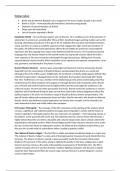
Polyclonal Antibodies Monoclonal Antibodies
• Heterogenous population of differing • Homogenous population of a
immunoglobulin molecules / antibodies specific antibody with one para
with differing paratopes for an antigen produced by a single clone of
• Interact with different epitopes on the plasma B cells
same antigen • Interact with a particular epitop
• Higher likelihood for background noise an antigen
• Quick to produce, inexpensive to • Low background noise
develop, with many hose species options
• Slow to produce, expensive to
• Higher overall affinity against the
antigen, due to the recognition of
develop and few host species o
multiple epitopes • Superior for use in detecting a
• High chance of cross-reactivity protein
• Low chance of cross-reactivity
• Heterogenous population of differing • Homogenous population of a
immunoglobulin molecules / antibodies specific antibody with one para
with differing paratopes for an antigen produced by a single clone of
• Interact with different epitopes on the plasma B cells
same antigen • Interact with a particular epitop
• Higher likelihood for background noise an antigen
• Quick to produce, inexpensive to • Low background noise
develop, with many hose species options
• Slow to produce, expensive to
• Higher overall affinity against the
antigen, due to the recognition of
develop and few host species o
multiple epitopes • Superior for use in detecting a
• High chance of cross-reactivity protein
• Low chance of cross-reactivity