NPTEFF2 Exam Questions with Correct Answers.docx
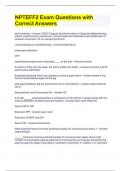
NPTEFF2 Exam Questions with Correct A sick syndrome - Answer-"SICK" Scapula Syndrome refers to Scapular Malpositioning, Inferior medial border prominence, Coracoid pain and malposition and DysKinesis of scapular movement. It's an overuse Syndrome contraindications to trendelenberg - Answer-hiatal hernia pulmonary embolism CHF superficial peroneal nerve innervates of the foot - Answer-evertors if evertors of the foot are weak, the foot is pulled into what? - Answer-inversion and PF (equinovarus deformity) Superficial peroneal nerve has cutaneous nerve supply where - Answer-dorsal of the foot and anterolateral aspect of the leg web space between big toe and second toe is innervated by - Answer-deep personal nerve deep perineal nerve innervates the - Answer-DF A pt with would experience a contracture of the intrinsic muscles along with the dorsal subluxation of lateral extensor tendons - Answer-swan neck deformity Flexion MCP, DIP Extension PIP - Answer-swan neck Extension of MCP and DIP flexion PIP - Answer-boutonniere What humeral fracture must be examined quickly for neuromuscular status ? - Answer- supracondylar to assess growth plate as well as these fractures have a high incidence of malunion - Answer-Supracondylar Causes of ITB friction syndrome in bikers - Answer-excessive bike seat height cleats ER on the pedal (tibia IR resulting in a valgus force on the knee) adrenal insufficiency leads to a decrease in - Answer-cortisol and aldosterone lack of cortisol can lead to the patient developing what disease - Answer-addison's Addison's disease causes and - Answer-hypoglycemia and hypotension syncope or fainting spells can commonly occur in its with disease - Answer- addison's aldosterone is responsible for rentension - Answer-sodium these symptoms are expected in disease hyponatremia hypoglycemia syncope hypotension fatigue muscle weakness - Answer-Addison's disease Pelvic drop on L side when pt is standing on R leg. MMT for hip abduction is 2+ on the weaker LE Correct placement, spacing and sensitivity of electrodes to initiate the biofeedback - Answer-place on R glut med Widely spaced High sensitivity Biofeedback for tight/spasm muscle - Answer-close together low sensitivity Can a PTA write progress notes? - Answer-no Can PTA set new goals? - Answer-No can PTA change the POC - Answer-no Can PTA re-evaluate - Answer-no Can PTA document changes in the daily note - Answer-yes a pneumothorax pushes the trachea to the - Answer-contralateral side massive atelectasis will pull the trachea to the - Answer-ipsilateral side Stage as the patient doesn't experience any changes of swelling during arm elevation and initial signs of fibrotic changes are present during this stage. Lymphedema - Answer-2 Stage is reversible lymphedema and elevation of the arm will reduce swelling - Answer-1 Stage is lymphostatic elephantiasis, hardening of dermal tissues, papilloma's of the skin will be noticed - Answer-3 Stage patient begins to feel heaviness in limbs. - Answer-0 (preclinical stage), is pregnancy induced hypertension and is an absolute contraindication to exercise during pregnancy. - Answer-Pre-eclampsia For diagnostic purposes, what is the recommended number of chest radiographs to be performed on a patient when standard radiographs are ordered for a patient with suspected pulmonary pathologies? - Answer-2 radiographs, in a posterior-anterior standing view and a left lateral view (unless the pathology is suspected on the right side) is breathlessness or SOB caused with sitting, which is relieved on lying down in supine position - Answer-Platypnea Patients with CHF generally have , which is difficulty breathing while lying supine and relieved when sitting up. - Answer-orthopnea Symptoms of: edema, ascites, frothy sputum, orthopnea - Answer-CHF hydrotherapy to strengthen LE, how can they increase resistance to knee movements? - Answer-add paddles for the feet Patients usually present with dyspnea on exertion that becomes progressive. They may develop nonspecific chest discomfort; sometimes the chest pain is pleuritic, which is a sharp, stabbing pain exacerbated by coughing or breathing that changes with position. Other symptoms characteristic of the underlying cause of pleural effusion may be the primary clinical picture (e.g., weight loss and fever with TB or cancer or signs of heart failure). Tachycardia, distant heart sounds, fixed jugular venous distention, edema of the extremities, and a paradoxical pulse may also be observed. - Answer-Pleural effusion Treatment force of lumbar traction for disc protrusion is - Answer-25 percent BWT in prone position Traction For joint distraction it is . - Answer-50 percent BWT in prone causes flattened or inverted T waves in the ECG. - Answer-Hypokalemia are diuretics which can cause excessive loss of what? - Answer-potassium leading to hypokalemia eyes open to pain incomprehensible sounds no movement in limbs in response to pain - Answer-eyes to pain: 2 incomprehensible sounds: 2 no movement: 1 =5/15 A Physical Therapist is educating a Physical Therapy Student on special tests and states that if the test result is negative then you can be certain the patient does not have the condition. Which of the following diagnostic characteristics MOST closely aligns with this description - Answer-Sensitivity IV/EV occur at the joint - Answer-subtalar medial glide at the subtalar joint improves what - Answer-eversion During which of the following three phases of gait will 0 degrees of knee extension be MOST beneficial for? - Answer-IC, end of terminal stance, end of terminal swing CRPS type with a confirmed nerve injury - Answer-2 CRPS type without a confirmed nerve injury - Answer-1 is associated with contralateral hemiparesis of face and extremities and ipsilateral nystagmus. - Answer-Medial inferior pontine syndrome if there is a lesion to CN medial strabismus of ipsilateral eye is observed - Answer-6 Patient presents with a hyperlordotic curve, retracted bilateral shoulder blades and displaced plumb line. Pelvic alignment? - Answer-Counternutation with an anterior pelvic tilt patient will often report difficulty with performing ADLs including rolling in bed and sit to stands. More common in F over 70 - Answer-Polymyalgia Rheumatica which gland is responsible for secretion of TSH hormone? - Answer-Thyroid Elevated TSH is an indicator of what - Answer-hypothyroidism
Geschreven voor
- Instelling
- NPTEFF2
- Vak
- NPTEFF2
Documentinformatie
- Geüpload op
- 11 juni 2024
- Aantal pagina's
- 13
- Geschreven in
- 2023/2024
- Type
- Tentamen (uitwerkingen)
- Bevat
- Vragen en antwoorden
Onderwerpen
- npteff2
- npteff2 exam questions
-
npteff2 exam questions with correct answers
Ook beschikbaar in voordeelbundel