01 . AGGREGATE DEMAND
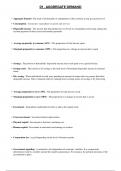
• Aggregate demand : The total of all demands or expenditures in the economy at any given price level
• Consumption : Consumers' expenditure on goods and services
• Disposable income : The income that households have to devote to consumption and saving, taking into
account payment of direct taxes and transfer payments
• Average propensity to consume (APC) : The proportion of total income spent.
• Marginal propensity to consume (MPC) : The proportion of a change in income that is spent
• Savings : The portion of households’ disposable income that is not spent over a period of time
• Savings ratio : The total level of savings to the total level of household disposable income in nominal
terms
• Dis- saving : When individuals in total were spending an amount of money that was greater than their
disposable income. This is nanced either by running down existing stocks of savings or by borrowing
• Average propensity to save (APS) : The proportion of total income saved.
• Marginal propensity to save (MPS) : The proportion of a change in income that is saved
• Investment : Expenditure undertaken by rms to add to the capital stock
• Gross investment : Investment before depreciation
• Physical capital : Investment in factories, machinery etc
• Human capital : Investment in education and training on workers
• Corporation tax : is paid depending on the level of business pro ts
• Government spending : is assumed to be independent of economic variables. It is exogenously
determined, xed by variables outside the model (autonomous). For instance, by political decisions of the
government in place
fi fi fi fi
, 02 . AGGREGATE SUPPLY
• Short run : Time period in which at least one factor of production is xed
(eg: land, capital). Labour is considered to be variable in the short- run
• Spare capacity (Output gap) : Where there are unemployed resources in an
economy.
• Productivity : The output per unit of input employed
• Labour productivity : The output per worker (GDP per hour worked)
• Capital productivity : The output per unit of capital employed
fi
• Aggregate demand : The total of all demands or expenditures in the economy at any given price level
• Consumption : Consumers' expenditure on goods and services
• Disposable income : The income that households have to devote to consumption and saving, taking into
account payment of direct taxes and transfer payments
• Average propensity to consume (APC) : The proportion of total income spent.
• Marginal propensity to consume (MPC) : The proportion of a change in income that is spent
• Savings : The portion of households’ disposable income that is not spent over a period of time
• Savings ratio : The total level of savings to the total level of household disposable income in nominal
terms
• Dis- saving : When individuals in total were spending an amount of money that was greater than their
disposable income. This is nanced either by running down existing stocks of savings or by borrowing
• Average propensity to save (APS) : The proportion of total income saved.
• Marginal propensity to save (MPS) : The proportion of a change in income that is saved
• Investment : Expenditure undertaken by rms to add to the capital stock
• Gross investment : Investment before depreciation
• Physical capital : Investment in factories, machinery etc
• Human capital : Investment in education and training on workers
• Corporation tax : is paid depending on the level of business pro ts
• Government spending : is assumed to be independent of economic variables. It is exogenously
determined, xed by variables outside the model (autonomous). For instance, by political decisions of the
government in place
fi fi fi fi
, 02 . AGGREGATE SUPPLY
• Short run : Time period in which at least one factor of production is xed
(eg: land, capital). Labour is considered to be variable in the short- run
• Spare capacity (Output gap) : Where there are unemployed resources in an
economy.
• Productivity : The output per unit of input employed
• Labour productivity : The output per worker (GDP per hour worked)
• Capital productivity : The output per unit of capital employed
fi