Exam 4 N332: wong ch 27, 29, 30
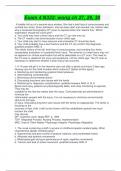
A toddler fell out of a second-story window. She had a brief loss of consciousness and vomited four times. Since admission, she has been alert and oriented. Her mother asks why a computed tomography (CT) scan is required when she "seems fine." Which explanation should the nurse give? a. Your child may have a brain injury and the CT can rule one out. b. The CT needs to be done because of your child's age. c. Your child may start to have seizures and a baseline CT should be done. d. Your child probably has a skull fracture and the CT can confirm this diagnosis. - qualified answers ANS: A The child's history of the fall, brief loss of consciousness, and vomiting four times necessitates evaluation of a potential brain injury. The severity of a head injury may not be apparent on clinical examination but will be detectable on a CT scan. The need for the CT scan is related to the injury and symptoms, not the child's age. The CT scan is necessary to determine whether a brain injury has occurred. 1. A 14-year-old girl is in the intensive care unit after a spinal cord injury 2 days ago. Nursing care for this child includes which action(s)? (Select all that apply.) a. Monitoring and maintaining systemic blood pressure b. Administering corticosteroids c. Minimizing environmental stimuli d. Discussing long-term care issues with the family e. Monitoring for respiratory complications -qualified answers ANS: A, B, E Spinal cord injury patients are physiologically labile, and close monitoring is required. They may be unstable for the first few weeks after the injury. Corticosteroids are administered to minimize the inflammation present with the injury. It is not necessary to minimize environmental stimuli for this type of injury. Discussing long-term care issues with the family is inappropriate. The family is focusing on the recovery of their child. It will not be known until the rehabilitation period how much function the child may recover. DIF: Cognitive Level: Apply REF: p. 1000 TOP: Integrated Process: Nursing Process: Implementation MSC: Area of Client Needs: Physiologic Integrity: Physiologic Adaptation 1. The nurse is planning a staff in-service on childhood spastic cerebral palsy. What characterizes spastic cerebral palsy? a. Hypertonicity and poor control of posture, balance, and coordinated motion b. Athetosis and dystonic movements c. Wide-based gait and poor performance of rapid, repetitive movements d. Tremors and lack of active movement -qualified answers ANS: A Hypertonicity and poor control of posture, balance, and coordinated motion are part of the classification of spastic cerebral palsy. Athetosis and dystonic movements are part of the classification of dyskinetic (athetoid) cerebral palsy. Wide-based gait and poor performance of rapid, repetitive movements are part of the classification of ataxic cerebral palsy. Tremors and lack of active movement may indicate other neurologic disorders. DIF: Cognitive Level: Understand REF: p. 978 TOP: Integrated Process: Teaching/Learning MSC: Area of Client Needs: Physiologic Integrity: Physiologic Adaptation 10. Latex allergy is suspected in a child with spina bifida. Appropriate nursing interventions include which action? a. Avoid using any latex product. b. Use only nonallergenic lat
Written for
- Institution
- 4N332: wong ch 27, 29, 30
- Module
- 4N332: wong ch 27, 29, 30
Document information
- Uploaded on
- June 10, 2024
- Number of pages
- 33
- Written in
- 2023/2024
- Type
- Exam (elaborations)
- Contains
- Questions & answers
Subjects
-
exam 4 n332 wong ch 27 29 30

Also available in package deal