

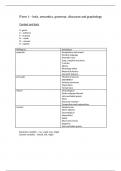
lTerm 1 – lexis, semantics, grammar, discourse and graphology
Context and lexis
G- genre
A – audience
P – purpose
M – mode
M – manner
R – register
Writing to… techniques
entertain Exclamatory verb mood
Emotive language
Dramatic irony
Long, complex structures
5 senses
Idioms
Phonology effect
Rhetorical devices
Semantic features
persuade Rhetorical devices
DAFORREST
Inclusive pronouns
Imperatives
Formal tone
inform Chronological
Easily navigated format
Lists and bullet points
Short
Discourse markers
Connectives and conjunctions
insrtuct Simple terms
Direct address
Chronological
Imperatives
Detail
Short and concise
Diagrams
Lists and bullet points
Epistemic modality – can, could, may, might
Deontic modality – should, will, might
, Lexis and semantics
How to analyse: Old English/German lexis are more common
Context >> lexis >> semantics >> e.g come, ask, buy
grammar >> syntax >> discourse >>
graphology French/Latin lexis are more sophisticated
e.g arrive, request, acquire
Inventing new words :
Borrow from other languages
Adapt existing words
Eponym – named after person
Propriety/proper names – given by an organisation Acronyms – letters that
Analogy – basing off of similar logic sound like a word = LOL
Neologism/coinage – completely new word or expression Initialism – letters sound
phonetically = DVD
Reusing words Archaic – no longer
Before root word = prefixes current/applicable
After root word = suffixes Obsolete – no longer have a
Changing a word without adding a suffix = conversion use
Combining 2 separate words = compounding
Shortening words or phrases = clipping
Remembered imagined affix = back formation
Fusing to make new words = blending Remember
-who wrote it
-secondary/primary purpose
-intentions
Semantic change -audience
-influence
Sematic change – a word’s meaning changes
Amelioration – develop positive connotations
Pejoration – develop negative connotation
Broadening – word acquires more meaning than before
Narrowing – a word acquires a more specific meaning
Free morpheme = stand alone with a meaning
Bound morpheme = can’t stand alone
Polysemic – words with a range of meanings
Collocation – words that go together nicely
Denotation – dictionary definition of a word
Connotation – emotional association and symbolic meaning
Hypernym – broad category
Hyponym – links of words
Context and lexis
G- genre
A – audience
P – purpose
M – mode
M – manner
R – register
Writing to… techniques
entertain Exclamatory verb mood
Emotive language
Dramatic irony
Long, complex structures
5 senses
Idioms
Phonology effect
Rhetorical devices
Semantic features
persuade Rhetorical devices
DAFORREST
Inclusive pronouns
Imperatives
Formal tone
inform Chronological
Easily navigated format
Lists and bullet points
Short
Discourse markers
Connectives and conjunctions
insrtuct Simple terms
Direct address
Chronological
Imperatives
Detail
Short and concise
Diagrams
Lists and bullet points
Epistemic modality – can, could, may, might
Deontic modality – should, will, might
, Lexis and semantics
How to analyse: Old English/German lexis are more common
Context >> lexis >> semantics >> e.g come, ask, buy
grammar >> syntax >> discourse >>
graphology French/Latin lexis are more sophisticated
e.g arrive, request, acquire
Inventing new words :
Borrow from other languages
Adapt existing words
Eponym – named after person
Propriety/proper names – given by an organisation Acronyms – letters that
Analogy – basing off of similar logic sound like a word = LOL
Neologism/coinage – completely new word or expression Initialism – letters sound
phonetically = DVD
Reusing words Archaic – no longer
Before root word = prefixes current/applicable
After root word = suffixes Obsolete – no longer have a
Changing a word without adding a suffix = conversion use
Combining 2 separate words = compounding
Shortening words or phrases = clipping
Remembered imagined affix = back formation
Fusing to make new words = blending Remember
-who wrote it
-secondary/primary purpose
-intentions
Semantic change -audience
-influence
Sematic change – a word’s meaning changes
Amelioration – develop positive connotations
Pejoration – develop negative connotation
Broadening – word acquires more meaning than before
Narrowing – a word acquires a more specific meaning
Free morpheme = stand alone with a meaning
Bound morpheme = can’t stand alone
Polysemic – words with a range of meanings
Collocation – words that go together nicely
Denotation – dictionary definition of a word
Connotation – emotional association and symbolic meaning
Hypernym – broad category
Hyponym – links of words


