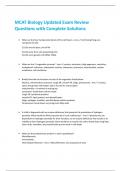
MCAT Biology Updated Exam Review Questions with Complete Solutions
What are the four fundamental tenets of the cell theory - Ans1) All living things are composed of cells 2) Cells are the basic unit of life 3) Cells arise from only preexisting cells 4) Cells carry genetic info (DNA +RNA) What are the 11 organelles to know? - Ansnucleus, nucleolus, Golgi apparatus, centrioles, endoplasmic reticulum, endocytotic vesicles, ribosomes, lysosomes, mitochondria, nuclear membrane, cell membrane Briefly Describe the functions of each of the organelles listed below: Nucleus, mitochondria, lysosome, rough ER, smooth ER, Golgi, peroxisomes - Ansnucleus: stores the genetic information and is the site for transcription mitochondria: is involved in making atp Lysosomes: break down cellular waste rough ER: synthesize proteins smooth ER: lipid synthesis and detoxification Golgi: packages, modifies, and distributes cellular products Peroxisomes: break down very long chain fatty acids A child is diagnosed with an enzyme deficiency that prevents the production of hydrogen peroxide. What would the likely outcome be of such a deficiency? - Ansperoxisomes are dependent on hydrogen peroxide for their functions, so an enzyme deficiency that results in an inability to form hydrogen peroxide, there would be no way for the cell to break down long fatty chain acids. therefore, they would build up and result in cell death What are the predominant proteins in each cytoskeleton? Microfilaments microtubules intermediate filaments - AnsMicrofilaments: are composed of actin Microtubules: composed of tubulin Intermediate Filaments: keratin, desmin, vimentin, and Lamins How do the Cytoskeleton structures of centrioles and flagella differ? - Anscentrioles consist of nine triplets of microtubules around a hollow center flagella consist of nine doublets on the outside, with two microtubules on the inside Classify each of the following cells as epithelial cells or connective tissue: - Fibroblasts, which produce collagen in a number of organs - endothelial cells, which line blood vessels - alpha cells, which produce glucagon in the pancreas - osteoblasts, which produces osteoid, the material that hardens into bone - chondroblasts, which produce cartilage - Ansendothelial and alpha cells are epithelial cells fibroblasts, osteoblasts, and chondroblasts are connective tissue cells In what ways are Archaea similar to bacteria? - AnsArchaea are similar to bacteria in that both are single-celled organisms that lack a nucleus or membrane-bound organelles, contain a single circular chromosome, divide by binary fission or budding, and overall share a similar structure In what ways are Archaea similar to eukaryotes? - AnsStart translation with methionine, contain similar RNA polymerases, and associate their DNA with histones What are the three common shapes of bacteria? - AnsRod shaped, spherical, spiral What difference between the envelopes of gram-positive and gram-negative bacteria make gram-positive bacteria more susceptible to antibiotics such as penicillin? - AnsThe antibiotic penicillin targets the enzyme that catalyzes the cross-linking of peptidoglycan. Gram positive have a thick layer of peptidoglycan and lipoteichoic acid, and contain no outer membrane, whereas gram negative bacteria have only a thin layer of peptidoglycan but also have an outer membrane. How do the structures of eukaryotic and prokaryotic flagella differ? - AnsEukaryotic flagella contain microtubules composed of tubulin whereas bacterial flagella are made of flagellin and consist of a filament, basal body, and a hook
Written for
- Institution
- MCAT Biology
- Course
- MCAT Biology
Document information
- Uploaded on
- June 10, 2024
- Number of pages
- 5
- Written in
- 2023/2024
- Type
- Exam (elaborations)
- Contains
- Questions & answers
Subjects
-
mcat biology updated exam review questions with co

Also available in package deal