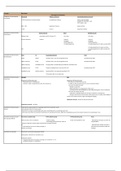
Concepts Description
Intercorporate Investments
Categories of intercorporate Ownership Degree of influence Accounting treatment (current)
investments
< 20% (Investment in financial assets) No significant influence Held to maturity (debt)
Available for sale (debt + eqt)
FVTPL (debt + eqt)
20% ‐ 50% Significant influence Equity method
> 50% Control Acquisition method
Investment in financial assets ‐ Held‐to‐maturity FVTPL Available‐for‐sale
Classification
Balance sheet ‐ Amortised cost (PV of future CF) ‐ Fair value ‐ Fair value
Income statement ‐ Interest ‐ Interest; ‐ Interest;
‐ Dividend; ‐ Dividend;
‐ Realised gain/loss ‐ Realised gain/loss
‐ Unrealised gain/loss ‐ Unrealised gain/loss for debt securities (IFRS)
‐ Unrealised gain/loss for equity securities
OCI ‐ Unrealised gain/loss for debt securities (US
GAAP)
investment in financial assets ‐ From To Accounting treatment Note
Reclassification
FVTPL Others Unrealisd Gain / Loss are recognised into PL Permitted under IFRS
Held to maturity FVTPL Unrealisd Gain / Loss are recognised into PL Permitted under IFRS
Held to maturity Available for sale Carrying value is remeasured @ FV, difference recorded in OCI
Available for sale FVTPL Transfer unrealised Gain / Loss from OCI to PL Permitted under IFRS
Available for sale Held to maturity Amortised Gain / Loss previosly recorded in OCI
*All transfers @ FV on transfer date
Investment in financial assets ‐ US GAAP IFRS
Impairment
Impairment of financial assets Impairment of financial assets
‐ Recovered value < carrying value ‐ If at least 1 loss event has occurred
‐ Decline in value is expected to be other than temporary ‐ its effect on the security's future CF can be estimated reliably
‐ Loss event for debt securities :
+ default on payment;
+ likely bankruptcy or reorganisation of the issuer
+ concessions from the bondholders (credit rating downgrade is not an indication)
‐ Loss event for equity securities :
+ substantial / extended decline of security's FV below its carrying value
+ change in the business environment of the equity issuers → equity value unlikely to
recover to its initial cost (econ, legal, technological changes)
Impairment reversal ‐ permit for debt securities only
Impairment reversal ‐ not allow
Investment in financial assets ‐ ‐ Important to separate the firm's operating results from investment results
Analysis ‐ Using market value for financial assets
‐ Necessary to remove non‐operating assets when calculating return on operating assets ratio
‐ Must assess the effects of investment classification on reported performance. Might be misleading because of inconsistent treatment of unrealised gain / loss
investment in financial assets ‐ Amortised cost (Debt only) FVTPL (Debt & Equity) FVTOCI (Debt & Equity) Note :
New standard IFRS 09
Debt securities, meet 2 conditions: ‐ Held for trading Similar with available for sale ‐ Reclassificatin of equity securities are
‐ Accounting @ amortised cost results in not permitted
‐ Business model test: held to collect contractual accounting mismatch
CF ‐ Reclassification of debt securities is
‐ CF characteristic test: CF are either principal, or permitted only if business model has
interest on principal changed
Investment in associates Investment is accounted using equity method
Initial period: Investment is recorded at cost
Subsequent periods :
‐ Proportionate share of investee's earnings : Dr. Investment ‐ Cr. PL
‐ Dividend received : Cr. Investment
, Investment in associates ‐ US GAAP : FV of investment < carrying value; decline is considered permanent → wri en down to FV
Impairment IFRS : One or more loss event → wri en down to FV
Loss is recorded in PL
No written‐up is permitted under both IFRS and US GAAP
Investment in associates ‐ Profit from these transactions must be deffered until the profit is confirmed through use / sale to 3rd party
Transaction with the investee
Investment in associates ‐ ‐ should consider the appropriateness of the equity method
Analytical issues ‐ Equity method ignore investee's debt → lower leverage
‐ Proportionate share of investee's earnings is recorded in investor's PL, but might not be available to the investor in form of CF
Business combination IFRS : no differentiate
US GAAP
‐ Merger : A absorb B ; B cease to exist
‐ Acquisition : Parent‐subsidiary relationship
‐ Consolidation : New entity absorb both A & B
Acquisition method is required both under IFRS and US GAAP.
Own < 100% → NCI
Goodwill Full goodwill = Purchase price ‐ FV of Net indentifiable assets of Sub
Partial goodill (IFRS only) = Purchase price ‐ % owned × FV of net indentifiable assets of Sub = % owned × full goodwill
Goodwill ‐ Impairment IFRS ‐ Single step approach US GAAP ‐ Two steps approach
Recoverable amount < carrying amount of CGU → impairment FV < carrying value of CGU → impairment
Goodwill impairment loss = Carrying value of Sub ‐ FV of Sub Goodwill impairment loss = Carrying value of GW ‐ Implied FV of GW
Implied FV of GW = New FV of Sub ‐ New FV of Sub's net asset
Impairment loss is recorded in PL
Impairment loss is recorded in PL
Non‐controlling interest Full goodwill : NCI = %NCI × FV of Sub
Partial goodwill : NCI = %NCI × FV of acquired company's identifiable net assets
Joint venture US GAAP and IFRS require equity method
In rare circumstances, propotionate consolidation may be allowed (only report % of assets, liabilities, revenue and expenses of the JV)
Special purpose entities (SPE) / VIE has one or both of the following characteristics :
Variable Interest Entities (VIE) 1. At‐risk equity that is insufficient o finance the entity's activities without additional financial support
2. Equity investors that lack any one of the following:
‐ Decision making rights
‐ Obligation to absorb expected losses
‐ Right to receive expectd residual returns
SPE is considered a VIE → must be consolidated by the parent company
Contigent assets / liabilities IFRS US GAAP
‐ Only contingent liabilities ‐ FV can be measured reliably @ acquisition ‐ Contractual assets / liabilities : recorded @ FV @ acquisition date
‐ Subsequent period : Contingent liabilities ‐ higher of initially recorded value and best ‐ Non‐contratual assets / liabilities : recorded of "more likely than not" meet the definition
amount needed to settle the liabilities of assets / liabilities
‐ Contingent assets are never recognised ‐ Subsequent periods
+ liabilities : similar with IFRS
+ assets : lower of initial value and estiate of future settlement amount
Contigent consideration E.g.: extra amount to be paid to former shareholders of Sub if certain earnings are met
Recorded as assets / liabilities / equity both under IFRS and US GAAP
Subsequent changes recorded in PL, unless the value is originally recorded in equity
In‐process R&D Capitalised as intangible assets
Subsequently amortised (if successful) ; or impaired (if fail)
Restructuring costs Expensed when incurred
Effects of Equity method, 1. Same net income
proportionate consolidation 2. Equity method and proportionate consoidation method : same equity. Acquisition method : higher equity due to NCI
methodm and acquisition method 3. Acquisition method assets & liabilities > Proportionate consolidaiton method assets & liabilities > Equity method assets & liabilities
4. Acquisition method revenue & expenses > Proportionate consolidation method revenue & expenses > Equity method revenue & expenses
Intercorporate Investments
Categories of intercorporate Ownership Degree of influence Accounting treatment (current)
investments
< 20% (Investment in financial assets) No significant influence Held to maturity (debt)
Available for sale (debt + eqt)
FVTPL (debt + eqt)
20% ‐ 50% Significant influence Equity method
> 50% Control Acquisition method
Investment in financial assets ‐ Held‐to‐maturity FVTPL Available‐for‐sale
Classification
Balance sheet ‐ Amortised cost (PV of future CF) ‐ Fair value ‐ Fair value
Income statement ‐ Interest ‐ Interest; ‐ Interest;
‐ Dividend; ‐ Dividend;
‐ Realised gain/loss ‐ Realised gain/loss
‐ Unrealised gain/loss ‐ Unrealised gain/loss for debt securities (IFRS)
‐ Unrealised gain/loss for equity securities
OCI ‐ Unrealised gain/loss for debt securities (US
GAAP)
investment in financial assets ‐ From To Accounting treatment Note
Reclassification
FVTPL Others Unrealisd Gain / Loss are recognised into PL Permitted under IFRS
Held to maturity FVTPL Unrealisd Gain / Loss are recognised into PL Permitted under IFRS
Held to maturity Available for sale Carrying value is remeasured @ FV, difference recorded in OCI
Available for sale FVTPL Transfer unrealised Gain / Loss from OCI to PL Permitted under IFRS
Available for sale Held to maturity Amortised Gain / Loss previosly recorded in OCI
*All transfers @ FV on transfer date
Investment in financial assets ‐ US GAAP IFRS
Impairment
Impairment of financial assets Impairment of financial assets
‐ Recovered value < carrying value ‐ If at least 1 loss event has occurred
‐ Decline in value is expected to be other than temporary ‐ its effect on the security's future CF can be estimated reliably
‐ Loss event for debt securities :
+ default on payment;
+ likely bankruptcy or reorganisation of the issuer
+ concessions from the bondholders (credit rating downgrade is not an indication)
‐ Loss event for equity securities :
+ substantial / extended decline of security's FV below its carrying value
+ change in the business environment of the equity issuers → equity value unlikely to
recover to its initial cost (econ, legal, technological changes)
Impairment reversal ‐ permit for debt securities only
Impairment reversal ‐ not allow
Investment in financial assets ‐ ‐ Important to separate the firm's operating results from investment results
Analysis ‐ Using market value for financial assets
‐ Necessary to remove non‐operating assets when calculating return on operating assets ratio
‐ Must assess the effects of investment classification on reported performance. Might be misleading because of inconsistent treatment of unrealised gain / loss
investment in financial assets ‐ Amortised cost (Debt only) FVTPL (Debt & Equity) FVTOCI (Debt & Equity) Note :
New standard IFRS 09
Debt securities, meet 2 conditions: ‐ Held for trading Similar with available for sale ‐ Reclassificatin of equity securities are
‐ Accounting @ amortised cost results in not permitted
‐ Business model test: held to collect contractual accounting mismatch
CF ‐ Reclassification of debt securities is
‐ CF characteristic test: CF are either principal, or permitted only if business model has
interest on principal changed
Investment in associates Investment is accounted using equity method
Initial period: Investment is recorded at cost
Subsequent periods :
‐ Proportionate share of investee's earnings : Dr. Investment ‐ Cr. PL
‐ Dividend received : Cr. Investment
, Investment in associates ‐ US GAAP : FV of investment < carrying value; decline is considered permanent → wri en down to FV
Impairment IFRS : One or more loss event → wri en down to FV
Loss is recorded in PL
No written‐up is permitted under both IFRS and US GAAP
Investment in associates ‐ Profit from these transactions must be deffered until the profit is confirmed through use / sale to 3rd party
Transaction with the investee
Investment in associates ‐ ‐ should consider the appropriateness of the equity method
Analytical issues ‐ Equity method ignore investee's debt → lower leverage
‐ Proportionate share of investee's earnings is recorded in investor's PL, but might not be available to the investor in form of CF
Business combination IFRS : no differentiate
US GAAP
‐ Merger : A absorb B ; B cease to exist
‐ Acquisition : Parent‐subsidiary relationship
‐ Consolidation : New entity absorb both A & B
Acquisition method is required both under IFRS and US GAAP.
Own < 100% → NCI
Goodwill Full goodwill = Purchase price ‐ FV of Net indentifiable assets of Sub
Partial goodill (IFRS only) = Purchase price ‐ % owned × FV of net indentifiable assets of Sub = % owned × full goodwill
Goodwill ‐ Impairment IFRS ‐ Single step approach US GAAP ‐ Two steps approach
Recoverable amount < carrying amount of CGU → impairment FV < carrying value of CGU → impairment
Goodwill impairment loss = Carrying value of Sub ‐ FV of Sub Goodwill impairment loss = Carrying value of GW ‐ Implied FV of GW
Implied FV of GW = New FV of Sub ‐ New FV of Sub's net asset
Impairment loss is recorded in PL
Impairment loss is recorded in PL
Non‐controlling interest Full goodwill : NCI = %NCI × FV of Sub
Partial goodwill : NCI = %NCI × FV of acquired company's identifiable net assets
Joint venture US GAAP and IFRS require equity method
In rare circumstances, propotionate consolidation may be allowed (only report % of assets, liabilities, revenue and expenses of the JV)
Special purpose entities (SPE) / VIE has one or both of the following characteristics :
Variable Interest Entities (VIE) 1. At‐risk equity that is insufficient o finance the entity's activities without additional financial support
2. Equity investors that lack any one of the following:
‐ Decision making rights
‐ Obligation to absorb expected losses
‐ Right to receive expectd residual returns
SPE is considered a VIE → must be consolidated by the parent company
Contigent assets / liabilities IFRS US GAAP
‐ Only contingent liabilities ‐ FV can be measured reliably @ acquisition ‐ Contractual assets / liabilities : recorded @ FV @ acquisition date
‐ Subsequent period : Contingent liabilities ‐ higher of initially recorded value and best ‐ Non‐contratual assets / liabilities : recorded of "more likely than not" meet the definition
amount needed to settle the liabilities of assets / liabilities
‐ Contingent assets are never recognised ‐ Subsequent periods
+ liabilities : similar with IFRS
+ assets : lower of initial value and estiate of future settlement amount
Contigent consideration E.g.: extra amount to be paid to former shareholders of Sub if certain earnings are met
Recorded as assets / liabilities / equity both under IFRS and US GAAP
Subsequent changes recorded in PL, unless the value is originally recorded in equity
In‐process R&D Capitalised as intangible assets
Subsequently amortised (if successful) ; or impaired (if fail)
Restructuring costs Expensed when incurred
Effects of Equity method, 1. Same net income
proportionate consolidation 2. Equity method and proportionate consoidation method : same equity. Acquisition method : higher equity due to NCI
methodm and acquisition method 3. Acquisition method assets & liabilities > Proportionate consolidaiton method assets & liabilities > Equity method assets & liabilities
4. Acquisition method revenue & expenses > Proportionate consolidation method revenue & expenses > Equity method revenue & expenses