

BIO-220 GCU Final Questions With Correct Answers!!
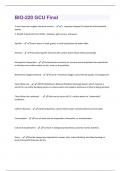
2 most important organic chemical sources: - 1. Improper disposal of industrial and household wastes. 2. Runoff of pesticides from fields, roadsides, golf courses, and lawns. Aquifers - Porous layers of sand, gravel, or rock lying below the water table. Artesian - Pressurized aquifer intersects the surface (water flows without pumping). Atmospheric Deposition - Contaminants carried by air currents and precipitated into watersheds or directly onto surface waters as rain, snow, or dry particles. Biochemical Oxygen Demand - Amount of dissolved oxygen consumed by aquatic microorganisms. Clean Water Act - (1972) Established a National Pollution Discharge System which requires a permit for any entity dumping wastes in surface waters and requires disclosure of what is being dumped. Clean Water Act continued... - Goal was to return all U.S. surface waters to "swimmable" conditions. Coliform bacteria - intestinal bacteria; used to detect water contamination by animal water. Consumption - Loss of water due to evaporation, absorption, or contamination. Cultural Eutrophication - Increase in biological productivity caused by human activities. Dams: - Provide inexpensive hydroelectric power, jobs, reduce flooding, and allow farming on lands that would otherwise be dry.Dinoflagellates - Single-celled organisms that swim with 2 whip-like flagella. Dissolved Oxygen Content - Measure of dissolved oxygen in the water. Diversions - Transfer and store water for redistribution. Eutrophic - Bodies of water that are rich in organisms and organic material. Groundwater - Second largest reservoir of fresh water. Groundwater Pollution - Occurs when pollution is put on the ground and then slowly sinks to the groundwater (spilling oil). Highly toxic metals: - Mercury, lead, cadmium, tin, and nickel. How many gallons per person per year needed to meet needs (According to UN)? - 264,172 gallons How much liquid water do the oceans hold? - 97% How much of the world's water is classified as fresh? - 2.4% How much water does agriculture claim? - 70% of total water withdrawal and 85% of consumption. How much water evaporates each year from the world's oceans? - 500,000km Hydrologic Cycle - Water evaporates from moist surfaces, falls as rain or snow, passes through living organisms and returns to the oceans.Infectious Agents - Main source of waterborne pathogens is improperly treated human waste. Infiltration - Process of water percolating through the soil and into fractures and permeable rocks. Inorganic Pollutants - Nonmetallic Salts & Acid. Non-point Sources - Scattered or diffuse having no specific location of discharge (agricultural field, feedlots, golf courses). Nonmetallic Salts - Many salts that are non-toxic at low concentrations can be mobilized by irrigation and concentrated evaporation, reaching levels toxic to plants and animals. Oceans role: - Play major role in moderating earth's climate. The currents moderate climate by redistributing warm and cold water around the earth. Oil Pollution facts: - 3-6 million tons of oil are released into the ocean each year. Oligotrophic - Bodies of water that have clear water and low biological productivity. Point Sources - Discharge pollution from specific locations (factories, power plants, drain pipes). Rain Shadow Effect - Cool, dry air descends from the mountaintop down the other side of the mountain (leeward side) creating dry areas with very little precipitation. Recharge zones - Areas where water infiltrates into an aquifer. Red tides - Dinoflagellate blooms.Smallest water reservoirs - Contains 0.001% of total water supply. Three principal factors controlling global water deficits and surpluses: - Global atmospheric circulation, proximity to water sources, and topography.
Document information
- Uploaded on
- June 9, 2024
- Number of pages
- 4
- Written in
- 2023/2024
- Type
- Exam (elaborations)
- Contains
- Questions & answers


