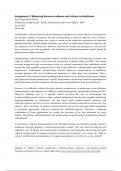
Assignment 3: Balancing between evidence and culture in healthcare
Yara Langeveld (2760223)
Workgroup 3/subgroup 10 - Health, Globalisation and Human Rights - MPA
20/11/2023
396 words
Traditionally, evidence-based medicine dominates healthcare to ensure effective treatments for
the greatest number of patients, thereby incorporating an external objective view of illness1.
Meanwhile, culturally-tailored care, which is based on the subjective experiences of individual
patients and their cultural beliefs, attitudes and values, is undervalued. Both the objective and
the subjective view of illness are, however, essential for healthcare institutions to provide the
best treatment and care to patients, and therefore a cultural interpretative model should be
adopted that combines the two2.
Implementing a cultural interpretative model in healthcare is first of all important to respect the
“right to culture”, as part of the Universal Declaration of Human Rights (UDHR)3. This entails
everyone having the right to participate freely in a cultural community, thus, individuals should
receive the best possible treatment that is also in line with their cultural beliefs and subjective
experiences2. Furthermore, incorporating cultural, subjective interpretations in healthcare
provides patients with more freedom and autonomy to make their own decisions3. This is
connected to the current trend of enabling patient-centred care. Hereby, every person is unique
and physicians should communicate actively with patients and develop cultural competencies to
jointly determine the best treatment, thereby empowering patients in their own treatment4.
However, it is difficult to define the right cultural competencies for physicians to have effective
communication with patients of a different cultural background, and provide training for this5.
Moreover, tailoring care to a specific culture increases the risk of stereotyping and
overgeneralising people based on their cultural background, thereby also possibly stimulating
departmentalisation in healthcare4. On the other hand, evidence-based medicine and
culturally-tailored care do not form a dichotomy and are already connected in several ways1. For
instance, both contribute to patient-centred medicine and aim for reducing health inequalities
by providing appropriate, effective treatment for individual patients. Therefore, a balanced
combination of these approaches can enable the provision of the best treatment for every
patient, and enhance individualisation and patient empowerment instead of departmentalisation
of healthcare4.
In conclusion, evidence-based medicine and culturally-tailored care should be equally valued in
healthcare through adopting a cultural interpretative model2. This way, both the objective and
subjective view of illness are incorporated in healthcare and physicians can develop the right
cultural competencies to empower patients in their own treatment4. As a result, the “right to
culture”, and freedom and autonomy are respected and patient-centred care can be realised3.
1
Whitley, R. (2007). Cultural competence, Evidence-Based medicine, and Evidence-Based
Practices. Psychiatric Services, 58(12), 1588–1590. https://doi.org/10.1176/ps.2007.58.12.1588
Yara Langeveld (2760223)
Workgroup 3/subgroup 10 - Health, Globalisation and Human Rights - MPA
20/11/2023
396 words
Traditionally, evidence-based medicine dominates healthcare to ensure effective treatments for
the greatest number of patients, thereby incorporating an external objective view of illness1.
Meanwhile, culturally-tailored care, which is based on the subjective experiences of individual
patients and their cultural beliefs, attitudes and values, is undervalued. Both the objective and
the subjective view of illness are, however, essential for healthcare institutions to provide the
best treatment and care to patients, and therefore a cultural interpretative model should be
adopted that combines the two2.
Implementing a cultural interpretative model in healthcare is first of all important to respect the
“right to culture”, as part of the Universal Declaration of Human Rights (UDHR)3. This entails
everyone having the right to participate freely in a cultural community, thus, individuals should
receive the best possible treatment that is also in line with their cultural beliefs and subjective
experiences2. Furthermore, incorporating cultural, subjective interpretations in healthcare
provides patients with more freedom and autonomy to make their own decisions3. This is
connected to the current trend of enabling patient-centred care. Hereby, every person is unique
and physicians should communicate actively with patients and develop cultural competencies to
jointly determine the best treatment, thereby empowering patients in their own treatment4.
However, it is difficult to define the right cultural competencies for physicians to have effective
communication with patients of a different cultural background, and provide training for this5.
Moreover, tailoring care to a specific culture increases the risk of stereotyping and
overgeneralising people based on their cultural background, thereby also possibly stimulating
departmentalisation in healthcare4. On the other hand, evidence-based medicine and
culturally-tailored care do not form a dichotomy and are already connected in several ways1. For
instance, both contribute to patient-centred medicine and aim for reducing health inequalities
by providing appropriate, effective treatment for individual patients. Therefore, a balanced
combination of these approaches can enable the provision of the best treatment for every
patient, and enhance individualisation and patient empowerment instead of departmentalisation
of healthcare4.
In conclusion, evidence-based medicine and culturally-tailored care should be equally valued in
healthcare through adopting a cultural interpretative model2. This way, both the objective and
subjective view of illness are incorporated in healthcare and physicians can develop the right
cultural competencies to empower patients in their own treatment4. As a result, the “right to
culture”, and freedom and autonomy are respected and patient-centred care can be realised3.
1
Whitley, R. (2007). Cultural competence, Evidence-Based medicine, and Evidence-Based
Practices. Psychiatric Services, 58(12), 1588–1590. https://doi.org/10.1176/ps.2007.58.12.1588