CNSC PEDIATRICS EXAM REVIEW QUESTIONS AND ANSWERS, GRADED A+/
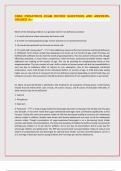
CNSC PEDIATRICS EXAM REVIEW QUESTIONS AND ANSWERS, GRADED A+/ Which of the following children is at greatest risk for iron deficiency anemia? 1: 3 month-old term infant exclusively fed human milk 2: 4 month corrected gestational age, former preemie on a transitional formula 3: 10 month-old switched from formula to whole milk 4: 17 month-old "picky eater" - -3 Iron deficiency anemia is the most common nutritional deficiency in childhood. Term infants usually have adequate iron stores up to 6 months of age. Infant formulas are fortified with sufficient iron to meet the needs of growing infants. The iron content of breast milk, though efficiently absorbed, is much lower compared to infant formula. Exclusively breastfed infants require additional iron starting at 4-6 months of age. This can be provided by complementary foods or iron supplementation. The iron content of cow's milk is similar to human breast milk but the bioavailability is very low due to inhibitory effect of calcium on iron absorption. Due to the inadequate nutritional composition, cow's milk should not be introduced before 12 months of age. A child with picky eating habits may or may not be at increased risk of iron deficiency anemia depending on which foods they are willing to consume. Diet assessment should be done to determine if iron supplementation is warranted. An obese 12-year-old female is admitted to the hospital for an evaluation of sleep apnea. A diet history reveals that she drinks three cans of soda, 24 ounces of juice, and 8 ounces of chocolate milk daily. In what mineral may she be deficient? 1: Calcium 2: Phosphorus 3: Selenium 4: Potassium - -1 Total energy intake from beverages has been increasing in the US diet over the past two decades. It has been noted that sugar-sweetened beverages have contributed significantly to this increase. During this same time period, intake of milk has decreased leading to concerns for inadequate calcium intake in children. Studies have shown that female adolescents are most at risk for inadequate calcium intake. Though consumption of sugar-sweetened beverages is on a decreasing trend, intake remains well above recommendations. The American Academy of Pediatrics (AAP) currently recommends limiting juice intake to 4 oz per day for toddlers, 4-6 oz per day for preschoolers and 8 oz per day for school-age children and adolescents. The APP also recommends increased dietary intake of calcium and vitamin D-containing foods and beverages for optimal bone health. Current recommendations are for 2 to 3 servings of dairy per day for young children and 4 servings per day for adolescents. A child with cerebral palsy and a gastrostomy tube is admitted to the hospital for a fundoplication. This procedure is used to manage 1: gastroesophageal reflux (GER). 2: oral/motor dysfunction. 3: malnutrition. 4: esophagitis. - -1 Gastroesophageal reflux (GER) is frequently seen in the children with neurological impairment. Initial management of these patients should include changes to feeding regimen, positioning as well as medications for reflux and motility. Though many patients will respond well to these changes, some will be refractory to treatment. In patients with intractable GER, a fundoplication may be performed. Given the potential for postoperative complications, this should only be considered in patients who have failed medical treatment. Conversion to a gastrojejunostomy tube could also be considered as an alternative to fundoplication. Premature infants are at increased risk of metabolic bone disease in all of the following scenarios EXCEPT 1: short duration parenteral nutrition. 2: cholestasis. 3: chronic steroid use. 4: very low birth weight. - -1 Metabolic bone disease (MBD) is a multifactorial condition characterized by osteopenia and osteomalacia. Studies have shown that MBD is most often seen in very low birth weight infants, particularly those weighing <1500 grams. Other risk factors associated with MBD are chronic steroid use, chronic diuretic use, prolonged duration of parenteral nutrition, immobilization and cholestasis. When used in assessment of critically ill children, how do predictive equations compare to indirect calorimetry? 1: No consistent comparison can be found 2: Equations typically overestimate needs 3: Equations typically underestimate needs 4: Equations correlate well with indirect calorimetry - -1 Though many equations exist to predict energy expenditure in children, all have been found to either over or underestimate resting energy expenditure. Indirect calorimetry continues to be the gold standard for assessment of energy needs in the critically ill patient and should be used whenever possible. When indirect calorimetry is not available, the Schofield or World Health Organization equation may be used. A 13-year-old boy whose body mass index (BMI) is at the 97th percentile on the Centers for Disease Control and Prevention growth chart for age and sex would be classified as 1: underweight. 2: healthy weight. 3: overweight. 4: obese. - -4 BMI is a screening tool used to identify children over 2 years of age and adolescents who are outside of their healthy weight ranges. Children with age and sex specific BMIs between the 85th and 94th percentiles are classified as overweight and those with BMIs greater than or equal to 95th percentile are classified as obese.
Written for
- Institution
- CNSC
- Course
- CNSC
Document information
- Uploaded on
- June 7, 2024
- Number of pages
- 18
- Written in
- 2023/2024
- Type
- Exam (elaborations)
- Contains
- Questions & answers
Subjects
-
cnsc pediatrics exam review questions and answers

Also available in package deal