Section 4:
Capacitors
Capacitors
• Capacitance
o The capacitance of an object (measured in farads) is the amount of charge it can store
per unit potential difference (p.d.) across it.
𝑄
𝐶=
𝑉
1. C – capacitance in F
2. Q – Charge in C
3. V – Voltage in V
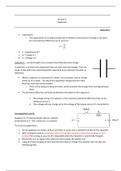
Capacitors: - can be thought of as a bucket that holds electrical charge
A capacitor is an electrical component that can store electrical charge. They are
made of two electrical conducting plates separated by an electrical insulator (a
dielectric).
• When a capacitor is connected to a direct current power source, charge
builds up on is plate – one becomes negatively charged and the other
becomes more positively charged.
o There is the dielectric between them, which prevents the charge from moving between
them
• The potential difference will build up between the plates of the capacitors
➢ The voltage rating of a capacitor is the maximum potential difference that can be
safely put across it.
➢ The voltage will only charge up to the voltage of the power source it’s connected to
Investigating V and Q:
Equation Q = CV demonstrates that Q is directly
proportional to V. This is because C is constant.
To carry out experiment:
1. Set up apparatus as shown, with an ammeter in series and a voltmeter parallel to the capacitor.
2. After closing the switch, constantly adjust the variable resistor to keep the changing current
constant for as long as you can (It’s impossible when the capacitor is nearly fully charged)
3. Record the p.d. at regular time intervals until it equals the battery p.d.
4. Using the fixed charging current and the time taken to charge the capacitor you can plot the
following graph:
Capacitors
Capacitors
• Capacitance
o The capacitance of an object (measured in farads) is the amount of charge it can store
per unit potential difference (p.d.) across it.
𝑄
𝐶=
𝑉
1. C – capacitance in F
2. Q – Charge in C
3. V – Voltage in V
Capacitors: - can be thought of as a bucket that holds electrical charge
A capacitor is an electrical component that can store electrical charge. They are
made of two electrical conducting plates separated by an electrical insulator (a
dielectric).
• When a capacitor is connected to a direct current power source, charge
builds up on is plate – one becomes negatively charged and the other
becomes more positively charged.
o There is the dielectric between them, which prevents the charge from moving between
them
• The potential difference will build up between the plates of the capacitors
➢ The voltage rating of a capacitor is the maximum potential difference that can be
safely put across it.
➢ The voltage will only charge up to the voltage of the power source it’s connected to
Investigating V and Q:
Equation Q = CV demonstrates that Q is directly
proportional to V. This is because C is constant.
To carry out experiment:
1. Set up apparatus as shown, with an ammeter in series and a voltmeter parallel to the capacitor.
2. After closing the switch, constantly adjust the variable resistor to keep the changing current
constant for as long as you can (It’s impossible when the capacitor is nearly fully charged)
3. Record the p.d. at regular time intervals until it equals the battery p.d.
4. Using the fixed charging current and the time taken to charge the capacitor you can plot the
following graph: