Section 2:
Thermal Physics
Thermal Energy Transfer
The Absolute Temperature Scale:
The lowest possible temperature that any object can theoretically have is the absolute zero –
around 273 ͦC or 0Kelvins.
o At this temperature, all molecules have zero kinetic energy
𝐾 (𝐾𝑒𝑙𝑣𝑖𝑛) = 𝐶 (𝐷𝑒𝑔𝑟𝑒𝑒𝑠) + 273
Internal Energy of a gas:
The Internal energy of a body is the sum of the randomly distributed kinetic and potential
energies of all its particles.
o Gas have potential energy too
(unless it’s an ideal gas)
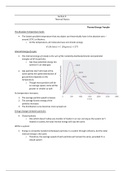
Gas particles don’t all travel at the
same speed; the speed distribution of
gas particles depends on the
temperature.
o Though most particles will be
an average speed, some will be
greater or smaller as well.
As temperature increases:
1. The average particle speed increases
2. The average kinetic energy of the
particles increases
3. The distribution curve becomes more spread out
Energy changes between particles:
Closed systems
o One which doesn’t allow any transfer of matter in or out. As long as the system isn’t
heated or cooled, the total internal energy will stay the same.
Within a system:
Energy is constantly transferred between particles in a system through collisions, but the total
internal energy is the same.
o Therefore, the average speed of each particles will remain the same, provided it’s a
closed system
Thermal Physics
Thermal Energy Transfer
The Absolute Temperature Scale:
The lowest possible temperature that any object can theoretically have is the absolute zero –
around 273 ͦC or 0Kelvins.
o At this temperature, all molecules have zero kinetic energy
𝐾 (𝐾𝑒𝑙𝑣𝑖𝑛) = 𝐶 (𝐷𝑒𝑔𝑟𝑒𝑒𝑠) + 273
Internal Energy of a gas:
The Internal energy of a body is the sum of the randomly distributed kinetic and potential
energies of all its particles.
o Gas have potential energy too
(unless it’s an ideal gas)
Gas particles don’t all travel at the
same speed; the speed distribution of
gas particles depends on the
temperature.
o Though most particles will be
an average speed, some will be
greater or smaller as well.
As temperature increases:
1. The average particle speed increases
2. The average kinetic energy of the
particles increases
3. The distribution curve becomes more spread out
Energy changes between particles:
Closed systems
o One which doesn’t allow any transfer of matter in or out. As long as the system isn’t
heated or cooled, the total internal energy will stay the same.
Within a system:
Energy is constantly transferred between particles in a system through collisions, but the total
internal energy is the same.
o Therefore, the average speed of each particles will remain the same, provided it’s a
closed system