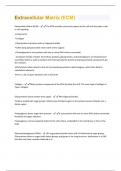
Extracellular Matrix (ECM) Questions And Answers With Verified Solutions
Extracellular Matrix (ECM) - The ECM provides structural support to the cell and also plays a role in cell signaling. -Components: • Collagen • Glycoproteins (proteins with an oligosaccharide) • GAGs (long polysaccharide chains with amino sugars) • Proteoglycans (a core protein with one or more GAG chains connected) - Composed mostly of water. All of those proteins, glycoproteins, and proteoglycans are dissolved and assembled within a watery medium and most typically the protein and polysaccharide components gel the medium. -ECM proteins often attach to the cell via membrane proteins called integrins, which then bind to cytoskeletal elements There is a lot of space between cells in the ECM Collagen - Major protein component of the ECM (outside the cell). The main type of collagen is Type I collagen. Glycoproteins (more protein than sugar) - AKA oligosaccharides. Proteins studed with sugar groups. Mostly have N-linked sugars to the protein (some 0-linked). Just a dozen sugars. Proteoglycans (more sugar than protein) - A core protein with one or more GAG chains connected. Hundreds of sugars attached. Proteoglycans can be covalently linked to the cell surface, embedded in the membrane or free in the ECM Glycosamineoglycans (GAGs) - Long polysaccharide chains with O-linked amino sugar groups. Glycosamino refers to sugars with amino groups and glycan is the long structure. Hyaluronan is a GAG but does not have a protein attached to it.Long polysaccharides with amino sugars (they have nitrogen - which is different from typical polysaccharides) Basement membrane - An extracellular matrix. Epithelial cells sit on basement membrane. Most apical aspect is the basal lamina (which the epithelial cells produce themselves). -Basement membrane = basal lamina + reticular lamina -Basal lamina is made by epithelial cells; reticular lamina is made by connective tissue and is made of type III collagen Integrins - It's typical for ECM proteins and glycoproteins to bind to integral membrane proteins that are called integrins. There's a whole family of integrins. The integrins in turn bind to elements of the cytoskeleton. You have actin and intermediate filaments in the cytoskeleton, and integrins are capable of binding to each. Further, there are integral membrane proteins called cadherins, which also bind to ECM proteins. -Integrins have an alpha chain and a beta chain, but there are different types of each chain and different combinations -All ECM proteins will have an R-G-D within it, but have specificity for different integrins -Growth factors can signal the cells to change the ECM and change the properties and behavior of that cell Planar ECM (basement membrane) vs. interstitial ECM - Planar ECM (basement membrane): Linking protein is laminin. Laminin has 3 polypeptide chains and it's a cross-like structure. You also have type IV collagen, which is an exception among the collagens. Most collagens form fibers but type IV collagen forms networks. The basement membrane consists of 2 parts: the basal lamina (which is made by the epithelial cells) and the reticular lamina (which is made by the connective tissue cells). Interstitial ECM: Fibroblasts are the main cells of connective tissue, and they produce the interstitial ECM. Some components of interstitial ECM include: Fibroblasts (typical cell of connective tissue that creates interstitial ECM), integrins bound to fibronectin (fibronectin in turn binds to proteoglycans and collagens).Fibronectin - A protein. One fibronectin gene per haploid genome, but there are many dif. fibronectin proteins. This happens through process of alternative splicing (RNA is produced from the gene and then gets cut up and pasted together in dif ways. There are 20-30 fibronectin proteins in the various tisses of the body. Fibronectin is made of two chains connective by a disulfide bridge. Fibronectin can be soluble in blood plasma, it's part of the clotting cascade, but in tissues it generally forms fibers and aggregates of different sizes. Fibronectin mediates a lot of morphogenesis. It's present in most ECM to some extent, but in ECM undergoing development or remodeling it is very abundant.
Written for
- Institution
- Extracellular Matrix
- Course
- Extracellular Matrix
Document information
- Uploaded on
- June 7, 2024
- Number of pages
- 5
- Written in
- 2023/2024
- Type
- Exam (elaborations)
- Contains
- Questions & answers
Subjects

Document also available in package deal