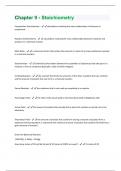
Chapter 9 - Stoichiometry Questions And Answers With Latest Updates
Composition Stoichiometry - calculations involving the mass relationships of elements in compounds Reaction Stoichiometry - calculations involving the mass relationships between reactants and products in a chemical reaction Mole Ratio - a conversion factor that relates the amounts in moles of any two substances involved in a chemical reaction Stoichiometry - (chemistry) the relation between the quantities of substances that take part in a reaction or form a compound (typically a ratio of whole integers) Limiting Reactant - the reactant that limits the amounts of the other reactants that can combine and the amount of product that can form in a chemical reaction Excess Reactant - the substance that is not used up completely in a reaction Percentage Yield - the ratio of the actual yield to the theoretical yield multiplied by 100 Actual Yield - the amount of product that actually forms when the reaction is carried out in the laboratory Theoretical Yield - the amount of product that could form during a reaction calculated from a balanced chemical equation; it represents the maximum amount of product that could be formed from a given amount of reactant Given the Balanced Reaction: 2Al2O3(l) → 4Al(s) + 3O2(g) How many moles of O2 will be formed if 10 moles of Al2O3 are used? - 15 moles of O2Given the reaction: NH3(g) + O2(g) → NO(g) + H2O(g) What is the limiting reactant when there are .5 moles of O2 and 1.5 moles of NH3 available to react? How much excess is there? - O2, there is .1 moles of excess NH3.
Geschreven voor
- Instelling
- Chapter 9 - Stoichiometry
- Vak
- Chapter 9 - Stoichiometry
Documentinformatie
- Geüpload op
- 7 juni 2024
- Aantal pagina's
- 2
- Geschreven in
- 2023/2024
- Type
- Tentamen (uitwerkingen)
- Bevat
- Vragen en antwoorden
Onderwerpen

Ook beschikbaar in voordeelbundel