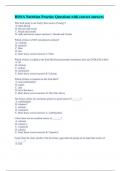
Biology 103 FINAL EXAM QUESTIONS AND ANSWERS What are the key characteristics of living things? - (1) Orderliness, complexity, organization (2) energy use and production, metabolism (3) balance, homeostasis (4) irritability, adaptation (evolution) (5) reproduction, growth, development The sum of all the chemical reactions that take place in the body is called _____. - metabolism Taxonomic Heirarchy (IN ORDER!) - Domain, Kingdom, Phylum, Class, Order, Family, Genus, Specific Epithet What two parts make up a scientific name? - genus and specific epithet What is the scientific method? - The process that scientists use to evaluate ideas and information. What are the parts of the scientific method? - Observation, Information, Hypothesis, Repeated experimentation, conclusion, retest conclusions What is taxonomy? - The scientific naming and classifying of organisms What is the proper term for a scientific name? - Binomial Nomenclature Who developed binomial nomenclature? - Carl Linnaeus A _____ _____ is a hypothesis that has withstood the test of time and much experimentation - scientific theory In experiments, a _____ _____ is a group that is the same as an experimental group except for one variable; used as a standard of comparison - control group What is an atom? - basic unit of matter What are the 3 subatomic particles in an atom and where are they found? - Protons (nucleus), Neutrons (nucleus), Electrons (electron shells). What is the charge of a proton? - positive What is the charge of a neutron? - neutral What is the charge of an electron? - negative What is the importance of the proton number in an atom? - It is the atomic number What are valence electrons and what do they determine? - Electrons in the outermost shell, they determine the number of bonds that an atom will form _____ are atoms of the same element which have different atomic weights because they have different numbers of neutrons - Isotopes _____ is the clinging of one substance to another. This makes water a particularly good solvent. - Adhesion I. Adenine, II Guanine, III Thymine, IV Cysosine: From the list of nitrogenous bases above, which are pyrimidines? - III and IV A(n) _____ is a substance made of only one kind of atom, and can't be broken down to other substances by chemical reactions - element _____ is the energy -storing polysaccharide of plants. - Starch Fats, oils, and waxes are all _____. - lipids _____ are negatively charged particles that orbit the nucleus of an atom. - Electrons A(n) _____ bond involves the equal sharing of valence electrons. - covalent An atom can form as many bonds as there are...? - unpaired electrons in its outermost electron shell _____ bear a positive electrical charge, while _____ have no electrical charge. - Protons, neutrons The ability of an atom to attract electrons from another atom is called _____. - electronegativity
Exam (elaborations)
Biology 103 FINAL EXAM QUESTIONS AND ANSWERS
Rating
Sold
-
Pages
20
Grade
A
Uploaded on
05-06-2024
Written in
2023/2024
What are the key characteristics of living things? - (1) Orderliness, complexity, organization (2) energy use and production, metabolism (3) balance, homeostasis (4) irritability, adaptation (evolution) (5) reproduction, growth, development The sum of all the chemical reactions that take place in the body is called _____. - metabolism Taxonomic Heirarchy (IN ORDER!) - Domain, Kingdom, Phylum, Class, Order, Family, Genus, Specific Epithet What two parts make up a scientific name? - genus and specific epithet What is the scientific method? - The process that scientists use to evaluate ideas and information. What are the parts of the scientific method? - Observation, Information, Hypothesis, Repeated experimentation, conclusion, retest conclusions What is taxonomy? - The scientific naming and classifying of organisms What is the proper term for a scientific name? - Binomial Nomenclature Who developed binomial nomenclature? - Carl Linnaeus A _____ _____ is a hypothesis that has withstood the test of time and much experimentation - scientific theory In experiments, a _____ _____ is a group that is the same as an experimental group except for one variable; used as a standard of comparison - control group What is an atom? - basic unit of matter What are the 3 subatomic particles in an atom and where are they found? - Protons (nucleus), Neutrons (nucleus), Electrons (electron shells). What is the charge of a proton? - positive What is the charge of a neutron? - neutral What is the charge of an electron? - negative What is the importance of the proton number in an atom? - It is the atomic number What are valence electrons and what do they determine? - Electrons in the outermost shell, they determine the number of bonds that an atom will form _____ are atoms of the same element which have different atomic weights because they have different numbers of neutrons - Isotopes _____ is the clinging of one substance to another. This makes water a particularly good solvent. - Adhesion I. Adenine, II Guanine, III Thymine, IV Cysosine: From the list of nitrogenous bases above, which are pyrimidines? - III and IV A(n) _____ is a substance made of only one kind of atom, and can't be broken down to other substances by chemical reactions - element _____ is the energy-storing polysaccharide of plants. - Starch Fats, oils, and waxes are all _____. - lipids _____ are negatively charged particles that orbit the nucleus of an atom. - Electrons
Show more
Read less
Institution
Biology 103
Course
Biology 103
Whoops! We can’t load your doc right now. Try again or contact support.
Written for
- Institution
- Biology 103
- Course
- Biology 103
Document information
- Uploaded on
- June 5, 2024
- Number of pages
- 20
- Written in
- 2023/2024
- Type
- Exam (elaborations)
- Contains
- Questions & answers
Subjects
- biology 103 final exam
- biology 103
-
biology 103 final exam questions and answers
Content preview
$12.49
Get access to the full document:
100% satisfaction guarantee
Immediately available after payment
Both online and in PDF
No strings attached

Document also available in package deal
Package deal
Combined Biology 103 FINAL EXAM QUESTIONS AND ANSWERS
13
2024
$ 173.37
More info