Sex Differences
Organisational effects of sex hormones produced by fetal
gonads – permanent alterations in body or CNS induced by a
hormone at a critical period of development.
Activational effects of sex hormones
produced by gonads – hormone
effects that occur in the fully
developed organism: depends on
previous organisational effects
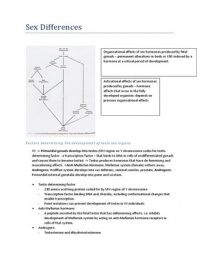
Factors determining the development of male sex organs
XY Primordial gonads develop into testes (SRY region on Y chromosome codes for testis-
determining factor -a transcription factor – that binds to DNA in cells of undifferentiated gonads
and causes them to become testes) Testes produces hormones that have de-feminising and
masculinising effects Anti-Mullerian Hormone: Mullerian system (female) withers away,
Androgens: Wolffian system develops into vas deferens, seminal vesicles, prostate, Androgens:
Primordial external genetalia develop into penis and scrotum.
Testis-determining factor
- 230 amino acid long protein coded for by SRY region of Y chromosome
- Transcription factor binding DNA and, thereby, including conformational changes that
enable transcription.
- Point mutations can prevent development of testes in XY individuals.
Anti-Mullerian hormone:
- A peptide secreted by the fetal testes that has defeminising effects. i.e. inhibits
development of Mullerian system by acting on anti-Mullerian hormone receptors in
cells of that system.
Androgens:
- Testosterone and dihydrotestosterone
, - Testosterone acts on androgen receptors in cells of the Wolffian system and stimulates
its development into male internal sex organs.
- Dihydrotestosterone, produced from testosterone by 5alpha reductase, acts on
androgen receptors in the primordial external genitals ( with higher affinity than
testosterone) and is critical to stimulate their development into male genitals.
Factors controlling the development of female sex organs
XX primordial gonads develop into ovaries Mullerian system develops into fimbraie, fallopian
tubes, uterus, inner vagina Wolffian system, without androgens, withers away Primordial
external genetalia develop into clitoris, labia, outer vagina.
By default, primordial sex organs will develop into female sex organs.
Abnormal development of sex organs
XY Sex reversal: Point mutations in the SRY region of the Y chromosome result in female sex
organs in XYs.
Androgen Insensitivity syndrome: A condition caused by congenital lack of functioning
androgen receptors, in a person with XY sex chromosomes, causes development of a female
with testes but no internal sex organs.
Turner’s syndrome: The presence of only one sex chromosome (X) results in a lack of
ovaries but otherwise normal female sex organs and genetalia.
Persistent Mullerian duct syndrome: Congenital lack of anti-Mullerian hormone causes the
development of both male and female sex organs in an XY individual – hermaphrodite.
Sexual Maturation: PUBERTY
While primary sex characteristics (gonads, internal and external sex organs) are present at
birth, secondary sex characterisitics (enlarged breasts, widened hips, facial hair, deep voice)
and sexual maturity are not developed until puberty.
Gonadotropic hormones: follicle-stimulating hormone(female menstrual cycle), luteinising
hormone(LH)
Sex differences in behaviour and cognition
Similarities across species – lordosis in females
Spatial learning
Organisation Hypothesis
Based on findings that exposing female rats and guinea pigs to androgen in utero during
critical periods altered their adult sexual behaviour.
Young and colleagues proposed that early androgens, similar to effects on sex organs,
organise the developing CNS in a masculine way, so as to make female behaviours less likely
and male behaviours more likely.
Organisational effects of sex hormones produced by fetal
gonads – permanent alterations in body or CNS induced by a
hormone at a critical period of development.
Activational effects of sex hormones
produced by gonads – hormone
effects that occur in the fully
developed organism: depends on
previous organisational effects
Factors determining the development of male sex organs
XY Primordial gonads develop into testes (SRY region on Y chromosome codes for testis-
determining factor -a transcription factor – that binds to DNA in cells of undifferentiated gonads
and causes them to become testes) Testes produces hormones that have de-feminising and
masculinising effects Anti-Mullerian Hormone: Mullerian system (female) withers away,
Androgens: Wolffian system develops into vas deferens, seminal vesicles, prostate, Androgens:
Primordial external genetalia develop into penis and scrotum.
Testis-determining factor
- 230 amino acid long protein coded for by SRY region of Y chromosome
- Transcription factor binding DNA and, thereby, including conformational changes that
enable transcription.
- Point mutations can prevent development of testes in XY individuals.
Anti-Mullerian hormone:
- A peptide secreted by the fetal testes that has defeminising effects. i.e. inhibits
development of Mullerian system by acting on anti-Mullerian hormone receptors in
cells of that system.
Androgens:
- Testosterone and dihydrotestosterone
, - Testosterone acts on androgen receptors in cells of the Wolffian system and stimulates
its development into male internal sex organs.
- Dihydrotestosterone, produced from testosterone by 5alpha reductase, acts on
androgen receptors in the primordial external genitals ( with higher affinity than
testosterone) and is critical to stimulate their development into male genitals.
Factors controlling the development of female sex organs
XX primordial gonads develop into ovaries Mullerian system develops into fimbraie, fallopian
tubes, uterus, inner vagina Wolffian system, without androgens, withers away Primordial
external genetalia develop into clitoris, labia, outer vagina.
By default, primordial sex organs will develop into female sex organs.
Abnormal development of sex organs
XY Sex reversal: Point mutations in the SRY region of the Y chromosome result in female sex
organs in XYs.
Androgen Insensitivity syndrome: A condition caused by congenital lack of functioning
androgen receptors, in a person with XY sex chromosomes, causes development of a female
with testes but no internal sex organs.
Turner’s syndrome: The presence of only one sex chromosome (X) results in a lack of
ovaries but otherwise normal female sex organs and genetalia.
Persistent Mullerian duct syndrome: Congenital lack of anti-Mullerian hormone causes the
development of both male and female sex organs in an XY individual – hermaphrodite.
Sexual Maturation: PUBERTY
While primary sex characteristics (gonads, internal and external sex organs) are present at
birth, secondary sex characterisitics (enlarged breasts, widened hips, facial hair, deep voice)
and sexual maturity are not developed until puberty.
Gonadotropic hormones: follicle-stimulating hormone(female menstrual cycle), luteinising
hormone(LH)
Sex differences in behaviour and cognition
Similarities across species – lordosis in females
Spatial learning
Organisation Hypothesis
Based on findings that exposing female rats and guinea pigs to androgen in utero during
critical periods altered their adult sexual behaviour.
Young and colleagues proposed that early androgens, similar to effects on sex organs,
organise the developing CNS in a masculine way, so as to make female behaviours less likely
and male behaviours more likely.