CHAPTER 13: LEVERAGE AND CAPITAL STRUCTURE
13.1 LEVERAGE
• Leverage = Use fixed costs/ funds to maximise returns
• Capital structure is how a firm finance operations with a mix of debt(D) and equity (E).
• More debt than equity result in increased leverage,
o results in higher returns but the downside is higher risk
o Directly impacts financial leverage
• 3 types of leverage
o Operating leverage: relationship between Revenue &EBIT
o Financial leverage: relationship between EBIT & EPS
o Total leverage: relationship between Revenue & EPS
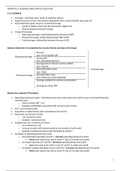
General statement of comprehensive income format and types of leverage
Revenue
Less: Cost of goods sold
Operating leverage
Gross profit
Less: Operating expenses
Earnings before interest and taxes (EBIT)
Less: Interest
Net profit before taxes Total leverage
Less: Taxes
Financial leverage Net profit after taxes
Less: Preference share dividends
Earnings available for ordinary shareholders
Earnings per share (EPS
Break-even analysis/CVP analysis
• Operating break-even point = Determine how many units need to be sold to cover costs (both fixed and
variable costs)
o Point at which EBIT = R 0
o Evaluates profitability associated with various levels of sales
• CVP = cost-volume-profit
• Important to understand & split costs between FC and VC
• Fixed costs are function of time
o are constant in total
o Example: contractual rent
• Variable costs are a function of volume
o are constant per unit
o increase in total (will increase based on the number of units sold)
o Example: material and labour directly linked to product
• Sensitivity of operating break-even point:
o Increased fixed operating cost (FC) = increase operating break-even point
More units need to be sold to cover FC and VC to make zero profit
o Increased sale price per unit (P) = decrease operating break-even point
Less units need to be sold to cover FC and VC to make zero profit
o Increased variable operating cost per unit (VC) = increase operating break-even point
More units need to be sold to cover FC and VC to make zero profit
1
13.1 LEVERAGE
• Leverage = Use fixed costs/ funds to maximise returns
• Capital structure is how a firm finance operations with a mix of debt(D) and equity (E).
• More debt than equity result in increased leverage,
o results in higher returns but the downside is higher risk
o Directly impacts financial leverage
• 3 types of leverage
o Operating leverage: relationship between Revenue &EBIT
o Financial leverage: relationship between EBIT & EPS
o Total leverage: relationship between Revenue & EPS
General statement of comprehensive income format and types of leverage
Revenue
Less: Cost of goods sold
Operating leverage
Gross profit
Less: Operating expenses
Earnings before interest and taxes (EBIT)
Less: Interest
Net profit before taxes Total leverage
Less: Taxes
Financial leverage Net profit after taxes
Less: Preference share dividends
Earnings available for ordinary shareholders
Earnings per share (EPS
Break-even analysis/CVP analysis
• Operating break-even point = Determine how many units need to be sold to cover costs (both fixed and
variable costs)
o Point at which EBIT = R 0
o Evaluates profitability associated with various levels of sales
• CVP = cost-volume-profit
• Important to understand & split costs between FC and VC
• Fixed costs are function of time
o are constant in total
o Example: contractual rent
• Variable costs are a function of volume
o are constant per unit
o increase in total (will increase based on the number of units sold)
o Example: material and labour directly linked to product
• Sensitivity of operating break-even point:
o Increased fixed operating cost (FC) = increase operating break-even point
More units need to be sold to cover FC and VC to make zero profit
o Increased sale price per unit (P) = decrease operating break-even point
Less units need to be sold to cover FC and VC to make zero profit
o Increased variable operating cost per unit (VC) = increase operating break-even point
More units need to be sold to cover FC and VC to make zero profit
1