Organisation & Environment (MAN-MOR003)
Chapter 1: the strategic management beast
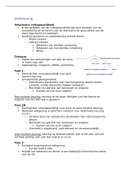
Organisation and environment will be fully about strategy formation. We will focus on the different
perspectives of how strategy if formed in organizations. There will be familiar perspectives: institutional,
population ecology, contingency perspective.
Strategy formation process
But is that reality? Strategy formation done by visionaries:
- Strategy is formed by humans (biases in strategic decision-making); attention/ intuition.
- Strategy is formed by whoever is the strongest politically.
- Strategy is formed by imitating what other firms do.
- And many more perspectives!
Prescriptive schools: more concerned with how strategies should be formulated than with how they
necessarily form. More deliberate and old fashioned → first create, then implement.
Descriptive schools: less prescribing, more describing how strategies do get made. Understand the
process of strategy formation as it unfolds. More emergent → not created before implemented.
→ 10 schools
Prescriptive Descriptive
Design school Entrepreneurial school Cultural school
Planning school Cognitive school Environmental school
Positioning school Learning school Power school
Configuration school
Strategy: ‘top management’ plans to attain (= bereiken) outcomes consistent with the organization’s
missions and goals. Strategy requires a number of definitions (5P’s):
1. Strategy as plans (intended) and pattern (realized)
o Plan: a direction or course of action into future, path from here to there (looking ahead).
o Pattern: consistency in behaviour overtime, looking at past behaviour.
2. Strategy as deliberate and emergent
o Deliberate: intentions that are fully realized.
o Unrealized: intentions that are not realized.
o Emergent: where a pattern is realised that was not expressly intended. Actions were
taken one by one, which became consistent (a pattern).
3. Strategy as positions and perspectives
o Position: the locating of particular products in particular markets
o Perspective: an organization’s fundamental way of doing things. This is an
interpretation of managers and its environment.
4. Strategy as ploy
o Ploy: a specific ‘manoeuvre’ intended to outwit an opponent or competitor.
1
,Four basic approaches to strategy formation
1. Strategic planning: deliberate plans and tangible positions
→ Planning school, design school and positioning school
2. Strategic visioning: deliberate plans and broad perspectives
→ Entrepreneurial school, design school, cultural school, and cognitive school
3. Strategic venturing: emergent patterns and tangible positions
→ Learning school, power school and cognitive school
4. Strategic learning: emergent patterns and broad perspectives
→ Learning school and entrepreneurial school
Chapter 2: The design school
Strategy formation as a process of conception, represented by the spider.
The design school is most influential of the ten schools. It seeks to attain a match or fit between internal
capabilities and external possibilities.
Origins of the design school
From 1990 started to pick up again. Selznick & Chandler produced distinctive competence. It is the need
to bring together organization’s internal state with its external expectations.
Basic design school model (‘process’ in notes, page 26)
The model focuses on the internal and external situations → SWOT
- External appraisal: PESTEL; opportunities and threats (OT) are changes, not stable factors in
the environment.
- Internal appraisal: hard to know yourself, experience is more important than individual
strengths. Way of acting is built into the organization.
- Managerial values: beliefs and preferences of those who lead the organization.
- Social responsibility: ethics of the society in which the organization functions.
Strategy formation is a creative act, not a linear process, but iterative. After determining alternative
strategies, the next step is to evaluate and choose the best one (Richard Rumelt tests):
- Consistency: strategy must not present inconsistent goals and policies
- Consonance: strategy must represent adaptive response to external environment with its
critical changes over time.
- Advantage: strategy must provide for creation/ maintenance of a competitive advantage in the
selected area of activity.
- Feasibility: strategy must neither overtax (=overbelasting) available resources nor created
unsolvable subproblems.
Analysis (external Formulation (creation
Implementation
and internal) & evaluation)
Once agreed upon, strategy is implemented (structure follows strategy). It is important to keep strategies
clear, simple, and specific. The CEO is the strategist. His tasks are to gather information, analyse and
organize this information, and formulate strategy.
Economic man/Homo economicus: “Agent who has complete information about the options available
for choice, perfect foresight of the consequences from choosing those options, and the wherewithal to
solve an optimization problem that identifies an option which maximizes the agent’s personal utility.”
2
, This school has not provided much basis for developments in other schools.
Premises (= how we think the strategy should look like?) of the design school
- Strategy formation as a deliberate process of conscious thought; action must flow from reason.
- The person highest in hierarchy person (CEO/ head of organization) develops strategy.
- Process of strategy formation should be simple and informal
- Strategies should be one of a kind; focussed on the process, not the content, a creative act to
build on distinctive competence, SWOT environment is given and cannot be changed.
- The design process is complete when strategy appears fully formulated, as a perspective.
- Strategy should be explicit, se keep it simple and informal; so, others can understand.
- After formulation, follows implementation; structure follows strategy.
Criticism/ limitations of the design school
- The capacity to learn is ignored by analytical assessment of environment and internal
capabilities; a process of conception (= opvatting) than of learning.
- Structure follows strategy; unrealistic for most organizations, cannot just change its course,
structure and strategy is integrated.
- Assumption of universality
- Making strategy explicit; promoting inflexibility (hierarchical and centralized organizations). A
premature closure can impede (= belemmeren) strategic change when necessary and create
resistance to change.
- Separating formulation from implementation: detaching thinking from acting. Assumption that
environment is understood, but if unstable the distinction will collapse. Remember: intended
strategies exist, but realized strategies also emerge. Design school focussed on the process.
Contributions of the design school
- One main brain (CEO) can handle all information for strategy formation.
- That brain is able to have full, detailed knowledge of the situation.
- That knowledge must be established before a new intended strategy has to be implemented;
situation has to remain stable.
- The organization must cope with a centrally articulated strategy, grand strategy.
- Vocabulary & tools.
Chapter 3: The planning school
Strategy formation as a formal process, represented by the squirrel.
Planning: the establishment of goals, policies, and procedures for a social or economic unit.
In strategy: formalized procedure to produce articulated results by using integrated system of decisions.
Formalization: systematic process of developing and implementing strategy through detailed and
rigorous analysis and planning; more analytical than designs.
- Systematic procedures: tools to see what is going on with internal/ external data
- Comprehensive documentations; manuals and reports
- Clear objectives and steps (strategizing)
- Rational decision making (reproduce in future); one person for decision making is not oke!
- Control and evaluation (monitoring)
Analysis (internal
Operationlization &
Objective-setting and external Evaluation
scheduling
forecast)
3
Chapter 1: the strategic management beast
Organisation and environment will be fully about strategy formation. We will focus on the different
perspectives of how strategy if formed in organizations. There will be familiar perspectives: institutional,
population ecology, contingency perspective.
Strategy formation process
But is that reality? Strategy formation done by visionaries:
- Strategy is formed by humans (biases in strategic decision-making); attention/ intuition.
- Strategy is formed by whoever is the strongest politically.
- Strategy is formed by imitating what other firms do.
- And many more perspectives!
Prescriptive schools: more concerned with how strategies should be formulated than with how they
necessarily form. More deliberate and old fashioned → first create, then implement.
Descriptive schools: less prescribing, more describing how strategies do get made. Understand the
process of strategy formation as it unfolds. More emergent → not created before implemented.
→ 10 schools
Prescriptive Descriptive
Design school Entrepreneurial school Cultural school
Planning school Cognitive school Environmental school
Positioning school Learning school Power school
Configuration school
Strategy: ‘top management’ plans to attain (= bereiken) outcomes consistent with the organization’s
missions and goals. Strategy requires a number of definitions (5P’s):
1. Strategy as plans (intended) and pattern (realized)
o Plan: a direction or course of action into future, path from here to there (looking ahead).
o Pattern: consistency in behaviour overtime, looking at past behaviour.
2. Strategy as deliberate and emergent
o Deliberate: intentions that are fully realized.
o Unrealized: intentions that are not realized.
o Emergent: where a pattern is realised that was not expressly intended. Actions were
taken one by one, which became consistent (a pattern).
3. Strategy as positions and perspectives
o Position: the locating of particular products in particular markets
o Perspective: an organization’s fundamental way of doing things. This is an
interpretation of managers and its environment.
4. Strategy as ploy
o Ploy: a specific ‘manoeuvre’ intended to outwit an opponent or competitor.
1
,Four basic approaches to strategy formation
1. Strategic planning: deliberate plans and tangible positions
→ Planning school, design school and positioning school
2. Strategic visioning: deliberate plans and broad perspectives
→ Entrepreneurial school, design school, cultural school, and cognitive school
3. Strategic venturing: emergent patterns and tangible positions
→ Learning school, power school and cognitive school
4. Strategic learning: emergent patterns and broad perspectives
→ Learning school and entrepreneurial school
Chapter 2: The design school
Strategy formation as a process of conception, represented by the spider.
The design school is most influential of the ten schools. It seeks to attain a match or fit between internal
capabilities and external possibilities.
Origins of the design school
From 1990 started to pick up again. Selznick & Chandler produced distinctive competence. It is the need
to bring together organization’s internal state with its external expectations.
Basic design school model (‘process’ in notes, page 26)
The model focuses on the internal and external situations → SWOT
- External appraisal: PESTEL; opportunities and threats (OT) are changes, not stable factors in
the environment.
- Internal appraisal: hard to know yourself, experience is more important than individual
strengths. Way of acting is built into the organization.
- Managerial values: beliefs and preferences of those who lead the organization.
- Social responsibility: ethics of the society in which the organization functions.
Strategy formation is a creative act, not a linear process, but iterative. After determining alternative
strategies, the next step is to evaluate and choose the best one (Richard Rumelt tests):
- Consistency: strategy must not present inconsistent goals and policies
- Consonance: strategy must represent adaptive response to external environment with its
critical changes over time.
- Advantage: strategy must provide for creation/ maintenance of a competitive advantage in the
selected area of activity.
- Feasibility: strategy must neither overtax (=overbelasting) available resources nor created
unsolvable subproblems.
Analysis (external Formulation (creation
Implementation
and internal) & evaluation)
Once agreed upon, strategy is implemented (structure follows strategy). It is important to keep strategies
clear, simple, and specific. The CEO is the strategist. His tasks are to gather information, analyse and
organize this information, and formulate strategy.
Economic man/Homo economicus: “Agent who has complete information about the options available
for choice, perfect foresight of the consequences from choosing those options, and the wherewithal to
solve an optimization problem that identifies an option which maximizes the agent’s personal utility.”
2
, This school has not provided much basis for developments in other schools.
Premises (= how we think the strategy should look like?) of the design school
- Strategy formation as a deliberate process of conscious thought; action must flow from reason.
- The person highest in hierarchy person (CEO/ head of organization) develops strategy.
- Process of strategy formation should be simple and informal
- Strategies should be one of a kind; focussed on the process, not the content, a creative act to
build on distinctive competence, SWOT environment is given and cannot be changed.
- The design process is complete when strategy appears fully formulated, as a perspective.
- Strategy should be explicit, se keep it simple and informal; so, others can understand.
- After formulation, follows implementation; structure follows strategy.
Criticism/ limitations of the design school
- The capacity to learn is ignored by analytical assessment of environment and internal
capabilities; a process of conception (= opvatting) than of learning.
- Structure follows strategy; unrealistic for most organizations, cannot just change its course,
structure and strategy is integrated.
- Assumption of universality
- Making strategy explicit; promoting inflexibility (hierarchical and centralized organizations). A
premature closure can impede (= belemmeren) strategic change when necessary and create
resistance to change.
- Separating formulation from implementation: detaching thinking from acting. Assumption that
environment is understood, but if unstable the distinction will collapse. Remember: intended
strategies exist, but realized strategies also emerge. Design school focussed on the process.
Contributions of the design school
- One main brain (CEO) can handle all information for strategy formation.
- That brain is able to have full, detailed knowledge of the situation.
- That knowledge must be established before a new intended strategy has to be implemented;
situation has to remain stable.
- The organization must cope with a centrally articulated strategy, grand strategy.
- Vocabulary & tools.
Chapter 3: The planning school
Strategy formation as a formal process, represented by the squirrel.
Planning: the establishment of goals, policies, and procedures for a social or economic unit.
In strategy: formalized procedure to produce articulated results by using integrated system of decisions.
Formalization: systematic process of developing and implementing strategy through detailed and
rigorous analysis and planning; more analytical than designs.
- Systematic procedures: tools to see what is going on with internal/ external data
- Comprehensive documentations; manuals and reports
- Clear objectives and steps (strategizing)
- Rational decision making (reproduce in future); one person for decision making is not oke!
- Control and evaluation (monitoring)
Analysis (internal
Operationlization &
Objective-setting and external Evaluation
scheduling
forecast)
3