

LANGUAGE OPTIMIZATION EXAM
CHAPTER 1- SENTENCES
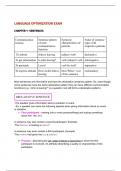
Communication Sentence pattern Syntactic Name of sentence
reasons of each characteristics of types with
communicative patterns respective patterns
function
To inform John is leaving subject+verb declarative
To get information Is john leaving? verb+subject+verb interrogative
To persuade Leave! verb by itself imperative
To express attitude How awful John is How/What + rest exclamatory
leaving of the sentence
Most sentences are informative and have the declarative sentence pattern. So, even though
some sentences have the same declarative pattern they can have different communication
functions (e.g. “John is leaving?” is a question, but still forms a declarative pattern).
-The speaker gives information about a situation or event.
- So, a speaker can name the following aspects when giving information about an event
or situation:
➢ First participant - naming one or more persons/things and saying something
about him, her, or it.
A sentence may also contain a second participant. Example:
‘The little boy is holding a balloon”
A sentence may even contain a third participant. Example:
‘The mother had given the boy a balloon.’
➢ Process - describing the act, state of being or becoming in which the first
participant is involved. An attribute describing a quality or characteristic of the
participant.
, Example of the process:
Example of the process of the second participant:
➢ Setting - how, where, when, why, under what conditions and in spite of which
conditions the process or event takes place. It is very broad, it refers to anything
that is not a participant, an attribute or a process.
Example of setting:
- CONSTITUENT: subject + predicator
- PREDICATE: remainder of a sentence
- COMPLEMENT: objects or attributes, which name other participants
or attributes
,Example of roles and function of sentence constituents:
, TYPICAL SENTENCE PATTERNS:
- the pattern that can be used depends on the meaning of the verb
- the first three patterns are most common in everyday language
● The running pattern (intransitive verbs)
Subject/ predicator + adverbial (often but not always used)
This pattern needs a verb that expresses an action involving only one main participant
(running, cycling, swimming). It may have more than one adverbial but no direct object
or subject attitude.
● The being pattern (copula verbs)
Subject/predicator + subject attribute (gives information about the subject only, not
about the predicator)
The meaning of such verbs is to link the first participant to an attribute.
● The doing/seeing pattern (monotransitive verbs)
Subject/Predicator + direct object
This pattern’s verb expresses an action or an experience.
CHAPTER 1- SENTENCES
Communication Sentence pattern Syntactic Name of sentence
reasons of each characteristics of types with
communicative patterns respective patterns
function
To inform John is leaving subject+verb declarative
To get information Is john leaving? verb+subject+verb interrogative
To persuade Leave! verb by itself imperative
To express attitude How awful John is How/What + rest exclamatory
leaving of the sentence
Most sentences are informative and have the declarative sentence pattern. So, even though
some sentences have the same declarative pattern they can have different communication
functions (e.g. “John is leaving?” is a question, but still forms a declarative pattern).
-The speaker gives information about a situation or event.
- So, a speaker can name the following aspects when giving information about an event
or situation:
➢ First participant - naming one or more persons/things and saying something
about him, her, or it.
A sentence may also contain a second participant. Example:
‘The little boy is holding a balloon”
A sentence may even contain a third participant. Example:
‘The mother had given the boy a balloon.’
➢ Process - describing the act, state of being or becoming in which the first
participant is involved. An attribute describing a quality or characteristic of the
participant.
, Example of the process:
Example of the process of the second participant:
➢ Setting - how, where, when, why, under what conditions and in spite of which
conditions the process or event takes place. It is very broad, it refers to anything
that is not a participant, an attribute or a process.
Example of setting:
- CONSTITUENT: subject + predicator
- PREDICATE: remainder of a sentence
- COMPLEMENT: objects or attributes, which name other participants
or attributes
,Example of roles and function of sentence constituents:
, TYPICAL SENTENCE PATTERNS:
- the pattern that can be used depends on the meaning of the verb
- the first three patterns are most common in everyday language
● The running pattern (intransitive verbs)
Subject/ predicator + adverbial (often but not always used)
This pattern needs a verb that expresses an action involving only one main participant
(running, cycling, swimming). It may have more than one adverbial but no direct object
or subject attitude.
● The being pattern (copula verbs)
Subject/predicator + subject attribute (gives information about the subject only, not
about the predicator)
The meaning of such verbs is to link the first participant to an attribute.
● The doing/seeing pattern (monotransitive verbs)
Subject/Predicator + direct object
This pattern’s verb expresses an action or an experience.


