NURS 451 Terms to Know Questions And Answers Graded A+
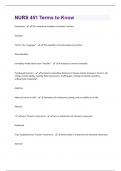
Echopraxia - The compulsive imitation of another's actions. Echolalia "Echos" the "language" - The repetition of words spoken by another. Waxy flexibility Immobility makes them seem "wax-like" - A tendency to remain immobile. Pseudoparkinsonism - Symptoms resembling Parkinson's Disease (motor slowing or tremors, pill rolling, muscle rigidity, masklike facial expressions, shuffling gait, slowing of speech) caused by antipsychotic medication. Akathisia Kathy can't ever sit still! - Sensations of restlessness, pacing, and an inability to sit still. Akinesia "A"-without, "kinesia"-movement - Loss or impairment of voluntary movement. Dyskinesia "Dys"-bad/abnormal, "kinesia"-movement - Abnormality or impairment of voluntary movement. Dystonia"Dys"-bad/abnormal, "tonia"-muscle tone - Spastic contractions of muscle groups. Hallucinations - Abnormal perceptual experiences that occur without external stimuli. -Auditory (hearing) -Olfactory (smell) -Tactile (touch) -Gustatory (taste) - Type of hallucinations Delusions Hallucinations are SENSORY, Delusions are PERCEPTIONS - False beliefs based on incorrect inference or perceptions Persecution - Type of delusion with a belief that others wish to harm, demean, or belittle the individual. Grandeur - Type of delusion where the individual has a false belief in their own superiority, greatness, or intelligence. Jealousy - Type of delusion where a person is preoccupied with the thought that their spouse or sexual partner is being unfaithful. Religious - Type of delusion where the individual assumes the identity of a religious figure. Obsessions (think persistent thoughts!!) - Recurrent and persistent thoughts, urges, or images that cause significant anxiety or distress.Rituals - Any repetitive psychomotor activity performed by a person to relieve anxiety (typically seen with OCD). Phobias - The individual has a marked fear or anxiety about a specific object or situation; either direct exposure to a stressor or the anticipation of exposure almost always triggers the anxiety response. Compulsions Obsessions are THOUGHTS, Compulsions are ACTS - Repetitive behaviors or mental acts that the individual feels driven to perform in response to an obsession or according to rules that must be applied rigidly. Tangentiality ("Tangent") - Occurs when a person digresses from the topic at hand and goes off on a tangent, starting an entire new train of thought. Neologisms "Neo"-new, "logisms"-words? (making up new words, random!) - Involves speaking in meaningless phrases with words that are seemingly randomly chosen, often made up, and not connected. Looseness of Association (transitioning between "loosely associated" topics) - Pattern of speech in which a person's ideas slip off track onto another unrelated or obliquely related topic; also known as derailment. Flight of ideas Flights are fast....so are the ideas! - Rapid speech that involves ideas that jump from topic to topic and may be loosely associated. Circumstantiality"Circum"-round (A roundabout conversation, circles about idea) - Occurs when the person goes into excessive detail about an event and has difficulty getting to the point of the conversation. Perseveration (pretty close to perseverance?) - The continued adherence to a course of action or path despite obstacles or resistance. Confabulation (fab-ricating memories!) - The creation of imaginary events to fill in memory gaps. Word salad - A confused or unintelligible mixture of seemingly random words and phrases, specifically as a form of speech indicative of advanced schizophrenia. Clang association Clanging creates similar sounding noises, but is often pointless. - A grouping of words, usually rhyming words, that are based on similar-sounding sounds, even though the words themselves don't have any logical reason to be grouped together. Depersonalization "De"-removal of person - The experience of unreality or detachment from the individual's mind, sense of self, and/or physical body. Derealization "De"-removal from "real" life - The experience of unreality or detachment from the person's surroundings. Ideas of Reference"Refer" back to coincidences - The phenomenon of an individual's experiencing innocuous events or mere coincidences and believing they have strong personal significance.
Written for
- Institution
- NURS 451 Terms to Know
- Module
- NURS 451 Terms to Know
Document information
- Uploaded on
- June 3, 2024
- Number of pages
- 7
- Written in
- 2023/2024
- Type
- Exam (elaborations)
- Contains
- Questions & answers
Subjects

Also available in package deal