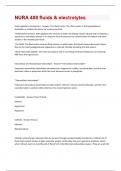
NURA 408 fluids & electrolytes Exam Questions With 100% Correct Answers.
Fluid regulation mechanisms - Answer--The thirst center. The thirst center in the hypothalamus stimulates or inhibits the desire for a person to drink. -Antidiuretic hormone. ADH regulates the amount of water the kidney tubules absorb and is released in response to low blood volume or in response to an increase in the concentration of sodium and other solutes in the intravascular fluids. -The RAAS. The RAA system controls fluid volume, in which when the blood volume decreases, blood flow to the renal juxtaglomerular apparatus is reduced, thereby activating the RAA system. -Atrial natriuretic peptide. The heart also plays a role in correcting overload imbalances, by releasing ANP from the right atrium. Intracellular and Extracellular electrolytes - Answer-*Intracellular electrolytes* Important intracellular electrolytes are potassium, magnesium, sulfate, and phosphate, and the most dominant cation is potassium while the most dominant anion is phosphate. *Extracellular electrolytes* Important extracellular electrolytes include sodium, chlorine, calcium, and bicarbonate, and the most essential cation is sodium while chlorine is the most important anion. Crystalloids - Answer-Clear IV fluids Isotonic Hypertonic Hypotonic Colloids - Answer-Viscous Albumin Blood products Colloids contain large molecules that do not pass through semipermeable membranes. Colloids are IV fluids that contain solutes of high molecular weight, technically, they are hypertonic solutions, which when infused, exert an osmotic pull of fluids from interstitial and extracellular spaces. They are useful forexpanding the intravascular volume and raising blood pressure. Colloids are indicated for patients in malnourished states and patients who cannot tolerate large infusions of fluid. Nursing interventions: -Assess allergy history. -Use a large-bore needle (18-gauge). A larger needle is needed when administering colloid solutions. -Document baseline data. Before infusion, assess the patient's vital signs, edema status, lung sounds, and heart sounds. - -Continue monitoring during and after the infusion. -Monitor the patient's response. Monitor intake and output closely for signs of hypervolemia, hypertension, dyspnea, crackles in the lungs, and edema. -Monitor coagulation indexes. Colloid solutions can interfere with platelet function and increase bleeding times, so monitor the patient's coagulation indexes. Albumin - Answer-Human albumin is a solution derived from plasma. It has two strengths: 5% albumin and 25% albumin. 5% Albumin is a solution derived from plasma and is a commonly utilized colloid solution. It is used to increase the circulating volume and restore protein levels in conditions such as burns, pancreatitis, and plasma loss through trauma. 25% Albumin is used together with sodium and water restriction to reduce excessive edema. They are considered blood transfusion products and uses the same protocols and nursing precautions when administering albumin. The use of albumin is contraindicated in patients with the following conditions: severe anemia, heart failure, or known sensitivity to albumin. Additionally, angiotensin-converting enzyme inhibitors should be withheld for at least 24 hours before administering albumin because of the risk of atypical reactions, such as hypotension and flushing. Isotonic solutions - Answer--cells retain their normal size and shape in isotonic solutions (same solute/water concentration as inside cells; water moves in and out) -Technically, electrolyte solutions are considered isotonic if the total electrolyte content is approximately 310 mEq/L -Isotonic IV fluids have a total osmolality close to that of the ECF and do not cause red blood cells to shrink or swell. -Great for fluid replacement0.9% NaCl, lactated ringer's Hypotonic solutions - Answer-0.45% NaCl Push volume from ECF into the cell (ICF) Higher water concentration to hydrate the patient Hypotonic IV solutions have a lower osmolality and contain fewer solutes than plasma. They cause fluid shifts from the ECF into the ICF to achieve homeostasis, therefore, causing cells to swell and may even rupture. IV solutions are considered hypotonic if the total electrolyte content is less than 250 mEq/L. Uses: provide free water for excretion of body wastes, treat cellular dehydration, and replace the cellular fluid. Hypertonic solutions - Answer-3% Saline 5% Saline 10% Dextrose in Water (D10W) 5% Dextrose in 0.9% Saline 5% Dextrose in 0.45% saline 5% Dextrose in Lactated Ringer's
Geschreven voor
- Instelling
- NURA 408 fluids & electrolytes
- Vak
- NURA 408 fluids & electrolytes
Documentinformatie
- Geüpload op
- 1 juni 2024
- Aantal pagina's
- 19
- Geschreven in
- 2023/2024
- Type
- Tentamen (uitwerkingen)
- Bevat
- Vragen en antwoorden
Onderwerpen
-
nura 408 fluids electrolytes

Ook beschikbaar in voordeelbundel