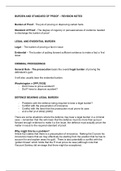
BURDEN AND STANDARD OF PROOF – REVISION NOTES
Burden of Proof - The job of proving or disproving certain facts
Standard of Proof - The degree of cogency or persuasiveness of evidence needed
to discharge the burden of proof
LEGAL AND EVIDENTIAL BURDEN
Legal – The burden of proving a fact in issue
Evidential – The burden of putting forward sufficient evidence to make a fact a ‘live’
issue
CRIMINAL PROCEEDINGS
General Rule - The prosecution bears the overall legal burden of proving the
defendant’s guilt.
It will also usually bear the evidential burden.
Woolmington v DPP [1935]
- Did D have to prove accident?
- Did P have to disprove accident?
DEFENCE BEARING LEGAL BURDEN
- Problems with the defence being required to bear a legal burden?
- Conflict with the presumption of innocence
- Conflict with the tenet that the prosecution must prove its case
- A-G’s Ref (4 of 2002) [2005]
There are some situations where the defence may bear a legal burden in a criminal
case – remember that this will mean that the defence must do more than just put
forward enough evidence to make it a live issue, the defence must actually prove the
matter in issue to the required standard of proof.
Why might this be a problem?
Article 6(2) states that there is a presumption of innocence. Making the D prove his
innocence means that we may effectively be starting from the position that he has to
account for and explain away his guilt. There is also potentially a conflict with the
‘golden thread’ which holds that the P must prove its case (although note that
Viscount Sankey did envisage that there might be exceptions).
Burden of Proof - The job of proving or disproving certain facts
Standard of Proof - The degree of cogency or persuasiveness of evidence needed
to discharge the burden of proof
LEGAL AND EVIDENTIAL BURDEN
Legal – The burden of proving a fact in issue
Evidential – The burden of putting forward sufficient evidence to make a fact a ‘live’
issue
CRIMINAL PROCEEDINGS
General Rule - The prosecution bears the overall legal burden of proving the
defendant’s guilt.
It will also usually bear the evidential burden.
Woolmington v DPP [1935]
- Did D have to prove accident?
- Did P have to disprove accident?
DEFENCE BEARING LEGAL BURDEN
- Problems with the defence being required to bear a legal burden?
- Conflict with the presumption of innocence
- Conflict with the tenet that the prosecution must prove its case
- A-G’s Ref (4 of 2002) [2005]
There are some situations where the defence may bear a legal burden in a criminal
case – remember that this will mean that the defence must do more than just put
forward enough evidence to make it a live issue, the defence must actually prove the
matter in issue to the required standard of proof.
Why might this be a problem?
Article 6(2) states that there is a presumption of innocence. Making the D prove his
innocence means that we may effectively be starting from the position that he has to
account for and explain away his guilt. There is also potentially a conflict with the
‘golden thread’ which holds that the P must prove its case (although note that
Viscount Sankey did envisage that there might be exceptions).