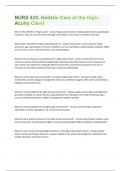
NURS 425: Holistic Care of the High-Acuity Client Complete Questions And Answers
What is the definition of high-acuity? - Answer-high-acuity involves complex patients with unpredictable outcomes. They are most commonly thought of as being in critical care or intensive care units. What factors contribute to high-acuity admissions? - Answer-acute issues, such as trauma, stroke, aneurysm; age; exacerbation of chronic conditions, such as heart failure, kidney disease, diabetes, COPD; lack of access to care; economic factors; and noncompliance What are the nursing care considerations for a high-acuity client? - Answer-clients will come from a variety of cultures and educational backgrounds; individual and family response to the situation will vary; proper care depends on adequate physical assessment, psychosocial assessment and use of resources to help client and family meet their needs and achieve goals What are some major areas to consider in caring for high-acuity clients? - Answer-the high-acuity environment, pharmacological management and issues, nutritional support, older adult considerations, palliative and end of life care What are some benefits to the high-acuity environment? - Answer-rapid access to labs and diagnostics; specialists available to consult; 24-hour, specialized care for individuals who need monitoring; rapid access to needed medications; ability to escalate care rapidly if needed What are some drawbacks to the high-acuity environment? - Answer-a lot of people, equipment, information, activity, stimulation; not a lot of communication What are some physical stressors in the high-acuity environment? - Answer-lack of sleep, isolation, pain, lack of movement, overstimulation (lights, sounds), pharmacological effects (sedatives, antipsychotics) What are some social and psychological stressors in the high-acuity environment? - Answer-anxiety (client, family), grief, family dynamics, stressors related to the event that brought the individual to the hospital, financial, post-stay concernsWhat are some common complications from stressors? - Answer-venous thromboembolism due to lack of mobility, common methods of prophylaxis are anticoagulant administration, compression stockings, and SCDs; GI bleed from stress causing GI bleed, common to give PPIs for stress prophylaxis; delirium What is delirium? - Answer-an acute disorder characterized by confusion, attention deficits, fluctuating mental status, altered level of consciousness, and possible disordered thinking; often involves a misinterpretation of stimuli; develops quickly; can be caused by infectious process, adverse drug reactions, or metabolic conditions, lack of sleep; most common cognitive disorder in the high-acuity setting; increase in delirium days increases the risk for death (5x) How should delirium be assessed and treated? - Answer-there are several different assessment scales that are used; find the underlying cause and treat; can use antipsychotics, but this should be the last choice for a client who is a danger to themselves or others; prevention is the goal (avoid medications that are known to cause delirium, such as benzos, if possible and manage the environment to support good sleep hygiene) What is the nurses role in facilitating care in the high-acuity environment? - Answer-acknowledge stressors and involve the client and family in planning to reduce them; the nurse is the mouthpiece for the client/family; assess client and communicate changes quickly; assess and manage stressors (do not neglect the role of anxiety, pain, or lack of sleep); do not jump straight to pharmacological interventions; connect to resources (pastoral care, social work, client and family education, palliative care); listen and understand the goals of client/family; communicare needs to members of the team to orchestrate holistic care What are the major areas that require pharmacological management? - Answer-pain, sedation, chronic illness (could be unrelated or an exacerbation), acute illness (can be multiple issues at once) Describe pain in the high-acuity client. - Answer-high-acuity clients typically have a higher level of pain based on the disease process; pain can be acute or chronic; can be somatic, visceral, neuropathic, or psychosomatic; pain perception varies widely because it includes psychosocial as well as physiological components; must have pain assessment as part of high-acuity nursing; pain can often cause anxiety and anxiety often makes pain worse
Written for
- Institution
- NURS 425: Holistic Care of the High-Acuity Client
- Course
- NURS 425: Holistic Care of the High-Acuity Client
Document information
- Uploaded on
- May 31, 2024
- Number of pages
- 7
- Written in
- 2023/2024
- Type
- Exam (elaborations)
- Contains
- Questions & answers
Subjects
-
nurs 425 holistic care of the high acuity client

Also available in package deal