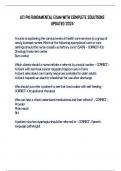
ATI RN Fundamentals Online Practice 2023 A V2 Exam B New Latest Version with Questions and Answers A nurse is administering 1 L of 0.9% sodium chloride to a client who is postoperative and has fluid volume deficit. Which of the following changes should the nurse identify as an indication that the treatment was successful? Increase in hematocrit increas e in respiratory rate Decrease in heart rate Decrease in capillary refill time - ✔✔ ANSW✔✔ Correct Answer: Decrease in heart rate Fluid volume deficit causes tachycardia. With correction of the imbalance, the heart rate should return to the expected range. Incorrect Answers: Increase in hematocrit: Fluid volume deficit causes an increase in hematocrit level due to depletion of extracellular fluid. With correction of the imbalance, the hematocrit level should decrease. increase in respiratory rate Fluid volu me deficit causes an increase in respiratory rate. With correction of the imbalance, the respiratory rate should return to the expected range. Decrease in capillary refill time Fluid volume deficit slows capillary refill. With correction of the imbalance, capillary refill time should return to the expected range. A nurse is caring for a client who is scheduled to be transferred to a long -term care facility. The client's family questions the nurse about the reasons for the transfer. Which of the following responses made by the nurse is appropriate? "The transfer of your family member is being done because the provider knows what's best." "Would you like it if we discussed the transfer with your family member?" "Why are you so concerned about this transfer? " "I know how you feel. My parent had to be transferred to a long -term care facility." - ✔✔ ANSW✔✔ Correct Answer: "Would you like it if we discussed the transfer with your family member?" This response facilitates therapeutic communication and provides gene ral leads while maintaining client confidentiality. Incorrect Answers: "The transfer of your family member is being done because the provider knows what's best." This is a defensive response which can hinder further communication. "Why are you so concerned about this transfer?" Asking a why question can make the recipient defensive which can hinder further communication. "I know how you feel. My parent had to be transferred to a long -term care facility." This is a sympathetic respo nse, which can interfere with a therapeutic relationship. A nurse is reviewing the laboratory results of a female client who has hypovolemia. Which of the following laboratory result would be a priority for the nurse report to the provider? BUN 21 mg/dL (10 to 20 mg/dL) Creatinine 1.4 mg/dL (0.5 to 1.1 mg/dL) Sodium 132 mEq/L (136 to 145 mEq/L) Potassium 5.8 mEq/L (3.5 to 5 mEq/L) - ✔✔ ANSW✔✔ Correct Answer: Potassium 5.8 mEq/L (3.5 to 5 mEq/L) When using the urgent versus nonurgent approach to client care, the nurse should determine that this potassium level is above the expected reference range and should be reported to the provider. Potassium affects the contractility of the heart and this client would be at risk for developing dysrhythmias. Incorrect an swers: BUN 21 mg/dL (10 to 20 mg/dL) This BUN level is slightly above the expected reference range and is an expected non -urgent finding for a client who has hypovolemia; therefore, there is another laboratory result that is a priority for the nurse to rep ort to the provider. Creatinine 1.4 mg/dL (0.5 to 1.1 mg/dL) This creatinine level is slightly above the expected reference range and is an expected non -urgent finding for a client who has hypovolemia; therefore, there is another laboratory result that is a a priority for the nurse to report to the provider. Sodium 132 mEq/L (136 to 145 mEq/L) This sodium level is slightly below the expected reference range and is an expected non -urgent finding for a client who has hypovolemia; therefore, there is another laboratory result that is a priority for the nurse to report to the provider. A nurse is caring for a client who reports difficulty falling asleep. Which of the following recommendations should the nurse make? "Drink a cup of hot cocoa before bedtime." "Maintain a consistent time to wake up each day." "Exercise 1 hour before going to bed." "Watch a television program in bed before going to sleep." - ✔✔ ANSW✔✔ Correct Answer: "Maintain a consistent time to wake up each day." The client should maintain a con sistent time for waking up and going to sleep. This helps to establish an internal sense of sleep and waking on a daily basis and helps to maintain it over time. This will help promote sleep for the client. Incorrect Answers: "Drink a cup of hot cocoa bef ore bedtime." Cocoa contains caffeine, which is a stimulant that can interfere with sleep. "Exercise 1 hour before going to bed." Exercising within 2 hr of bedtime can interfere with sleep. "Watch a television program in bed before going to sleep." The c lient should avoid watching television in bed before going to sleep to reduce stimulation in order to promote rest. A nurse on a medical -surgical unit is caring for a client who has a new prescription for wrist restraints. Which of following actions shoul d the nurse take? Pad the client's wrist before applying the restraints. Evaluate the client's circulation every 8 hr after application. Remove the restraints every 4 hr to evaluate the client's status. Secure the restraint ties to the bed's side rails. - ✔✔ ANSW✔✔ Correct Answer: Pad the client's wrist before applying the restraints. The use of restraints without padding can abrade the client's skin, resulting in client injury. Incorrect Answers:
Exam (elaborations)
ATI RN Fundamentals Online Practice 2023 A V2 Exam B New Latest Version with
ATI RN Fundamentals Online Practice 2023 A V2 Exam B New Latest Version with
Institution
ASU SHS 470
Course
ASU SHS 470
Whoops! We can’t load your doc right now. Try again or contact support.
Written for
- Institution
- ASU SHS 470
- Course
- ASU SHS 470
Document information
- Uploaded on
- May 30, 2024
- Number of pages
- 51
- Written in
- 2023/2024
- Type
- Exam (elaborations)
- Contains
- Questions & answers
Subjects
-
ati rn fundamentals online practice 2023 a v2 exam
-
ati rn fundamentals online practice 2023 a v2 ex
Content preview
$20.99
Get access to the full document:
100% satisfaction guarantee
Immediately available after payment
Both online and in PDF
No strings attached

Also available in package deal
Package deal
ATI RN Concept Based Assessment Level 1 Examz Online Practice Exam B New Latest
6
2024
$ 125.44
More info