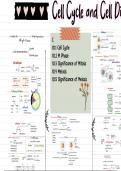
Cell Cycle and Cell Di
Telophase
single cell large organisms No discrete elements r
C
spindle pole
m
Chromosomes cluster N
Cell cycle & Division g
Nuclear envelope
10.1 Cell Cycle
E
..
forming
Chromosomes cluster
Growth spindle pole
2 daughter nuclei
cell characteristics
reproduction 10.2 M Phase Cytokinesis
cytoplasm division 2 daughter ce!s
10.1 Cell Cycle
synthesises Ce! constituents two daughter
10.3 Significance of Mitosis Animal cytokinesis
furrow plasma
10.4 Meiosis
plasma membrane
cell
divides
Ce! genome Ce!
duplicates deepens joins c
I divid
10.5 Significance of Meiosis
ce! division
ce! growth DNA synthesis coordinated 2 cell cytoplas
DNA replication
(cytoplasmic increase) genetic
ce! growth
For
control
correct cell
continuous process Only ce! division cycle,division
Plant cytokinesis
10.1.1 Phases of Cell Cycle Di#erent bcz of ce! wa!
new ce
human ce!s Yeast duration vary formation ice!-pl
90 min
organism to organism
24 hours cell to cell mitochon
distributed
A plastids
cell cycle
V
interphase M Phase
↓ ↓
multinucleate [ only karyo
95% 5%
Interphase
·
syncytium formation
23 hr 1 hr M Phase (Mitosis phase) two adjacent ce!s (e.g., liquid endosperm in c
M Phase Significance of Mitosis
cell division or mitosis most dramatic period Mitosis Mito
- equational division
' interphase ( resting phase) Subdivided
starts(karyokinesis) 7 ends (cytokinesis)
reorganisation a! ce! components
diploid daughter ce!s ↓ ↓
haploid
nuclear division cytoplasm division diploid ce!s only
G1 phase (Gap 1)
l parent Csome lowe
S phase (Synthesis) equational division chromosomes same
genetica!y same insectsS
Preparation progeny ce!s
v W G2 phase (Gap 2)
Karyokinesis involves 4 stages
ce! growth DNA replication
Prophase cell repair restore nucleo-
G1 phase S or synthesis phase Metaphase Prophase cytoplasmic ratio
Anaphase
do not
show multicellular ↑ ↑
mitosis DNA synthesis or replication organisms ep
interval -" Telophase Mitosis Significance cell replace
DNA replication initiation golgi growth -
↓ -
-
gu
ER
metabolica!y active DNA doubles no increase in chromosome nucleolus meristematic tissues b
apical H lateral cambium
continuously grows nuclear envelope
no DNA replication If 2C then 4C If 2n then also 2n
·
All life
initiation of chromosomal condensation compact mitotic chromosomes
Leads to
Meiosis
.
G2 phase replicate DNA In nucleus 2 chromatids with centromere
proteins synthesised
In animal
cells E duplicate centriole In cytoplasm
chromosome untangled
During
chromatin condensation centrosome
move
ce! opposite poles
2 asters with spindle "bres
ce! growth continues gametogenesis in plants and animals
forms
G1 S G2 mitotic apparatus
Male ce! (2n) ↳ Sperm (n)
Fertization
Chromosome 2n 2n 2n
Female ce! (2n) 7
Egg (n) Zygote (2n)
DNA 4C Chromosome half
Telophase
single cell large organisms No discrete elements r
C
spindle pole
m
Chromosomes cluster N
Cell cycle & Division g
Nuclear envelope
10.1 Cell Cycle
E
..
forming
Chromosomes cluster
Growth spindle pole
2 daughter nuclei
cell characteristics
reproduction 10.2 M Phase Cytokinesis
cytoplasm division 2 daughter ce!s
10.1 Cell Cycle
synthesises Ce! constituents two daughter
10.3 Significance of Mitosis Animal cytokinesis
furrow plasma
10.4 Meiosis
plasma membrane
cell
divides
Ce! genome Ce!
duplicates deepens joins c
I divid
10.5 Significance of Meiosis
ce! division
ce! growth DNA synthesis coordinated 2 cell cytoplas
DNA replication
(cytoplasmic increase) genetic
ce! growth
For
control
correct cell
continuous process Only ce! division cycle,division
Plant cytokinesis
10.1.1 Phases of Cell Cycle Di#erent bcz of ce! wa!
new ce
human ce!s Yeast duration vary formation ice!-pl
90 min
organism to organism
24 hours cell to cell mitochon
distributed
A plastids
cell cycle
V
interphase M Phase
↓ ↓
multinucleate [ only karyo
95% 5%
Interphase
·
syncytium formation
23 hr 1 hr M Phase (Mitosis phase) two adjacent ce!s (e.g., liquid endosperm in c
M Phase Significance of Mitosis
cell division or mitosis most dramatic period Mitosis Mito
- equational division
' interphase ( resting phase) Subdivided
starts(karyokinesis) 7 ends (cytokinesis)
reorganisation a! ce! components
diploid daughter ce!s ↓ ↓
haploid
nuclear division cytoplasm division diploid ce!s only
G1 phase (Gap 1)
l parent Csome lowe
S phase (Synthesis) equational division chromosomes same
genetica!y same insectsS
Preparation progeny ce!s
v W G2 phase (Gap 2)
Karyokinesis involves 4 stages
ce! growth DNA replication
Prophase cell repair restore nucleo-
G1 phase S or synthesis phase Metaphase Prophase cytoplasmic ratio
Anaphase
do not
show multicellular ↑ ↑
mitosis DNA synthesis or replication organisms ep
interval -" Telophase Mitosis Significance cell replace
DNA replication initiation golgi growth -
↓ -
-
gu
ER
metabolica!y active DNA doubles no increase in chromosome nucleolus meristematic tissues b
apical H lateral cambium
continuously grows nuclear envelope
no DNA replication If 2C then 4C If 2n then also 2n
·
All life
initiation of chromosomal condensation compact mitotic chromosomes
Leads to
Meiosis
.
G2 phase replicate DNA In nucleus 2 chromatids with centromere
proteins synthesised
In animal
cells E duplicate centriole In cytoplasm
chromosome untangled
During
chromatin condensation centrosome
move
ce! opposite poles
2 asters with spindle "bres
ce! growth continues gametogenesis in plants and animals
forms
G1 S G2 mitotic apparatus
Male ce! (2n) ↳ Sperm (n)
Fertization
Chromosome 2n 2n 2n
Female ce! (2n) 7
Egg (n) Zygote (2n)
DNA 4C Chromosome half