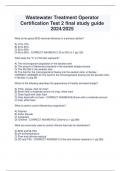
Wastewater Treatment Operator Certification Test 2 final study guide 2024/2025
Wastewater Treatment Operator Certification Test 2 final study guide 2024/2025 What is the typical BOD removal efficiency in a primary clarifier? A) 10 to 15% B) 40 to 60% C) 20 to 50% D) 95 to 99% - CORRECT ANSWER-C) 20 to 50% (v.1 pg 129) What does the "F" in F/M ratio represent? A) The microorganism population in the aeration tank B) The amount of filamentous bacteria in the activated sludge process C) The MLVSS in the aeration tank D) The food for the microorganisms flowing into the aeration tank, in lbs/day - CORRECT ANSWER-D) The food for the microorganisms flowing into the aeration tank, in lbs/day (v.2 pg 58) Which of the following describes the appearance of healthy activated sludge? A) Thick, greasy, dark tan foam B) Brown with a moderate amount of crisp, white foam C) Clear liquid with clear foam D) Gray liquid with no foam - CORRECT ANSWER-B) Brown with a moderate amount of crisp, white foam What is used to control filamentous organisms? A) Polymer B) Sulfur Dioxide C) Coagulant D) Chlorine - CORRECT ANSWER-D) Chlorine (v.1 pg 399) What are commonly used to control chlorine feed rate for disinfection? A) BOD and MLVSS B) pH and temperature C) Flow and chlorine residual D) DO and TSS - CORRECT ANSWER-C) Flow and chlorine residual (v.1 pg 356) Which toxic gas is commonly found in septic wastewater and smells like rotten eggs?
Written for
- Institution
- Wastewater treatment
- Course
- Wastewater treatment
Document information
- Uploaded on
- May 30, 2024
- Number of pages
- 15
- Written in
- 2023/2024
- Type
- Exam (elaborations)
- Contains
- Questions & answers
Subjects
-
wastewater treatment operator certification test
-
what is the typical bod removal efficiency in a pr
-
what are commonly used to control chlorine feed ra

Also available in package deal