Samantha Cruz
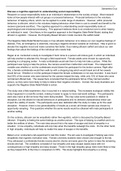
Discuss a cognitive approach to understanding social responsibility.
Research on social responsibility looks at an individual’s relationships to the society at large. Most research
looks at how people interact with out groups or prosocial behaviour. Prosocial behaviour is the voluntary
behaviour of helping others, which can be applied to a wide range of situations. However, within prosocial
behaviour is altruism, which is the voluntary helping behaviour when there is cost to oneself and benefit to the
receiver (personal sacrifice). The cognitive approach to understanding social responsibility looks at
psychological and emotional processing. This approach believes there is an emotional core to when helping
an individual in need. One theory in the cognitive approach is the Negative State Relief Model, stating that
altruism is egotistic. However, the Empathy-Based Altruism model counters this selfish belief.
The Negative State Relief Model focuses on how altruistic behaviour is to relieve our own negative feelings of
distress. First, an emergency is observed, inducing a negative emotion towards an individual. Help is given to
elevate this negative mood and make ourselves feel better, thus making altruism selfish and about our own
feelings than about the feelings of the individual who needs help.
Regan et al. conducted a study to investigate if harm done to a person will induce guilt, in which an individual
will help another to alleviate this, through a field experiment. Female adults were chosen by opportunity
sampling in a shopping center. A male confederate would ask them to help him take a picture. While the
participant was trying to take the picture, the camera would then malfunction and break. The independent
variable was whether or not the confederate would blame the participant for the broken camera. Right after
this, a female confederate would then walk by with a shopping bag which would break and all her sweets
would fall out. Whether or not the participant helped the female confederate or not was recorded. It was found
that 55% of the women who were blamed for the camera helped the lady, while only 15% of those who were
not blamed offered help. The researchers concluded that the participants felt as if they harmed another
person, so they were more likely to help to relieve their negative emotions. Overall, this study illustrates and
supports the Negative State Relief Model in action.
This study was a field experiment, thus it occurred in a natural setting. This increases ecological validity this
study happened in a real-life context, making it easier to apply to more real-world settings. The participants
were also naive at did not know they were being studied. This may raise some questions in relation to
deception, but this allows for natural behaviours of participants and no demand characteristics which can
impact the validity of results. The participants were also debriefed after the study to make up for the used
deception. However, there is low generalizability of results as a small, all female sample was chosen by
opportunity sampling. This questions whether the same results would be obtained with male participants in
another setting.
On the contrary, altruism can be empathetic rather then egotistic, which is discussed by Empathy-Based
Altruism. Empathy is feeling the same feelings as another person. This type of helping is unselfish and is to
better the welfare of others. The main idea around this is the ease of escape and level of empathy in a
situation. In low empathy, individuals will only help when the benefits outweigh the costs. On the other hand,
in high empathy, individuals will help no matter the ease of escape or the benefits.
Batson et al. conducted a lab experiment to test this model. The aim was to investigate if helping was more
empathetic than egoistic motivation wise. Female university students were chosen and brought to the lab.
They witnessed a confederate female receive electric shocks and were given the option to take the remaining
shocks she had. The conditions consisted of: low empathy and easy escape (easily leave with not
consequences) or high empathy and easy escape. Those in the high empathy group were more likely to help
as they helped 83% of the time in comparison to 58%. This study highlights that empathy is a strong
Discuss a cognitive approach to understanding social responsibility.
Research on social responsibility looks at an individual’s relationships to the society at large. Most research
looks at how people interact with out groups or prosocial behaviour. Prosocial behaviour is the voluntary
behaviour of helping others, which can be applied to a wide range of situations. However, within prosocial
behaviour is altruism, which is the voluntary helping behaviour when there is cost to oneself and benefit to the
receiver (personal sacrifice). The cognitive approach to understanding social responsibility looks at
psychological and emotional processing. This approach believes there is an emotional core to when helping
an individual in need. One theory in the cognitive approach is the Negative State Relief Model, stating that
altruism is egotistic. However, the Empathy-Based Altruism model counters this selfish belief.
The Negative State Relief Model focuses on how altruistic behaviour is to relieve our own negative feelings of
distress. First, an emergency is observed, inducing a negative emotion towards an individual. Help is given to
elevate this negative mood and make ourselves feel better, thus making altruism selfish and about our own
feelings than about the feelings of the individual who needs help.
Regan et al. conducted a study to investigate if harm done to a person will induce guilt, in which an individual
will help another to alleviate this, through a field experiment. Female adults were chosen by opportunity
sampling in a shopping center. A male confederate would ask them to help him take a picture. While the
participant was trying to take the picture, the camera would then malfunction and break. The independent
variable was whether or not the confederate would blame the participant for the broken camera. Right after
this, a female confederate would then walk by with a shopping bag which would break and all her sweets
would fall out. Whether or not the participant helped the female confederate or not was recorded. It was found
that 55% of the women who were blamed for the camera helped the lady, while only 15% of those who were
not blamed offered help. The researchers concluded that the participants felt as if they harmed another
person, so they were more likely to help to relieve their negative emotions. Overall, this study illustrates and
supports the Negative State Relief Model in action.
This study was a field experiment, thus it occurred in a natural setting. This increases ecological validity this
study happened in a real-life context, making it easier to apply to more real-world settings. The participants
were also naive at did not know they were being studied. This may raise some questions in relation to
deception, but this allows for natural behaviours of participants and no demand characteristics which can
impact the validity of results. The participants were also debriefed after the study to make up for the used
deception. However, there is low generalizability of results as a small, all female sample was chosen by
opportunity sampling. This questions whether the same results would be obtained with male participants in
another setting.
On the contrary, altruism can be empathetic rather then egotistic, which is discussed by Empathy-Based
Altruism. Empathy is feeling the same feelings as another person. This type of helping is unselfish and is to
better the welfare of others. The main idea around this is the ease of escape and level of empathy in a
situation. In low empathy, individuals will only help when the benefits outweigh the costs. On the other hand,
in high empathy, individuals will help no matter the ease of escape or the benefits.
Batson et al. conducted a lab experiment to test this model. The aim was to investigate if helping was more
empathetic than egoistic motivation wise. Female university students were chosen and brought to the lab.
They witnessed a confederate female receive electric shocks and were given the option to take the remaining
shocks she had. The conditions consisted of: low empathy and easy escape (easily leave with not
consequences) or high empathy and easy escape. Those in the high empathy group were more likely to help
as they helped 83% of the time in comparison to 58%. This study highlights that empathy is a strong