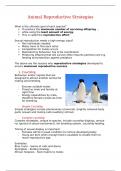
Animal Reproductive Strategies
What is the ultimate goal of each species?
To produce the maximum number of surviving offspring ...
while using the least amount of energy.
This is called the reproductive effort.
Sexual reproduction needs a high energy input?
Two individuals needed
Mates have to find each other
Competition for mates occurs
Reproductive behaviour has to be coordinated
Producing offspring that will survive often requires parental care e.g.
feeding and protection against predators
The above are the reasons why reproductive strategies developed to
ensure maximum reproductive success.
1. Courtship
Behaviour and/or signals that are
designed to attract another animal for
mating and breeding.
- Ensures suitable mates
- Timed so male and female at
right time
- Energy expenditure by male,
therefore female conserves time
for breeding.
- Simple Courtship
Simple strategies include pheromones (chemical), brightly coloured body
parts (visual) and mating calls (auditory) stimuli.
- Complex courtship
Complex strategies, unique to species, include courtship displays, annual
rut (period of sexual excitement), lek breeding system, courtship-feeding.
Timing of sexual display is important:
- Females will be in peak condition to nurture developing baby.
- Young are born when enough food is available to enable them to
reach reproductive age.
Examples:
Blue crane – Series of calls and dance
Springbok – Rutting strategy
African hoopoes – feed insects to mates
, 2. External vs. Internal fertilisation
- Males and females find suitable mates e.g. male with best genetic
potential.
- Sexual behaviour in courtship is timed so that male and female both
ready for mating at same time.
- Energy expenditure by male; female conserves energy for breeding.
External fertilisation
Sperm cell united with egg cell external to bodies of individuals (Leopard
toad and trout). In most aquatic vertebrates, fertilsation takes place
outside of the body, in water.
Disadvantages of external fertilisation:
1. Wasteful; huge loss of energy – many eggs produced, few survive.
2. Fertilisation not certain.
3. Environmental conditions important for hatching of eggs
Advantages of external fertilisation:
1. Less energy required to produce offspring due to reduced parental
care
How does external fertilisation maximise reproduction?
1. Huge numbers of eggs increases probability of fertilisation.
2. Courtship rituals ensure that males and females are closer to each
other.
3. Eggs of marine species release species-specific chemotactic factor
to attract sperm.
4. Spawning is timed to occur when ocean currents can disperse eggs
e.g. sessile species.
5. Young easily dispersed by sea currents; reduce competition.
6. No complicated physical mating, using energy.
7. Larval form gets food directly from environment; no energy input
from parent.
Internal fertilisation
Male gametes directly into female body (mating) to fertilise within body.
Most terrestrial vertebrates and ALL mammals.
- Occurs in insects and terrestrial vertebrates i.e. birds, reptiles
and mammals.
- Marine mammals and some fish e.g. sharks and rays also have
internal fertilisation.
- Mating and copulation occurs.
- Most animals have cloaca – common opening for reproduction
and egestion – during fertilisation cloacas are lined up.
- Male insects and mammals have a penis – organ to transfer
sperm to body of female.
What is the ultimate goal of each species?
To produce the maximum number of surviving offspring ...
while using the least amount of energy.
This is called the reproductive effort.
Sexual reproduction needs a high energy input?
Two individuals needed
Mates have to find each other
Competition for mates occurs
Reproductive behaviour has to be coordinated
Producing offspring that will survive often requires parental care e.g.
feeding and protection against predators
The above are the reasons why reproductive strategies developed to
ensure maximum reproductive success.
1. Courtship
Behaviour and/or signals that are
designed to attract another animal for
mating and breeding.
- Ensures suitable mates
- Timed so male and female at
right time
- Energy expenditure by male,
therefore female conserves time
for breeding.
- Simple Courtship
Simple strategies include pheromones (chemical), brightly coloured body
parts (visual) and mating calls (auditory) stimuli.
- Complex courtship
Complex strategies, unique to species, include courtship displays, annual
rut (period of sexual excitement), lek breeding system, courtship-feeding.
Timing of sexual display is important:
- Females will be in peak condition to nurture developing baby.
- Young are born when enough food is available to enable them to
reach reproductive age.
Examples:
Blue crane – Series of calls and dance
Springbok – Rutting strategy
African hoopoes – feed insects to mates
, 2. External vs. Internal fertilisation
- Males and females find suitable mates e.g. male with best genetic
potential.
- Sexual behaviour in courtship is timed so that male and female both
ready for mating at same time.
- Energy expenditure by male; female conserves energy for breeding.
External fertilisation
Sperm cell united with egg cell external to bodies of individuals (Leopard
toad and trout). In most aquatic vertebrates, fertilsation takes place
outside of the body, in water.
Disadvantages of external fertilisation:
1. Wasteful; huge loss of energy – many eggs produced, few survive.
2. Fertilisation not certain.
3. Environmental conditions important for hatching of eggs
Advantages of external fertilisation:
1. Less energy required to produce offspring due to reduced parental
care
How does external fertilisation maximise reproduction?
1. Huge numbers of eggs increases probability of fertilisation.
2. Courtship rituals ensure that males and females are closer to each
other.
3. Eggs of marine species release species-specific chemotactic factor
to attract sperm.
4. Spawning is timed to occur when ocean currents can disperse eggs
e.g. sessile species.
5. Young easily dispersed by sea currents; reduce competition.
6. No complicated physical mating, using energy.
7. Larval form gets food directly from environment; no energy input
from parent.
Internal fertilisation
Male gametes directly into female body (mating) to fertilise within body.
Most terrestrial vertebrates and ALL mammals.
- Occurs in insects and terrestrial vertebrates i.e. birds, reptiles
and mammals.
- Marine mammals and some fish e.g. sharks and rays also have
internal fertilisation.
- Mating and copulation occurs.
- Most animals have cloaca – common opening for reproduction
and egestion – during fertilisation cloacas are lined up.
- Male insects and mammals have a penis – organ to transfer
sperm to body of female.