
LECTURE 1: ANXIETY DISORDERS
Anxiety: the feeling of fear or panic. Most people only feel anxious in stressful situations and
once these are over, they feel calmer. However, sometimes the feelings of anxiety continua
after the difficult situation or someone may feel a stronger sense of fear than others. This is
when anxiety may become a problem and can affect your daily life.
Functionality of anxiety:
Survival: anxiety makes us approach situations that increase survival and avoid
situations that decrease survival.
Social function: signaling danger and a motivation of social adapt behavior.
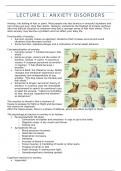
Conceptualization of anxiety:
Common sense: “I tremble because I feel
afraid.”
James & Lange: viscera are the center of
emotion. Senses cortex muscles &
viscera response perceived as emotion
reaction. “I feel afraid because I
tremble.”
Canon & Bard: the thalamus is key. Bodily
changes and emotional experience occur
separately and independently of one
another. “The dog makes me tremble and
feel afraid.”
Schachter & Singer: two factor theory of
emotion a person uses the immediate
environment to search for emotional cues
to label the arousal. “I label my trembling
as fear, because I appraise the situation
as dangerous.”
The reaction to threat is first a moment of
freeze to prepare for fight-or-flight and decrease
the chance for detection.
After the freeze-phase, there is a phase of defense, which can either be fight or flight.
The physiological reaction to anxiety is as follows:
Parasympathetic NS down
o Contraction of bladder and intestines urge to go to the toilet.
o Digestion stops dry mouth and throat.
o Feeling sick.
Sympathetic NS up
o Blood pressure increases.
o Heartrate increases.
o Respiration increases.
o Sweating
o Increase of blood in muscles.
o Tense muscles trembling of hands or other parts.
o Tingling of hands or feet
o Pupils enlarge seeing more light.
o Goosebumps/hairs standing upright.
Cognitive reactions to anxiety:
Hyperalert
, Narrowing of attention
Idea that time goes slower.
Present or actual situation seems unreal.
Perception that you watch yourself from a distance.
Thinking you might faint.
Behavioral reactions to anxiety:
Protect yourself safety behaviors.
Urge to run.
Urge to cry.
Fight
Mental symptoms of anxiety:
Anxious thoughts
Ruminating
Worry
Wanting to hide/hiding.
Wanting to get away.
Becoming upset/angry.
Differences between fear and anxiety:
Fear Anxiety
Threat present Threat expected
Clear threat source No threat source
Short Long
High tension Discomfort
Clear start Unclear start
Emergency response Heightened vigilance
Views on anxiety:
Terror management theory (Greenberg et al., 1986): humans are motivated to quell the
potential for terror inherent in the human awareness of vulnerability and mortality by
investing in cultural belief systems. Self-esteem consists of the perception that one is a
valuable member of a meaningful universe.
Usually, children will start to learn and become concerned with the problem of death
around 3 years old and the anxieties regarding darkness and monsters become more
linked to real threats that culminate with the realization of the inevitability of death.
They find out that parents/caregivers are mortal and fallible.
Self-esteem thus functions as an anxiety buffer to maintain relative equanimity despite
the awareness of vulnerability and mortality.
Since its inception, the theory has generated empirical research into not just the nature
of self-esteem, motivation and prejudice, but also a host of other forms of human social
behavior, depression and psychopathology.
Irvin Yalom: death agony has been a taboo even under psychotherapists. People do
experience this fear. Some dream about it, others try to suppress it, which leads to
psychological symptoms.
Culture comes into play to provide a secure base in which the virtuous are rewarded
and the evil are punished.
Psycho-analytic view (Freud): the importance of anxiety was recognized. Anxiety is an
aversive inner state that people seek to avoid or escape. There are 3 major types of
anxiety:
o Reality anxiety: most basic form, rooted in reality. Fear of a dog bite or fear
arising from an impending accident.
o Neurotic anxiety: arises from an unconscious fear that the libidinal impulses of
the ID will take control at an in opportune time. This type of anxiety is driven by
a fear of punishment that will result from expressing the ID’s desires without
proper sublimation.
, o Moral anxiety: results from fear of violating moral or societal codes, moral
anxiety appears as guilt or shame.
In Freud’s view, the human is driven towards tension reduction in order to reduce
feelings of anxiety. This is done through defense mechanisms. These defense
mechanisms can be healthy or maladaptive, but tension reduction is the overall goal in
both cases.
When some type of anxiety occurs, the mind responds in two ways:
o Problem solving efforts increase.
o Defense mechanisms are triggered. These are tactics developed by the Ego to
help deal with the ID and the Super Ego. All defense mechanisms share two
common properties:
They can operate unconsciously.
They can distort, transform, or falsify reality in some way. The changing of
perceived reality allows for a lessening of anxiety, reducing the
psychological tension felt by an individual.
Anna Freud developed a comprehensive list of defense mechanisms:
o Repression/defensiveness: can be conscious but is most commonly unconscious.
o Denial: severe form of memory repression.
o Projection: anxiety is reduced by claiming another person actually has the
unpleasant thoughts that you are thinking. The repressed thoughts are
attributed to someone else.
o Rationalization: allows to find logical reasons for inexcusable actions.
o Intellectualization: protects against anxiety by repressing the emotions
connected with an event.
o Regression: the giving up of mature problem solving methods in favor of child-
like approaches to fixing problems.
o Displacement: shifting of intended targets, especially when the initial target is
threatening.
Learning theory: anxiety is based on conditioning. Classical conditioning is about when
one will have an anxiety response. Thus, when adrenaline is released and as a result
their heart rate, blood pressure and breathing increases.
Which conditioned stimuli (CS) are associated with the conditioned response (CR) of
anxiety and fear. In classical conditioning one learns the meaning of stimuli and to
predict what will happen if the stimulus appears. Classical conditioning if therefore
about predictability.
Operant conditioning is about how to cope with this anxiety response and what to do
(R) to avoid or reduce this bodily anxiety response. How can one get control over
these stimuli. Operant conditioning in about controllability.
Anxiety disorders:
Differ from developmentally normative fear or anxiety by being excessive or persisted
beyonf developmentally appropriate periods.
The fear/anxiety/avoidance causes clinically significant distress or impairment in social,
occupational, or other important areas of functioning.
Each disorder is diagnosed only when the symptoms are not attributable to the
physiological effects of a substance/medication or another medical condition, or are not
better explained by another mental disorder.
Types of anxiety disorders:
Specific phobia: fearful or anxious about circumscribed objects or situations. The fear is
almost immediately induced by the phobic situation, to a degree that is persistent and
out of proportion to the actual risk posed.
o Animal
o Natural environment
o Blood-injection-injury
Anxiety: the feeling of fear or panic. Most people only feel anxious in stressful situations and
once these are over, they feel calmer. However, sometimes the feelings of anxiety continua
after the difficult situation or someone may feel a stronger sense of fear than others. This is
when anxiety may become a problem and can affect your daily life.
Functionality of anxiety:
Survival: anxiety makes us approach situations that increase survival and avoid
situations that decrease survival.
Social function: signaling danger and a motivation of social adapt behavior.
Conceptualization of anxiety:
Common sense: “I tremble because I feel
afraid.”
James & Lange: viscera are the center of
emotion. Senses cortex muscles &
viscera response perceived as emotion
reaction. “I feel afraid because I
tremble.”
Canon & Bard: the thalamus is key. Bodily
changes and emotional experience occur
separately and independently of one
another. “The dog makes me tremble and
feel afraid.”
Schachter & Singer: two factor theory of
emotion a person uses the immediate
environment to search for emotional cues
to label the arousal. “I label my trembling
as fear, because I appraise the situation
as dangerous.”
The reaction to threat is first a moment of
freeze to prepare for fight-or-flight and decrease
the chance for detection.
After the freeze-phase, there is a phase of defense, which can either be fight or flight.
The physiological reaction to anxiety is as follows:
Parasympathetic NS down
o Contraction of bladder and intestines urge to go to the toilet.
o Digestion stops dry mouth and throat.
o Feeling sick.
Sympathetic NS up
o Blood pressure increases.
o Heartrate increases.
o Respiration increases.
o Sweating
o Increase of blood in muscles.
o Tense muscles trembling of hands or other parts.
o Tingling of hands or feet
o Pupils enlarge seeing more light.
o Goosebumps/hairs standing upright.
Cognitive reactions to anxiety:
Hyperalert
, Narrowing of attention
Idea that time goes slower.
Present or actual situation seems unreal.
Perception that you watch yourself from a distance.
Thinking you might faint.
Behavioral reactions to anxiety:
Protect yourself safety behaviors.
Urge to run.
Urge to cry.
Fight
Mental symptoms of anxiety:
Anxious thoughts
Ruminating
Worry
Wanting to hide/hiding.
Wanting to get away.
Becoming upset/angry.
Differences between fear and anxiety:
Fear Anxiety
Threat present Threat expected
Clear threat source No threat source
Short Long
High tension Discomfort
Clear start Unclear start
Emergency response Heightened vigilance
Views on anxiety:
Terror management theory (Greenberg et al., 1986): humans are motivated to quell the
potential for terror inherent in the human awareness of vulnerability and mortality by
investing in cultural belief systems. Self-esteem consists of the perception that one is a
valuable member of a meaningful universe.
Usually, children will start to learn and become concerned with the problem of death
around 3 years old and the anxieties regarding darkness and monsters become more
linked to real threats that culminate with the realization of the inevitability of death.
They find out that parents/caregivers are mortal and fallible.
Self-esteem thus functions as an anxiety buffer to maintain relative equanimity despite
the awareness of vulnerability and mortality.
Since its inception, the theory has generated empirical research into not just the nature
of self-esteem, motivation and prejudice, but also a host of other forms of human social
behavior, depression and psychopathology.
Irvin Yalom: death agony has been a taboo even under psychotherapists. People do
experience this fear. Some dream about it, others try to suppress it, which leads to
psychological symptoms.
Culture comes into play to provide a secure base in which the virtuous are rewarded
and the evil are punished.
Psycho-analytic view (Freud): the importance of anxiety was recognized. Anxiety is an
aversive inner state that people seek to avoid or escape. There are 3 major types of
anxiety:
o Reality anxiety: most basic form, rooted in reality. Fear of a dog bite or fear
arising from an impending accident.
o Neurotic anxiety: arises from an unconscious fear that the libidinal impulses of
the ID will take control at an in opportune time. This type of anxiety is driven by
a fear of punishment that will result from expressing the ID’s desires without
proper sublimation.
, o Moral anxiety: results from fear of violating moral or societal codes, moral
anxiety appears as guilt or shame.
In Freud’s view, the human is driven towards tension reduction in order to reduce
feelings of anxiety. This is done through defense mechanisms. These defense
mechanisms can be healthy or maladaptive, but tension reduction is the overall goal in
both cases.
When some type of anxiety occurs, the mind responds in two ways:
o Problem solving efforts increase.
o Defense mechanisms are triggered. These are tactics developed by the Ego to
help deal with the ID and the Super Ego. All defense mechanisms share two
common properties:
They can operate unconsciously.
They can distort, transform, or falsify reality in some way. The changing of
perceived reality allows for a lessening of anxiety, reducing the
psychological tension felt by an individual.
Anna Freud developed a comprehensive list of defense mechanisms:
o Repression/defensiveness: can be conscious but is most commonly unconscious.
o Denial: severe form of memory repression.
o Projection: anxiety is reduced by claiming another person actually has the
unpleasant thoughts that you are thinking. The repressed thoughts are
attributed to someone else.
o Rationalization: allows to find logical reasons for inexcusable actions.
o Intellectualization: protects against anxiety by repressing the emotions
connected with an event.
o Regression: the giving up of mature problem solving methods in favor of child-
like approaches to fixing problems.
o Displacement: shifting of intended targets, especially when the initial target is
threatening.
Learning theory: anxiety is based on conditioning. Classical conditioning is about when
one will have an anxiety response. Thus, when adrenaline is released and as a result
their heart rate, blood pressure and breathing increases.
Which conditioned stimuli (CS) are associated with the conditioned response (CR) of
anxiety and fear. In classical conditioning one learns the meaning of stimuli and to
predict what will happen if the stimulus appears. Classical conditioning if therefore
about predictability.
Operant conditioning is about how to cope with this anxiety response and what to do
(R) to avoid or reduce this bodily anxiety response. How can one get control over
these stimuli. Operant conditioning in about controllability.
Anxiety disorders:
Differ from developmentally normative fear or anxiety by being excessive or persisted
beyonf developmentally appropriate periods.
The fear/anxiety/avoidance causes clinically significant distress or impairment in social,
occupational, or other important areas of functioning.
Each disorder is diagnosed only when the symptoms are not attributable to the
physiological effects of a substance/medication or another medical condition, or are not
better explained by another mental disorder.
Types of anxiety disorders:
Specific phobia: fearful or anxious about circumscribed objects or situations. The fear is
almost immediately induced by the phobic situation, to a degree that is persistent and
out of proportion to the actual risk posed.
o Animal
o Natural environment
o Blood-injection-injury


