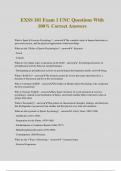
EXSS 181 FINAL Exam Questions With 100% Correct Answers
EXSS 181 FINAL Exam Questions With 100% Correct Answers Sport and exercise psychology - answerthe scientific study of human behavior in sport and exercise and practical application of that knowledge three roles of sport psychologists - answer1. Research 2. Teaching 3. consulting two major types of questions in the field? - answer1. Understand the effects of psych factors on sport/physical activity behavior and performance 2. Understand the effects of participating in sport and physical activity on psych, development, health and wellbeing What does B=f(P,E) mean? - answerBehavior is a function of the person and environment Norman triplett - answerStudied social facilitation of bikers Tested whether they rode faster alone or in groups Coleman Griffith - answerFather of modern sports psychology 1st sports psych research lab Studied red grange at illinois Worked with notre dame and chicago cubs the 6 periods of sport psychology. - answer1. Early years () 2. Griffith era () Lab at university of illinois 3. Preparation for the future () Franklin henry establishes grad program 4. Establishment of academic branch (_ 1st NASPSPA Conference 5. Multidisciplinary research () New research and establishment of journals 6. Contemporary (2000-present) 3 ways of knowing. - answer1. Common sense (intuition, speculation) 2. Practical experience (observation) 3. Science (controlled experiments) 4 steps involved in the scientific method? - answer1. Develop the problem 2. Formulate hypotheses 3. Gather data 4. Analyze and interpret results Identify the IV and DV in the following statement: Do 8-year old gymnasts learn new vaults faster if they are exposed to mastery versus coping models? - answerIV: mastery versus coping models DV: time it takes to learn vaults What is a theory? - answerwell-tested explanation that unifies a broad range of observations What is personality? - answerPattern of characteristics, thoughts, feelings and behaviors that distinguishes one person from another and persists over time Explain the difference between internal psychological core, typical responses, and role-related behavior in Hollander's model of personality. - answer1. Core = basic level, values, interests, motives etc 2. Typical responses = ways we learn to adjust to the environment, how we usually respond to the world around us 3. Role related = most changeable aspect of personality, different situations elicit different behaviors Name the big 5 traits (OCEAN) - answerOpenness to Experience Conscientiousness Extraversion/introversion Agreeableness Neuroticism What is the iceberg profile? - answer- profile of a successful athlete shows vigor above the mean population but tension, depression, anger, fatigue, and confusion below the mean population - less successful athletes have a flat profile Describe the trait approach to personality. Why are traits a poor predictor of behavior on their own? - answer1. Trait theory implies that a person's traits (relatively stable attributes of a person) are consistent and generalizable 2. Traits are weak predictors of behavior on their own because they don't take into account that people act differently depending on the environment There are two theories that suggest that the situation influences personality development. Name them, and explain the basic premise of each. - answer1. Behaviorism: people learn behaviors for specific situations through rewards and punishments 2. Social learning theory: people learn behaviors for certain situations via observational learning/modeling What does the interactionist approach to personality suggest about how personality develops? - answer1. Combination of state and trait characteristics 2. Behavior is a function of the person and situation Should personality testing be used in athlete selection processes? Why or why not? - answer1. Clinical tests focus on abnormality but are used in the general population 2. Not sufficient evidence of reliability or validity 3. Social desirability factor 4. Does not account for non psychological factors that affect sports performance 5. Don't use for athlete selection Attribution theory What is the definition of motivation? - answerThe direction and intensity of effort a) direction=approach/avoid or attraction b) intensity=how much effort what are attributions? how do they relate to success/failure? - answer1. attributions are interpretations for success or failure a) personal ability, personal effort, opponent's ability, opponent's effort, luck, referee decisions, facility conditions, weather what are two key assumptions of attribution theory (Weiner, 1979, 1985)? - answer1. motivations are influenced by attributions 2. there are some commonly cited reasons for success/failure (weather, luck, personal ability, etc.) What are the 3 characteristics of attributions? Be able to give an example of each type of attribution and/or infer one from a case study. - answer1. Stability: can be stable or unstable 2. Locus of causality: can be internal or external
Written for
- Institution
- EXSS 181
- Course
- EXSS 181
Document information
- Uploaded on
- May 28, 2024
- Number of pages
- 40
- Written in
- 2023/2024
- Type
- Exam (elaborations)
- Contains
- Questions & answers
Subjects
-
exss 181 final exam questions with 100 correct an

Document also available in package deal