

NYSTCE EXAM WITH ACCURATE ANSWERS
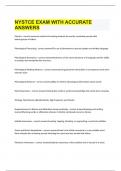
Phonics - correct answersA method of teaching students to read by correlating sounds with letters/groups of letters Phonological Processing - correct answersThe use of phonemes to process spoken and written language Phonological Awareness - correct answersAwareness of the sound structure of a language and the ability to analyze and manipulate the structure. Phonological Working Memory - correct answersstoring phoneme information in a temporary short-term memory store Phonological Retrieval - correct answersability to retrieve phonological information about words Word Awareness - correct answersTracking the words in sentences knowledge that words have meaning. Strategy: Read Aloud, Alphabet Books, high frequency word books Responsiveness to Rhyme and alliteration during word play - correct answersEnjoying and reciting learned Rhyming words or alliterative phrases in familiar storybooks/nursery rhymes. Syllable Awareness - correct answersCounting, tapping, blending, or segmenting a word into syllables. Onset and Rime Manipulation - correct answersOnset is the initial consonant in a one-syllable word. Rime includes the remaining sounds including the vowel and any sounds that follow. Phonemic Awareness - correct answersStudents awareness of the smallest unit of sounds in a word. Also refers to the ability to segment, blend, and manipulate these units. Phoneme Manipulation - correct answersTasks that tap into phonological processing, such as phoneme manipulation tasks (say "cat" without the Kuh) Orthographic Processing - correct answersDefined as "the ability to form, store, and access orthographic representations." Orthography is the methodology of writing a language, which primarily consists of spelling, but includes, contractions, punctuation and capitalization. Semantic Processing - correct answersEncode the meaning of a word and relate it to similar words with similar meaning. Syntactic Processing - correct answersThe order and arrangement of words in phrases and sentences; you might depend in part on syntactic processing to know the difference between "The cat is on the mat" and "The mat is on the cat." Discourse Processing - correct answersFocus on the ways in which readers and listeners comprehend language. Development of Oral Language - correct answers1. Cooing 2. Babbling 3. One-Word Stage 4. Telegraphic Stage 5. Beginning Oral Fluency 1) Cooing - correct answersAs early as six weeks, infants begin to make cooing sounds, resemble vowel sounds. Children are learning to make sounds by manipulating their tongues, mouths, and breathing. 2) Babbling - correct answersAround 4-6 mo, they begin to babble making repeated consonant-vowel sounds. More complex babbling develops around 8-10 mo. 3) One-Word Stage - correct answersAround 1 yr, children begin to produce word-like units. Known as idiomorphs (invented word). Use a stable language unit to communicate meaning. 4) Telegraphic Stage - correct answersToddlers string several words together. i.e. "go bye-bye" or "cookie all gone" 5) Beginning Oral Fluency - correct answersBy age 3-4, children are moderately fluent in language used at home. Development of Reading - correct answers1. Emerging pre-reader (6 mo to 6 yrs) 2. Novice reader (6-7 yrs) 3. Decoding reader (7-9 yrs) 4. Fluent, comprehending reader (9-15 yrs) 5. Expert reader (16 yrs +) 1) Emerging Pre-Reader - correct answersThe emergent pre-reader sits on 'beloved laps,' samples and learns from a full range of multiple sounds, words, concepts, images, stories, exposure to print, literacy materials, and just plain talk during the first five years of life. The major insight in this period is that reading never just happens to anyone. Emerging reading arises out of years of perceptions, increasing conceptual and social development, and cumulative exposures to oral and written language. By the end of this stage, the child "pretends" to read, can - over time - retell a story when looking at pages of book previously read to him/her, can names letters of alphabet; can recognise some signs; can prints own name; and plays with books, pencils and paper. The child acquires skills by being read to by an adult (or older child) who responds to the child's questions and who warmly appreciates the child's interest in books and reading. The child understand thousands of words they hear by age 6 but can read few if any of them. 2) Novice Reader - correct answersIn this stage, the child is learning the relationships between letters and sounds and between printed and spoken words. The child starts to read simple text containing high frequency words and phonically regular words, and uses emerging skills and insights to "sound out" new one-syllable words. There is direct instruction in letter-sound relations (phonics). The child is being read to on a level above what a child can read independently to develop more advanced language patterns, vocabulary and concepts. In late Stage 2, most children can understand up to 4000 or more words when heard but can read about 600. 3) Decoding Reader - correct answersIn this stage, the child is reading simple, familiar stories and selections with increasing fluency. This is done by consolidating the basic decoding elements, sight vocabulary, and meaning in the reading of familiar stories and selections. There is direct instruction in advanced decoding skills as well as wide reading of familiar, interesting materials. The child is still being read to at levels above their own independent reading level to develop language, vocabulary and concepts. In late Stage 3, about 3000 words can be read and understood and about 9000 are known when heard. Listening is still more effective than reading. 4. Fluent, comprehending reader - correct answersBy this stage, reading is used to learn new ideas in order to gain new knowledge, to experience new feelings, to learn new attitudes, and to explore issues from one or more perspectives. Reading includes the study of textbooks, reference works, trade books, newspapers, and magazines that contain new ideas and values, unfamiliar vocabulary and syntax. There is a systematic
Document information
- Uploaded on
- May 27, 2024
- Number of pages
- 14
- Written in
- 2023/2024
- Type
- Exam (elaborations)
- Contains
- Questions & answers


