foundations of finance 2
formula sheet
lecture 1 & 2: capital budgeting ad risk
project NPV
mini intro to corporate financing
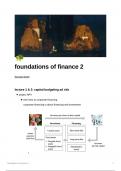
corporate financing is about financing and investment
foundations of finance 2 1
, → CFOs use financing and investment decisions to maximise shareholders’
wealth
what is capital budgeting?
it is an investment decision process used to analyse alternate investment
decisions and decide which ones to accept
what is a capital budget?
it is list of the investment that a company plans to undertake
what is the role of the financial manager?
investment decisions: identify good projects
financing decisions: how to pay for the projects
working capital management: ensure the availability of cash
one application of discounting is net present value
what is the NPV decision rule?
Net Present Value (NPV) of a project or investment:
➢ = PV(benefits) – PV(cost)
➢ i.e., compares the present value of cash inflows (benefits) to the
present value of cash outflows (costs).
Cash inflows are positive values and cash outflows are negative values.
→ NPV decision rule: accept projects with positive NPV and reject projects
with negative NPV
what is present value?
present value, AKA current value, of an asset (V0 ) = present value of its
expected future cash flows E(CFt ) discounted at appropriate cost of capital
(k)
foundations of finance 2 2
, cost of capital (k)
what is it?
it is a market determined opportunity cost
Investors’ opportunity cost: represents return offered in financial market
on investments of equivalent risk.
➢ Also called required (and expected) rate of return: given the project
risk, investors require/expect minimum return they could achieve by
investing in financial market.
➢ Hence: market determined rate.
Different terminology reflects two different view points of same thing: for
issuer of a financial security it is cost of capital; for investors it is
expected rate of return.
basically, what is the risk of a project?
what is WACC
Weighted Average Cost of Capital (WACC)
For simplicity, firms assume project risk = firm risk.
Firm risk = weighted average of expected return of firm’s sources of
capital (equity (E) + debt (D)) = weighted average cost of capital
(WACC).
foundations of finance 2 3
, → cost of debt is reduced by corporate tax
tax shield effect of debt
In most countries, interest payments on debt are tax deductible, while
dividend payments on equity are not.
➢ Financing through debt saves the company paying taxes.
Tax-deductibility of interest considered in WACC.
estimating the cost of capital
what do you need for it?
need to know cost of debt and cost of equity
➢ 1) cost of equity → required return of equity.
➢ 2) cost of debt → required return of debt.
➢ 3) cost of capital → required return of debt and equity.
starting point
→ is the SML equation
cost of equity
foundations of finance 2 4
formula sheet
lecture 1 & 2: capital budgeting ad risk
project NPV
mini intro to corporate financing
corporate financing is about financing and investment
foundations of finance 2 1
, → CFOs use financing and investment decisions to maximise shareholders’
wealth
what is capital budgeting?
it is an investment decision process used to analyse alternate investment
decisions and decide which ones to accept
what is a capital budget?
it is list of the investment that a company plans to undertake
what is the role of the financial manager?
investment decisions: identify good projects
financing decisions: how to pay for the projects
working capital management: ensure the availability of cash
one application of discounting is net present value
what is the NPV decision rule?
Net Present Value (NPV) of a project or investment:
➢ = PV(benefits) – PV(cost)
➢ i.e., compares the present value of cash inflows (benefits) to the
present value of cash outflows (costs).
Cash inflows are positive values and cash outflows are negative values.
→ NPV decision rule: accept projects with positive NPV and reject projects
with negative NPV
what is present value?
present value, AKA current value, of an asset (V0 ) = present value of its
expected future cash flows E(CFt ) discounted at appropriate cost of capital
(k)
foundations of finance 2 2
, cost of capital (k)
what is it?
it is a market determined opportunity cost
Investors’ opportunity cost: represents return offered in financial market
on investments of equivalent risk.
➢ Also called required (and expected) rate of return: given the project
risk, investors require/expect minimum return they could achieve by
investing in financial market.
➢ Hence: market determined rate.
Different terminology reflects two different view points of same thing: for
issuer of a financial security it is cost of capital; for investors it is
expected rate of return.
basically, what is the risk of a project?
what is WACC
Weighted Average Cost of Capital (WACC)
For simplicity, firms assume project risk = firm risk.
Firm risk = weighted average of expected return of firm’s sources of
capital (equity (E) + debt (D)) = weighted average cost of capital
(WACC).
foundations of finance 2 3
, → cost of debt is reduced by corporate tax
tax shield effect of debt
In most countries, interest payments on debt are tax deductible, while
dividend payments on equity are not.
➢ Financing through debt saves the company paying taxes.
Tax-deductibility of interest considered in WACC.
estimating the cost of capital
what do you need for it?
need to know cost of debt and cost of equity
➢ 1) cost of equity → required return of equity.
➢ 2) cost of debt → required return of debt.
➢ 3) cost of capital → required return of debt and equity.
starting point
→ is the SML equation
cost of equity
foundations of finance 2 4