BIOMG 3300 UNITS 4/5 Questions with Complete Solutions
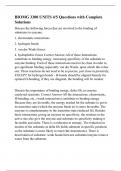
Discuss the following forces that are involved in the binding of substrates to enzyme: 1. electrostatic interactions 2. hydrogen bonds 3. van der Waals forces 4. hydrophobic forces Correct Answer-All of these interactions contribute to binding energy, increasing specificity of the substrate to enzyme binding. Each of these interactions need to be close in order to get significant binding (especially van der Waals, upon which this relies on). These reactions do not need to be as precise, just close in proximity, EXCEPT for hydrogen bonds - H-bonds should be aligned linearly for optimal H-bonding, if they are diagonal, the bonding will be weaker. Discuss the importance of binding energy, delta Gb, in enzyme catalyzed reactions. Correct Answer-All the interactions, electrostatic, H-bonding, etc., (weak interactions) contribute to binding energy. Because they are favorable, the energy needed for the substate to get to its transition state (which the enzyme binds to) is more favorable. The enzyme is complementary to the transition state (induced fit). Besides these interactions giving an enzyme its specificity, the residues in the active site also give the enzyme and substrate its specificity making it favorable and niche. There is a reduction in entropy. The reduction in motion of the substrate as delta Gb holds substrate in specific positions so the substrate is more likely to react (the itneractions). There is desolvation of substrate: weak bonds between substrate/enzyme remove water from the substrate.
Geschreven voor
- Instelling
- BIOMG
- Vak
- BIOMG
Documentinformatie
- Geüpload op
- 26 mei 2024
- Aantal pagina's
- 19
- Geschreven in
- 2023/2024
- Type
- Tentamen (uitwerkingen)
- Bevat
- Vragen en antwoorden
Onderwerpen
-
biomg 3300 units 45 questions with complete solut

Ook beschikbaar in voordeelbundel