

SUMMARY FOR FOOD SAFETY MANAGEMENT (FHM-61312)
Lecture 1: Introduction to the course
Management has three aspects:
1. Short term management: consumer complaints, incidents, crisis
Example: Two cashiers are sick, the manager should have a list with reserve people that they can call.
Example: There is an Listeria outbreak (incident)
What to decide (stop production, recall etc.)
How to communicate (media, consumers, authorities)
An Incident Management protocol can help you to be prepared when these types pf incidents
happen (helps you what to decide and how to communicate) + also keep in mind the legal
aspects
2. Intermediate term management: HACCP, audits, certification, regulation
Example: The supermarket has to comply with these type of rules
How to prevent problems and incidents
Compliance with law
In practice we have: GMP, HACCP, audits and certification
Can also be in the incident management protocol
3. Long term management: risk management, lobbying
Example: On the parking lot next to the supermarket they are going to start building new apartments,
maybe get less costumers, needs to be prepared for these type of situations.
Can analyze the process or problem and preform a risk assessment (look more from the
technical perspective)
After the risk assessment weigh all kind of policy alternatives and also consider the view of
other interesting parties
After considering the risk assessment and other factors appropriate prevention and control
options should be applied (if needed)
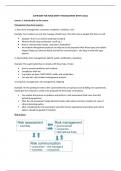
Risk analysis
,Risk assessment
Hazard identification
Hazard characterization
Exposure assessment
Risk characterization
Risk management
Risk evaluation
Option assessment
Option implementation
Monitoring and review
Mainly in case study
Risk communication
Important words: Risk = Severity x Probability
,Lecture 2: Legal perspective on incident management
Learning goals:
Identify the scope and objectives of the GFL with reference to the incident management
Identify the relevant definitions, food safety requirements and FBO’s obligations in the GFL
Recognize when food is unsafe (and related consequences)
Identify the responsibilities of FBOs
Acquire basic knowledge about the structure of official controls
What aspects are handled in the lecture:
General Food Law (Regulation 178/2002)
The horsemeat scandal and the issue of fraud
Official Controls (Regulation 2017/625)
General Food Law (Regulation 178/ 2002)
Foundation of food and feed law
WHAT: Umbrella framework for specific legislation that includes general principles,
requirements for food law, procedures that underpin decision making in matters of food and
feed safety specific, as well as specific topics (EFSA)
AIM: High level of protection of human life and consumers' interests in relation to food,
while ensuring the effective functioning of the internal market
Definition of food (Article 2 GFL)
… any substance or product, whether processed, partially processed or unprocessed,
intended to be, or reasonably expected to be ingested by humans. [It] includes drink,
chewing gum and any substance, including water, intentionally incorporated into the food
during its manufacture, preparation or treatment.”
Also a negative list of what food is not (medicines).
Why is it important to have a legal definition for food? When you know that what you are
handling or making is food, you need to comply with the GFL and are responsible for certain
specific actions.
Pre-market authorization is needed for novel foods and GMO’s (is based on Article 7 ‘better
safe than sorry’)
Definition of food business (Article 3 GFL)
“food business means any undertaking, whether for profit or not and whether public or
private, carrying out any of the activities related to any stage of production, processing and
distribution of food”
Natural or legal persons:
Definition of food business operator (Article 3 GFL)
“Food business operator means the natural or legal persons responsible for ensuring that
the requirements of food law are met within the food business under their control”
Responsibility of the Food Business Operator (FBO)
, Responsibility (Article 17 GFL)
“Food and feed business operators at all stages of production, processing and distribution
within the businesses under their control shall ensure that foods or feeds satisfy the
requirements of food law which are relevant to their activities and shall verify that such
requirements are met.”
This article is based on risk analysis principle
Responsible risk assessment is EFSA
Responsible risk communication is EFSA together with the European Commission
Responsible for risk management is the European commission
There are two different institutions because EFSA looks technical at problems and
commission looks at all the factors (takes into account that majority of the people do not
want GMO’s), to not have conflicts of interest
How would we define ‘safe food’?
There is no definition of safe food in the regulation.
Injurious to health
Unfit for human consumption
Food safety requirements (Article 14 GFL)
(1) Food shall not be placed on the market if it is unsafe.
(2) Food shall be deemed to be unsafe if it is considered to be:
(a) injurious to health;
(b) unfit for human consumption Has to do with human acceptability
3) In determining whether any food is unsafe, regard shall be had:
(a) to the normal conditions of use of the food by the consumer and at each stage of production,
processing and distribution, and
(b) to the information provided to the consumer, including information on the label, or other
information generally available to the consumer concerning the avoidance of specific adverse health
effects from a particular food or category of foods.
Example raw chicken: it is not expected that chicken would be eaten raw, this is common
knowledge and easy to look up, it also states on the packaging that the chicken should be
cooked thoroughly.
(4) In determining whether any food is injurious to health, regard shall be had:
(a) not only to the probable immediate and/or short-term and/or long-term effects of that food on
the health of a person consuming it, but also on subsequent generations;
Lecture 1: Introduction to the course
Management has three aspects:
1. Short term management: consumer complaints, incidents, crisis
Example: Two cashiers are sick, the manager should have a list with reserve people that they can call.
Example: There is an Listeria outbreak (incident)
What to decide (stop production, recall etc.)
How to communicate (media, consumers, authorities)
An Incident Management protocol can help you to be prepared when these types pf incidents
happen (helps you what to decide and how to communicate) + also keep in mind the legal
aspects
2. Intermediate term management: HACCP, audits, certification, regulation
Example: The supermarket has to comply with these type of rules
How to prevent problems and incidents
Compliance with law
In practice we have: GMP, HACCP, audits and certification
Can also be in the incident management protocol
3. Long term management: risk management, lobbying
Example: On the parking lot next to the supermarket they are going to start building new apartments,
maybe get less costumers, needs to be prepared for these type of situations.
Can analyze the process or problem and preform a risk assessment (look more from the
technical perspective)
After the risk assessment weigh all kind of policy alternatives and also consider the view of
other interesting parties
After considering the risk assessment and other factors appropriate prevention and control
options should be applied (if needed)
Risk analysis
,Risk assessment
Hazard identification
Hazard characterization
Exposure assessment
Risk characterization
Risk management
Risk evaluation
Option assessment
Option implementation
Monitoring and review
Mainly in case study
Risk communication
Important words: Risk = Severity x Probability
,Lecture 2: Legal perspective on incident management
Learning goals:
Identify the scope and objectives of the GFL with reference to the incident management
Identify the relevant definitions, food safety requirements and FBO’s obligations in the GFL
Recognize when food is unsafe (and related consequences)
Identify the responsibilities of FBOs
Acquire basic knowledge about the structure of official controls
What aspects are handled in the lecture:
General Food Law (Regulation 178/2002)
The horsemeat scandal and the issue of fraud
Official Controls (Regulation 2017/625)
General Food Law (Regulation 178/ 2002)
Foundation of food and feed law
WHAT: Umbrella framework for specific legislation that includes general principles,
requirements for food law, procedures that underpin decision making in matters of food and
feed safety specific, as well as specific topics (EFSA)
AIM: High level of protection of human life and consumers' interests in relation to food,
while ensuring the effective functioning of the internal market
Definition of food (Article 2 GFL)
… any substance or product, whether processed, partially processed or unprocessed,
intended to be, or reasonably expected to be ingested by humans. [It] includes drink,
chewing gum and any substance, including water, intentionally incorporated into the food
during its manufacture, preparation or treatment.”
Also a negative list of what food is not (medicines).
Why is it important to have a legal definition for food? When you know that what you are
handling or making is food, you need to comply with the GFL and are responsible for certain
specific actions.
Pre-market authorization is needed for novel foods and GMO’s (is based on Article 7 ‘better
safe than sorry’)
Definition of food business (Article 3 GFL)
“food business means any undertaking, whether for profit or not and whether public or
private, carrying out any of the activities related to any stage of production, processing and
distribution of food”
Natural or legal persons:
Definition of food business operator (Article 3 GFL)
“Food business operator means the natural or legal persons responsible for ensuring that
the requirements of food law are met within the food business under their control”
Responsibility of the Food Business Operator (FBO)
, Responsibility (Article 17 GFL)
“Food and feed business operators at all stages of production, processing and distribution
within the businesses under their control shall ensure that foods or feeds satisfy the
requirements of food law which are relevant to their activities and shall verify that such
requirements are met.”
This article is based on risk analysis principle
Responsible risk assessment is EFSA
Responsible risk communication is EFSA together with the European Commission
Responsible for risk management is the European commission
There are two different institutions because EFSA looks technical at problems and
commission looks at all the factors (takes into account that majority of the people do not
want GMO’s), to not have conflicts of interest
How would we define ‘safe food’?
There is no definition of safe food in the regulation.
Injurious to health
Unfit for human consumption
Food safety requirements (Article 14 GFL)
(1) Food shall not be placed on the market if it is unsafe.
(2) Food shall be deemed to be unsafe if it is considered to be:
(a) injurious to health;
(b) unfit for human consumption Has to do with human acceptability
3) In determining whether any food is unsafe, regard shall be had:
(a) to the normal conditions of use of the food by the consumer and at each stage of production,
processing and distribution, and
(b) to the information provided to the consumer, including information on the label, or other
information generally available to the consumer concerning the avoidance of specific adverse health
effects from a particular food or category of foods.
Example raw chicken: it is not expected that chicken would be eaten raw, this is common
knowledge and easy to look up, it also states on the packaging that the chicken should be
cooked thoroughly.
(4) In determining whether any food is injurious to health, regard shall be had:
(a) not only to the probable immediate and/or short-term and/or long-term effects of that food on
the health of a person consuming it, but also on subsequent generations;


